Contents
Exiled to earth and finding a weeping family about to sacrifice their last daughter to the eight-headed serpent, Susanoo devises a plan involving sake and discovers inside the dragon a divine sword.
- When
- Age of the Gods — after Susanoo's expulsion from heaven, Kojiki Book I
- Where
- The province of Izumo — the headwaters of the Hi River in western Honshu
He finds them at the headwaters of the river, weeping.
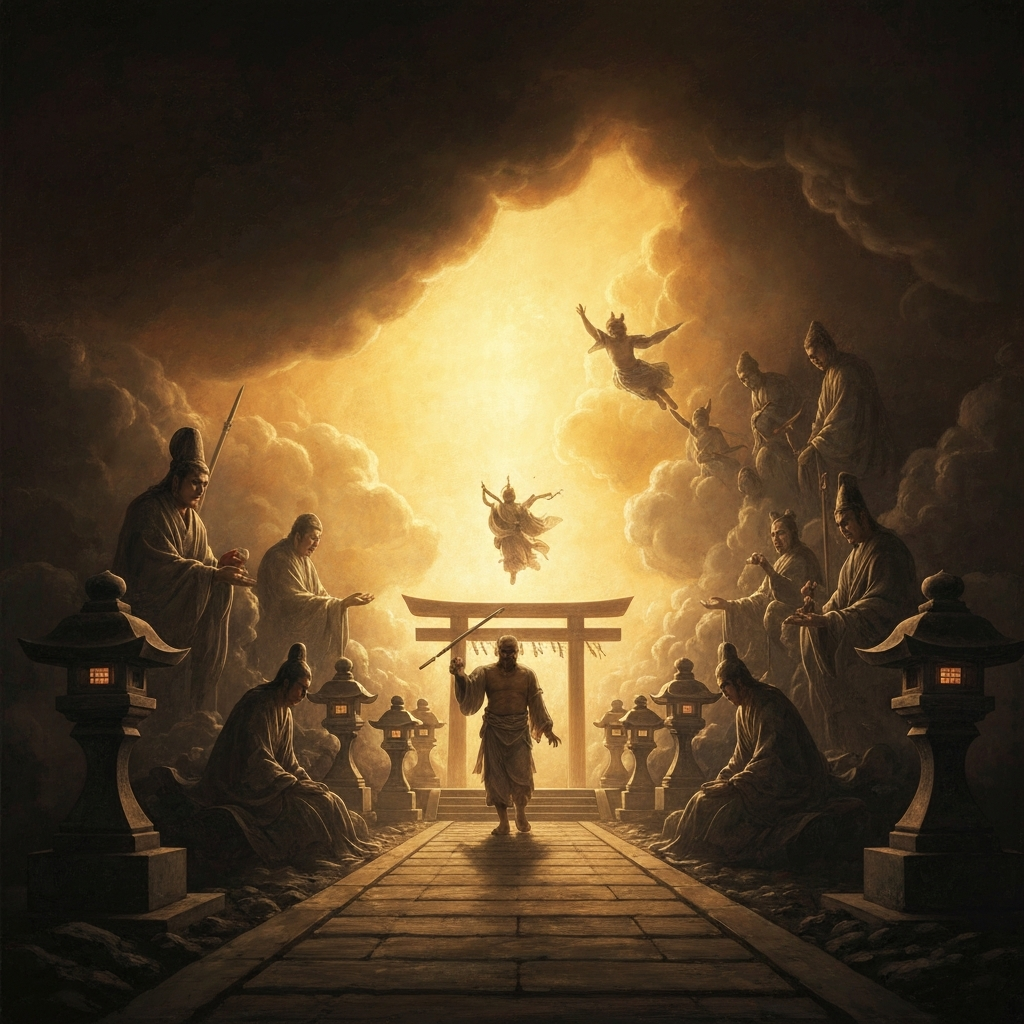
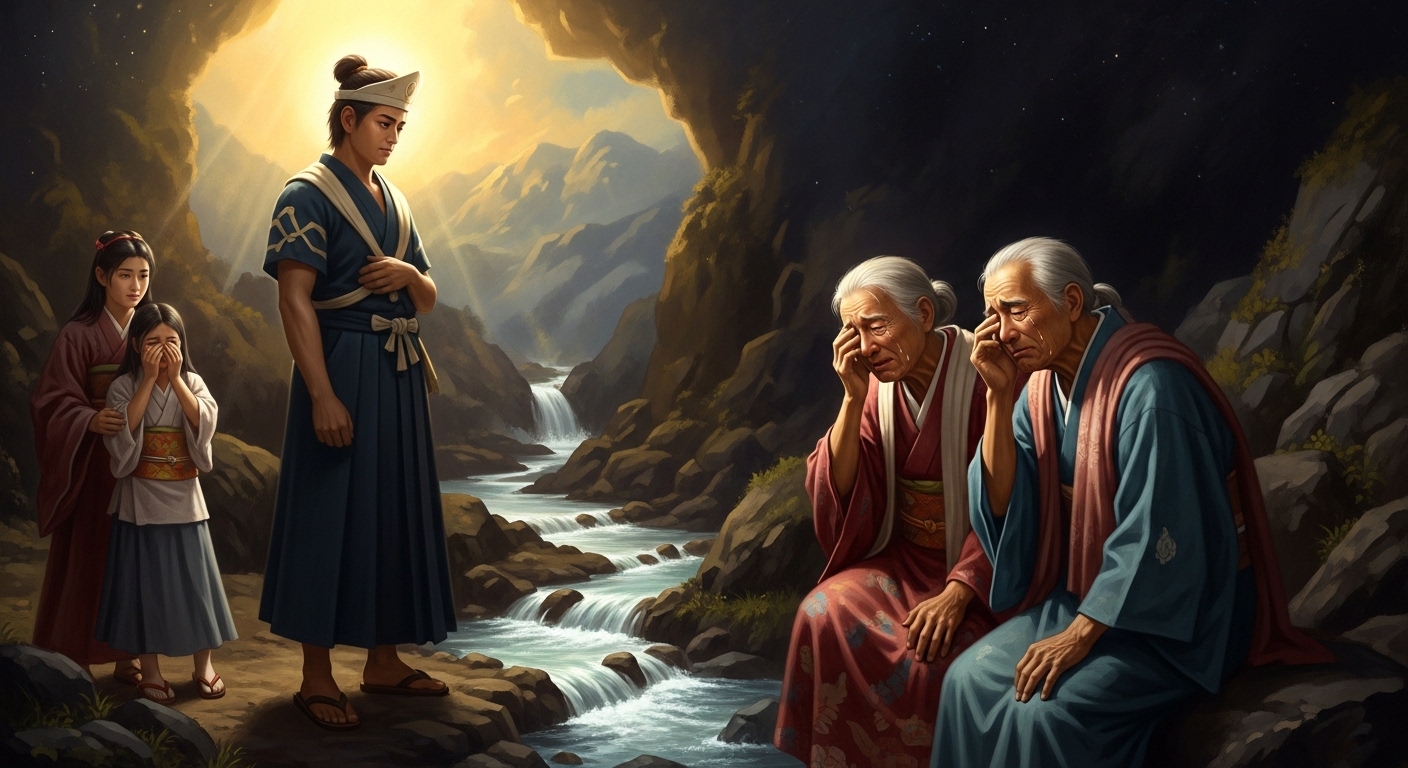
Susanoo has been expelled from the heavens and has descended to earth — to the province of Koshi, at the headwaters of the Hi River in Izumo, which will become the most mythologically dense territory in all of Japan. He follows the chopsticks floating downstream, which is how the Kojiki tells him that people live up this river. He walks toward the source and finds an old man and an old woman weeping, and between them a young woman who is clearly the reason for the weeping.
He asks what is wrong.
The old man — his name is Ashinazuchi, Foot-Stroker Elder — explains. Once they had eight daughters. Every year the eight-headed serpent Yamata no Orochi comes down from the mountains and takes one. Seven years have passed. Seven daughters have been taken. This year the last daughter, Kushinadahime, will be taken. Hence the weeping.
Susanoo looks at Kushinadahime and asks: who is she?
She is beautiful, and she is about to die.
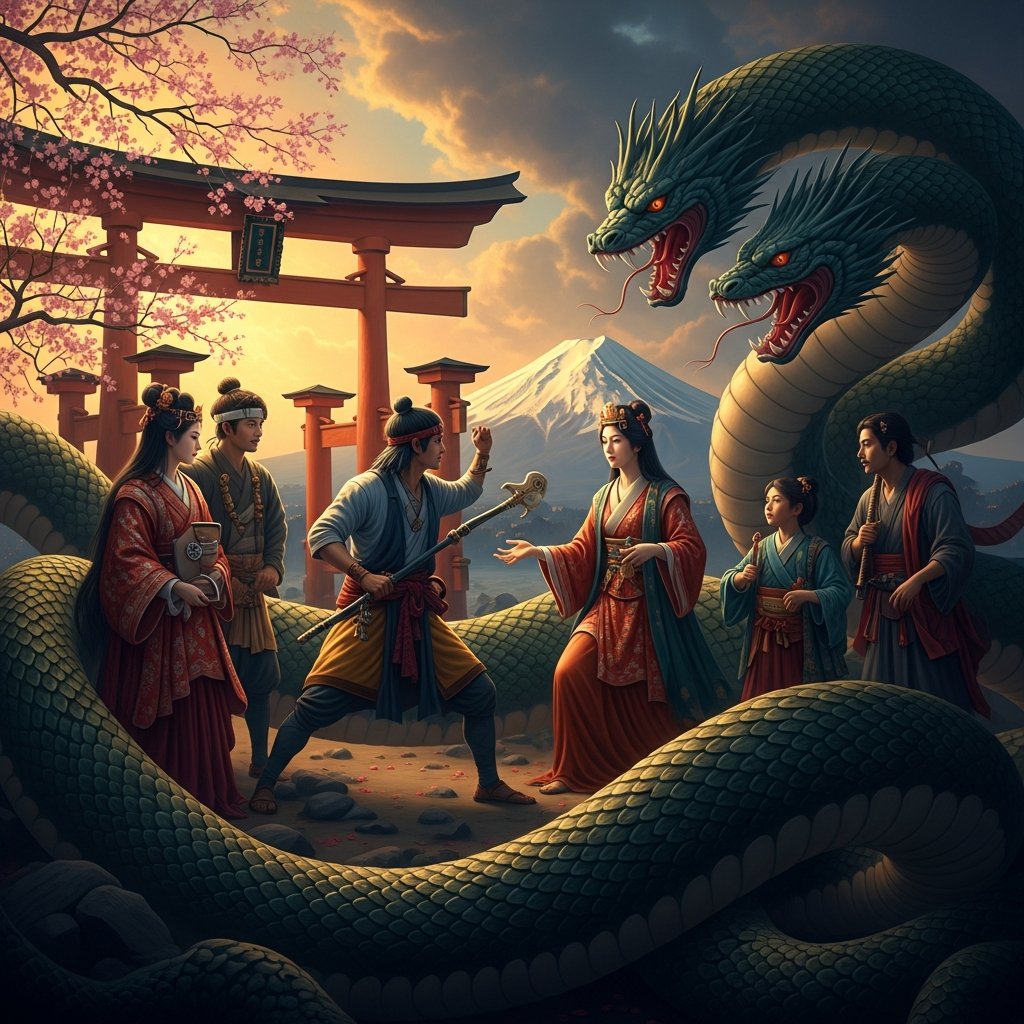
He says: Give her to me as my wife and I will kill the serpent.
The plan is sake.
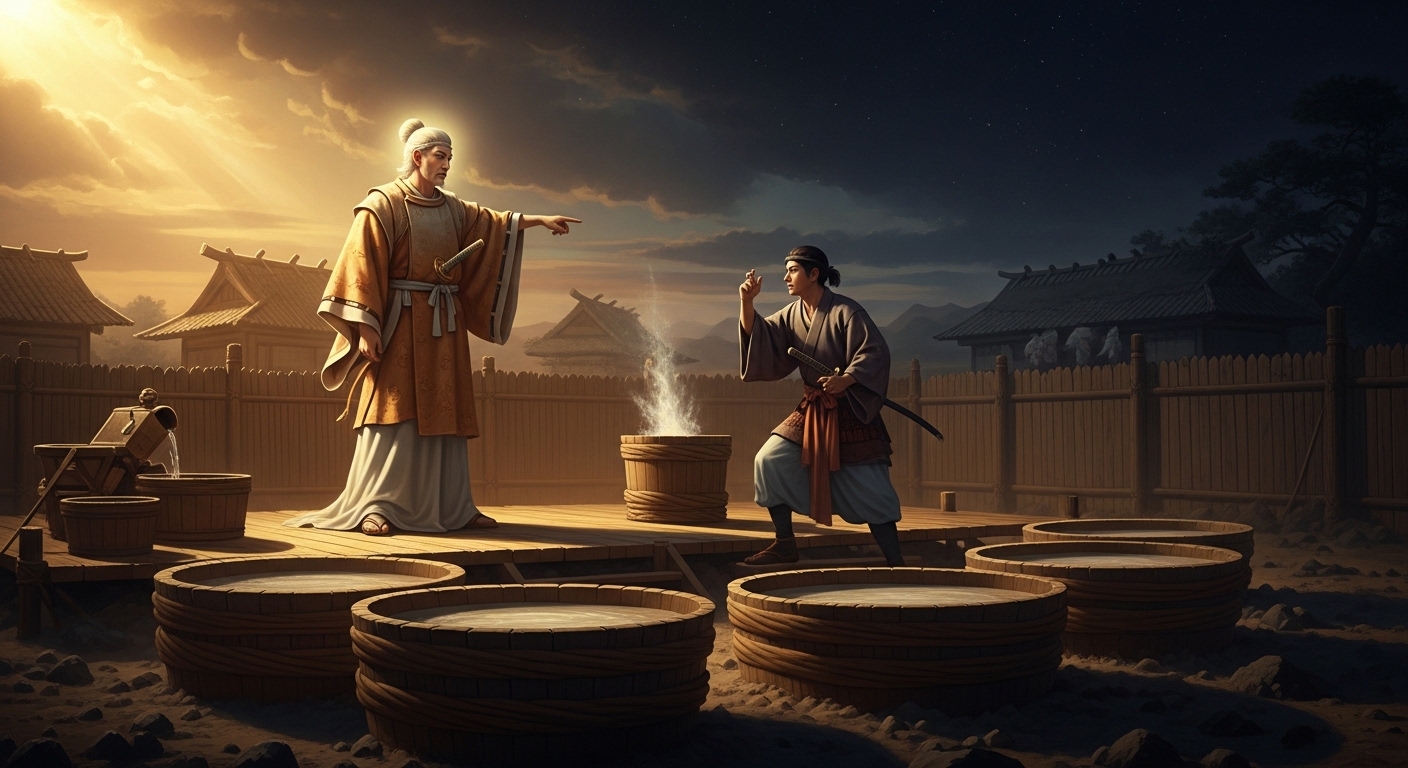
Susanoo instructs Ashinazuchi to brew the strongest possible rice wine — eight-fold distilled, the most powerful sake imaginable — and to build a fence around their dwelling with eight gates, each gate opening onto a platform with a great tub. Each tub is to be filled with the sake. Then they wait.
The serpent comes.
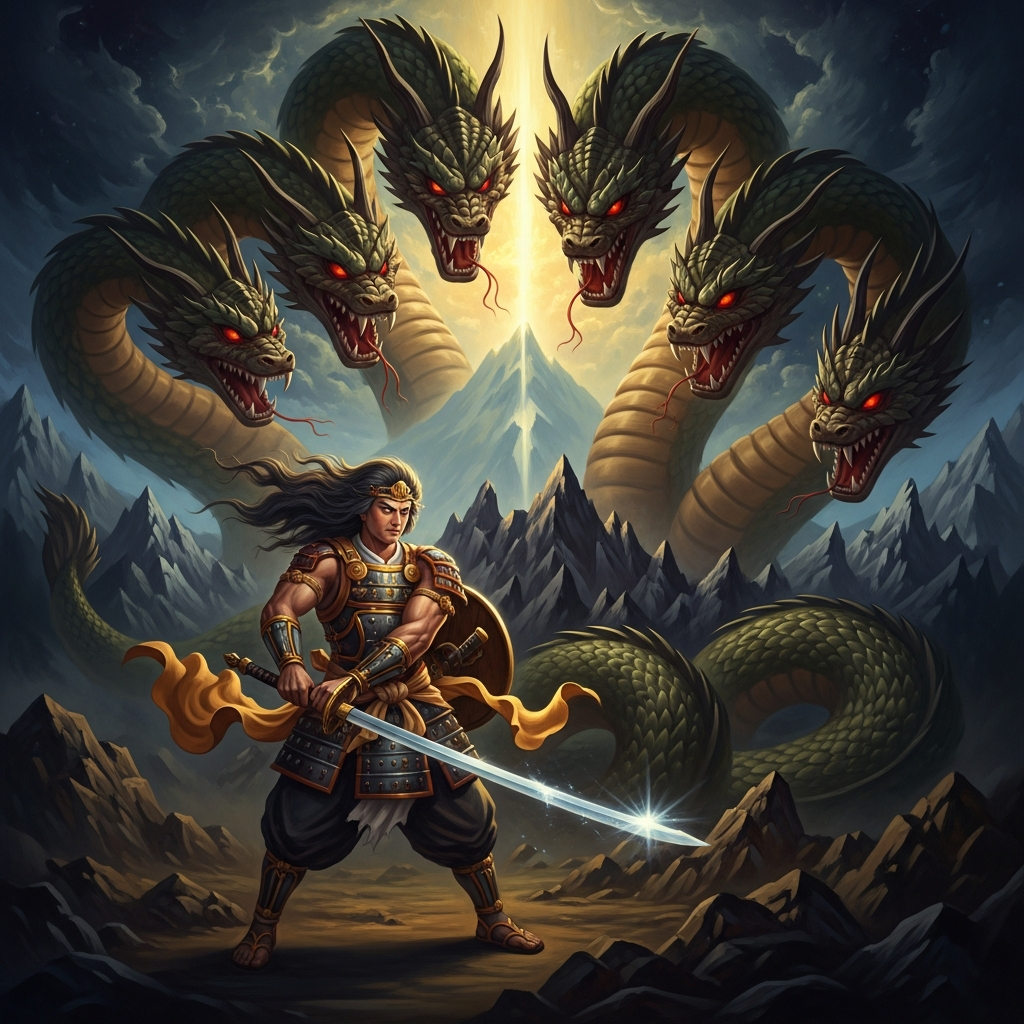
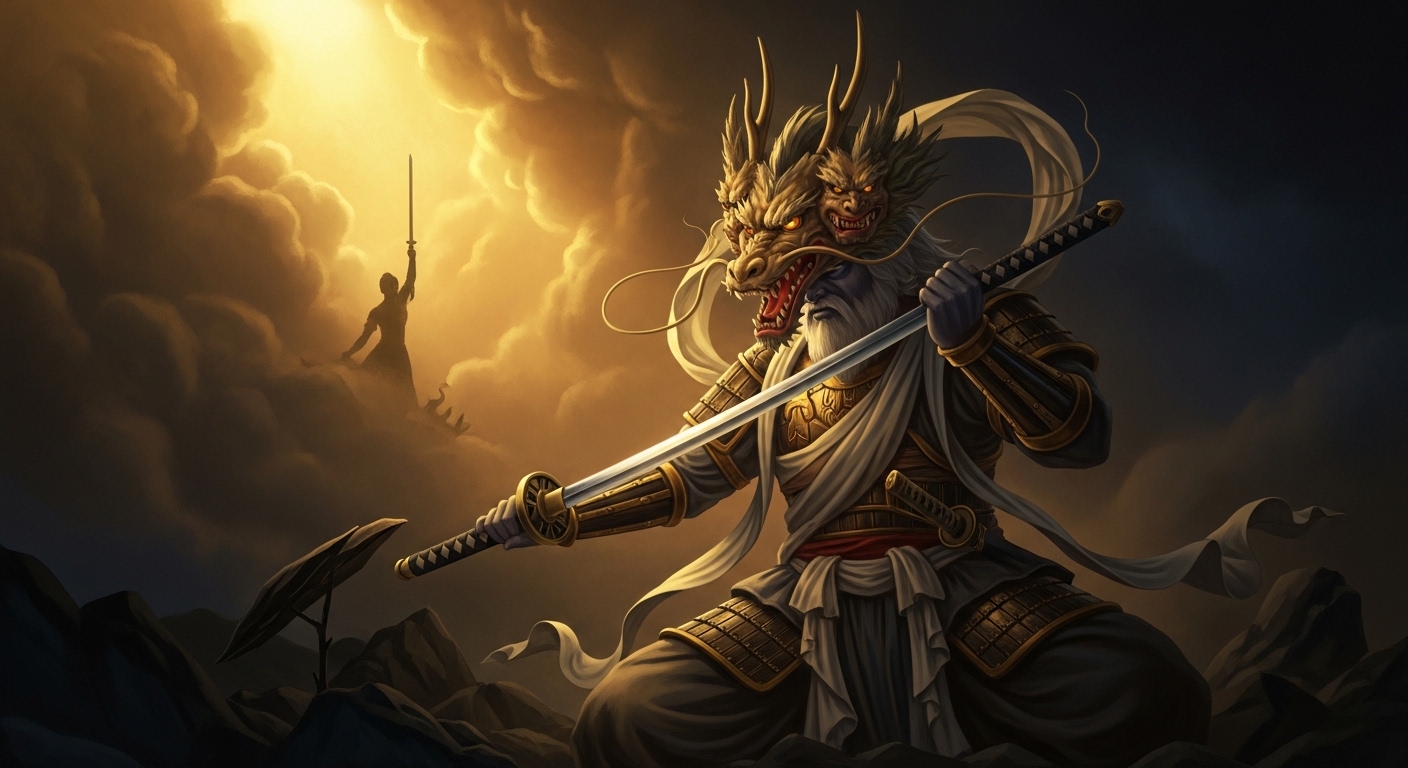
The Kojiki describes it in an accumulation of eights: eight heads, eight tails, a body so vast that it covers eight valleys and eight hills. On its back grow trees and moss, suggesting a creature so old the landscape has colonized it. Its eyes are crimson, like winter cherries. Its belly is perpetually bloody.
Each head finds a gate. Each head finds a tub. Each head begins to drink.
The sake does what sake does. The eight heads drink until they cannot hold themselves up. The eight-headed serpent, monster of the river, devourer of seven daughters, collapses in its own excess. It lies on the earth with its eight heads in eight tubs, drunk.
Susanoo draws his sword and begins cutting.
He cuts until the Hi River runs red with the serpent’s blood. He cuts all eight heads, all eight tails, and the body between them into pieces. But when he reaches the fourth tail, his sword strikes something hard. Metal against metal. He looks, and inside the flesh of the dragon there is a sword.
It is a beautiful sword. Its name, when the gods examine it, is Kusanagi no Tsurugi — the Grass-Cutting Sword — though it will also be called Ama-no-Murakumo, the Heavenly Cloud Cluster Sword. Susanoo, understanding instinctively that a sword found inside a dragon is not a sword to keep, sends it up to his sister Amaterasu in the heavens. She receives it. It becomes one of the Three Imperial Regalia — the sword, the mirror, the jewel — the three objects that legitimate the rule of every Japanese emperor from that point forward.
The dragon’s body is the gift that keeps giving.
But Susanoo is not done. He has a wife now. He needs a palace.
He composes a poem about the clouds gathering at Izumo and the chambers he is building for his bride within them. It is the first waka poem in the Japanese literary tradition — thirty-one syllables, five-seven-five-seven-seven, the form that will carry Japanese emotion for the next fourteen centuries. The first poem in Japan is a wedding song composed by a storm-god who has just killed a dragon with sake.
This is the story that makes Susanoo something more than a divine problem.
He wept. He was expelled. He destroyed his sister’s weaving hall. He was punished and sent down.
And then he saved a girl, found a treasure inside the monster, and wrote a poem.
Scenes
Echoes Across Traditions
Entities
- Susanoo
- Yamata no Orochi
- Kushinadahime
- Ashinazuchi
- Tenazuchi
Sources
- Kojiki (Record of Ancient Matters), compiled 712 CE, Book I, Sections 18-20
- Nihon Shoki (Chronicles of Japan), compiled 720 CE
- Philippi, Donald, *Kojiki* (University of Tokyo Press, 1968)
- Yiengpruksawan, Mimi, 'Susanoo and the Yamata Orochi in the Kojiki,' *Journal of Japanese Studies*, 1999