Contents
Teshub, the Hittite storm god, fights the great dragon Illuyanka and loses — humiliated, stripped of his eyes and heart. He does not accept defeat. He goes to his daughter Inara, who devises a plan using wine, a mortal man, and the dragon's own greed. In the second version, Teshub gives his own son to Illuyanka's daughter as a ransom for his organs, then kills the dragon and his son both.
- When
- Recorded in cuneiform on clay tablets from Hattusa, c. 1400–1200 BCE; myths are older
- Where
- The divine realm; the mountains of Hatti; the Puruli spring festival site
The storm god Teshub fought the dragon Illuyanka.
This is the oldest fact in the tablet — the conflict older than the writing, older perhaps than the particular name the Hittites gave to the storm god and the particular name they gave to the serpent. The Hittites recorded two versions of the fight, one after another, on the same clay tablet, and the scribe who copied it named them both, distinguished them, and declined to choose between them. This is unusual. Myths generally converge on a single canonical form. The Illuyanka myths stayed doubled, because neither version could be discarded, and neither could fully satisfy without the other.
Version One begins with loss.
Teshub fought Illuyanka in the first battle and Teshub lost.
The tablets do not record the details of the defeat — what formation the armies took, how long the combat lasted, at what moment the storm god understood he had lost. What the tablets record is the consequence: after the battle, Illuyanka possessed Teshub’s eyes and his heart. The dragon had taken the organs of divine power. The storm god of the Hittites — the great deity of rain and thunder, the deity whose bull-drawn chariot crossed the mountains, the deity whose blessing made the crops grow and whose anger brought the hail — was walking the world without his eyes, without his heart, diminished.
He went to his daughter.
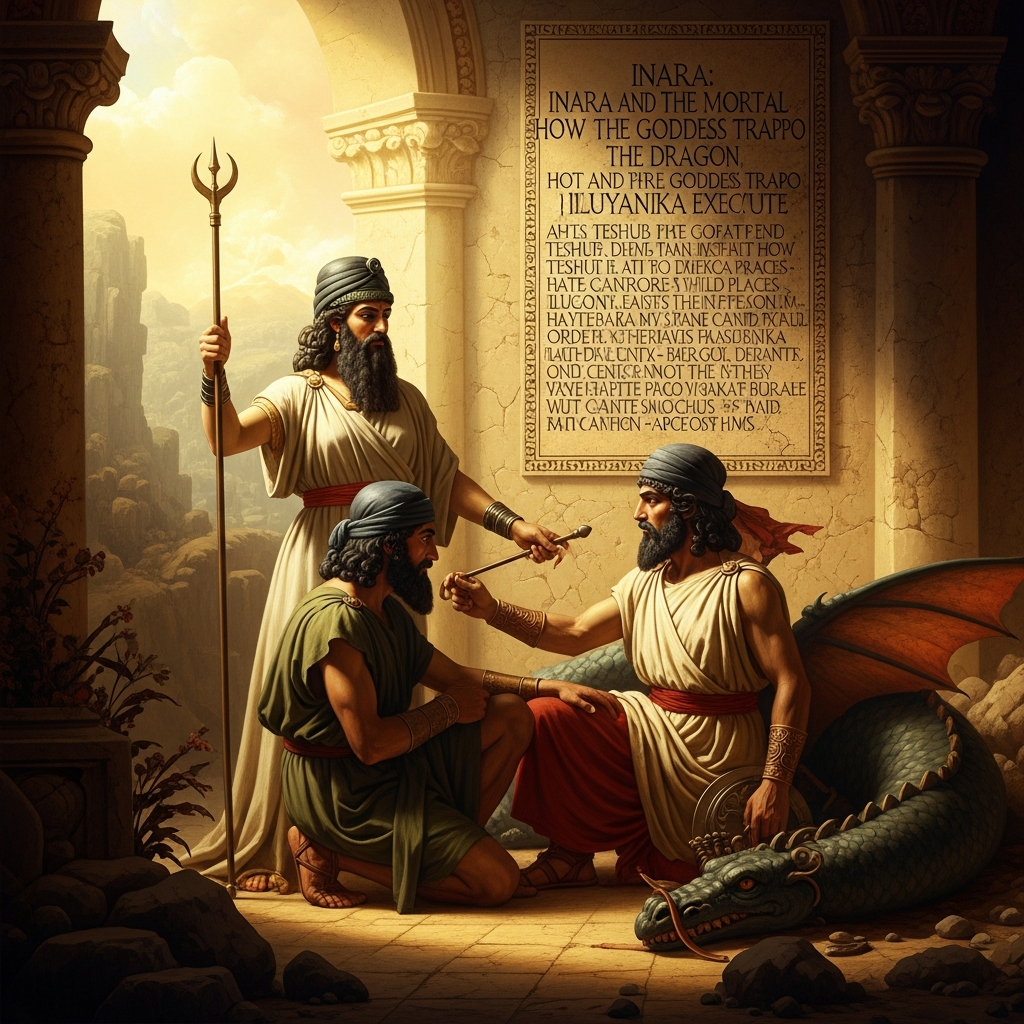
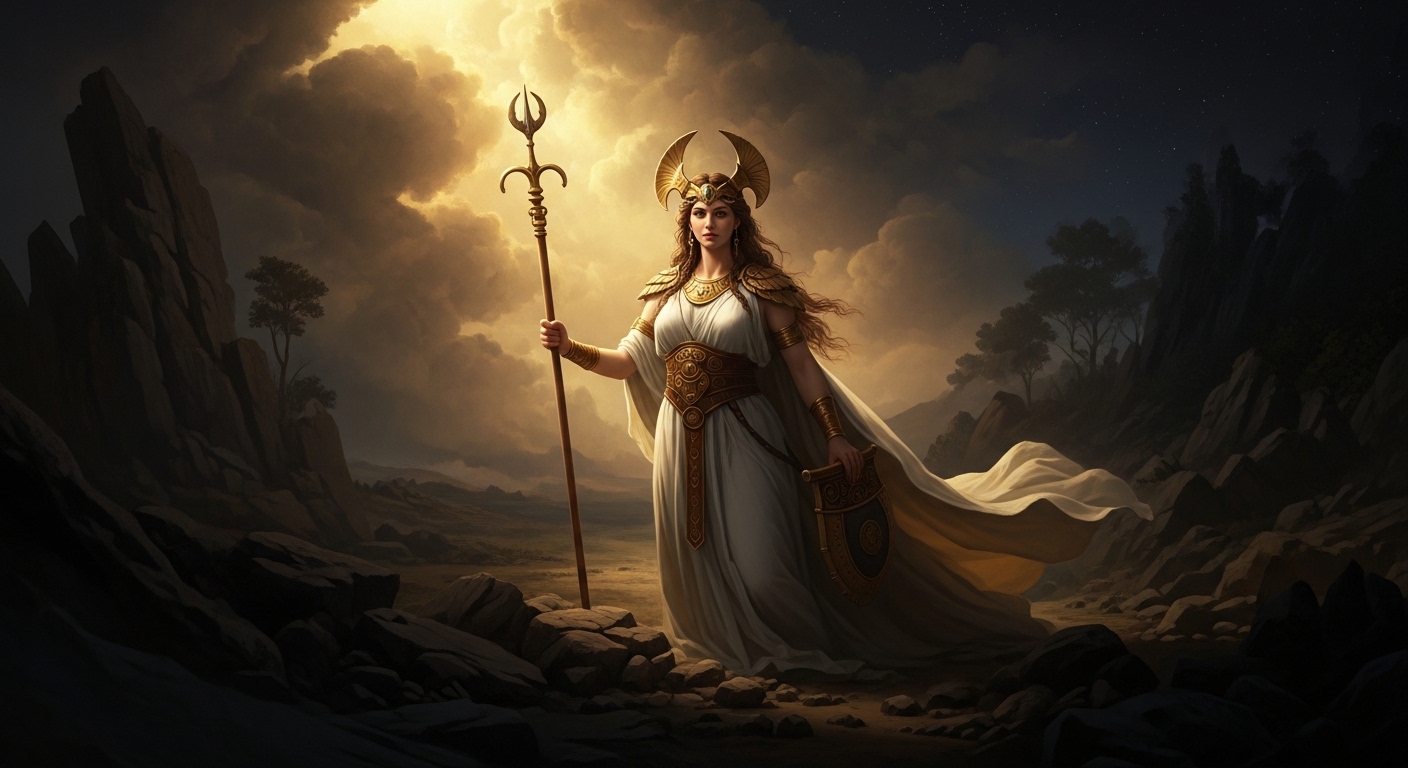
Inara was the daughter of Teshub and she was a goddess of wild places — the divine authority of the hunt, the uninhabited regions, the space beyond the settled order her father’s storms nourished. She had inherited her father’s ferocity without his dignity. She was practical in a way that the tablets suggest the Hittite gods of the sky were not. She listened to what had happened and she made a plan.
The plan required a mortal man.
She went to the human settlements and she found a man named Hupashiya. She asked him to help her and he agreed on one condition: that she sleep with him. Inara agreed. She slept with him, and then she put him to work.
The plan was this: Inara would prepare a great feast. She would fill the vessels — the mixing bowls, the jugs, the great amphoras — with wine and with mead. She would send word to Illuyanka the dragon that a festival was being held in the valleys below the mountains, and that the dragon and his children were invited, that there was more food and drink than any family could finish, that the dragon should come and eat and drink and celebrate.
Illuyanka came.
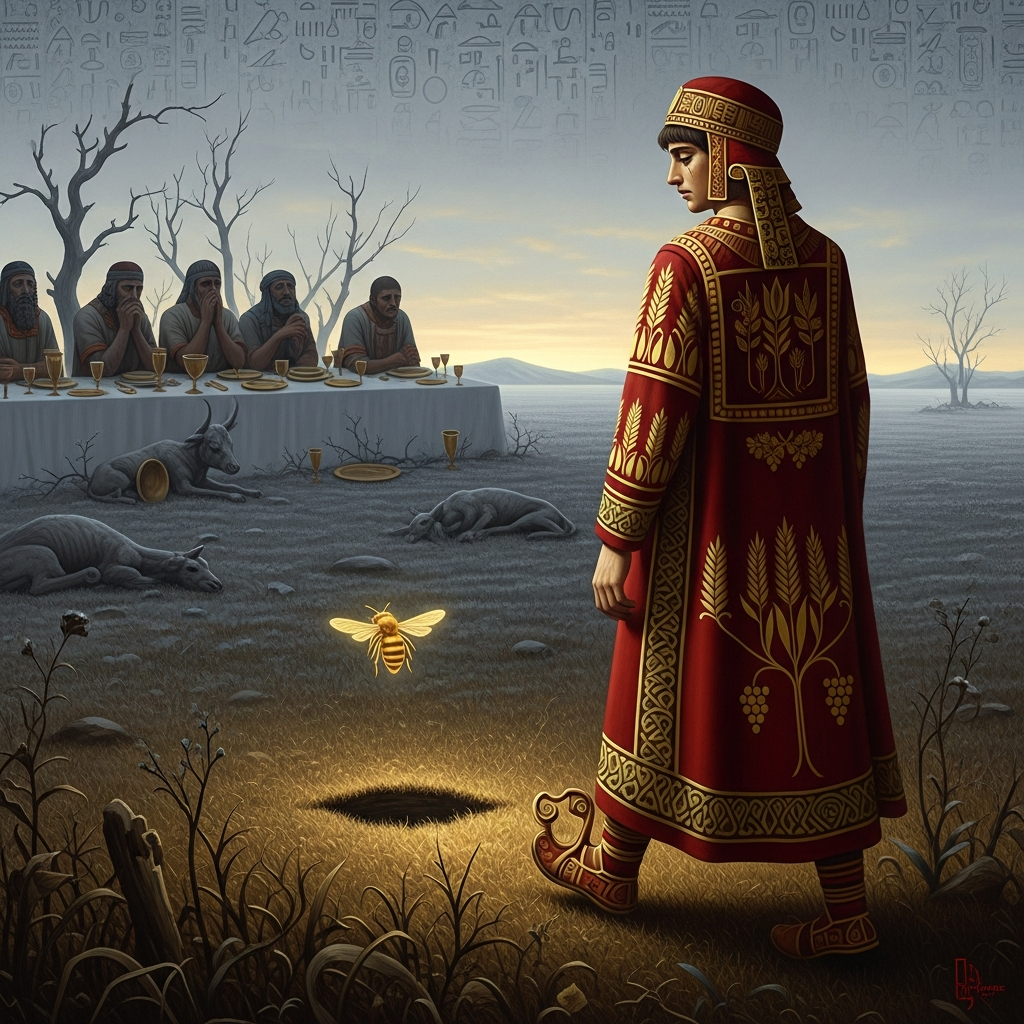
This is the crux of the first version: the dragon was defeated not by force but by appetite. Illuyanka came to the feast with his children, and they ate and drank. They ate and drank until they had consumed everything Inara had set out, and then they ate and drank more, because the appetite of a dragon who has already defeated the storm god is without self-restraint. They ate and drank until they were so full, so distended, that they could not return to their holes.
Illuyanka and his children lay in the valley, unable to move, too gorged to retreat.
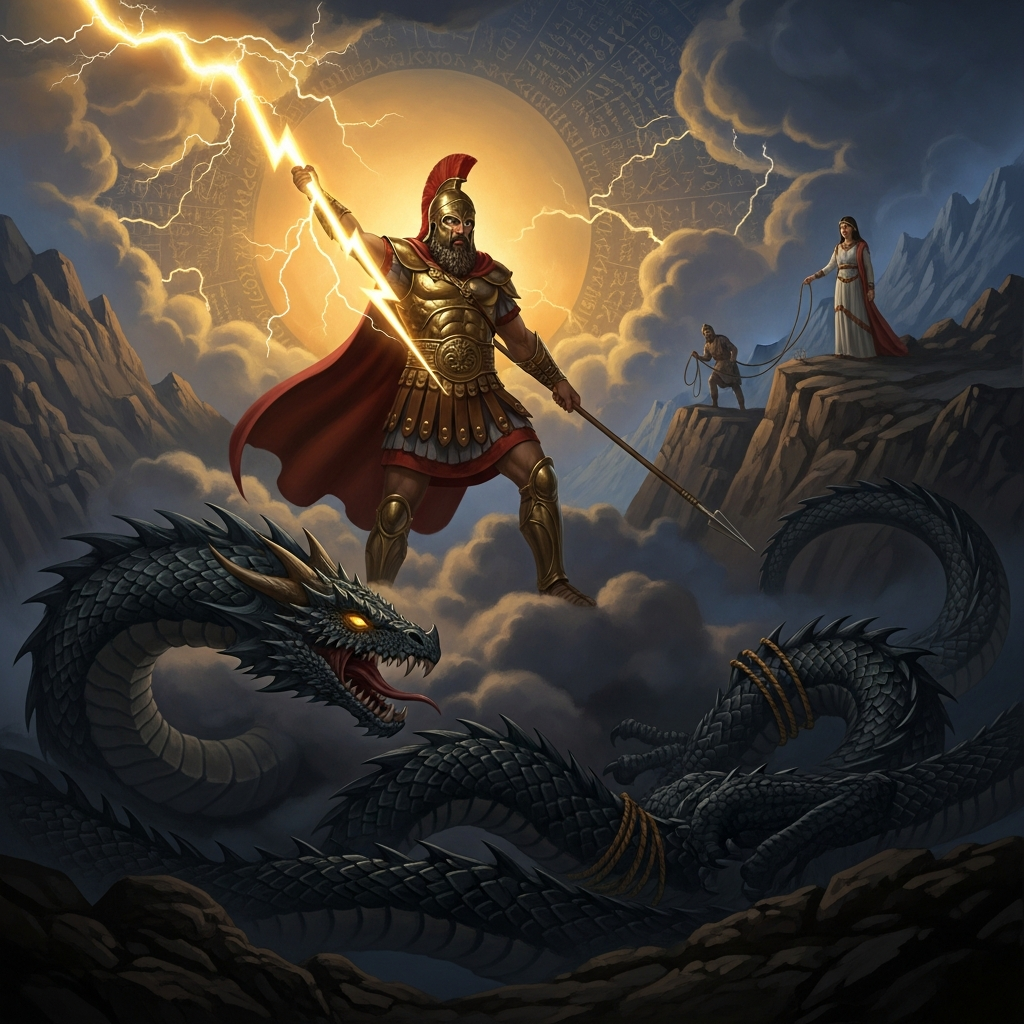
Hupashiya emerged from wherever Inara had hidden him and he bound the dragon with ropes.
Teshub descended from whatever diminished place he had retreated to and he killed Illuyanka.
The tablets state this matter-of-factly. The combat was not heroic the second time — it was an execution, the storm god reclaiming what had been taken from him, the dragon helpless in its ropes. When it was done, Teshub’s eyes and his heart were restored to him. The tablet does not say how.
What it does record is the subsequent fate of Hupashiya.
Inara hid Hupashiya in a house she had built in the mountains. She told him, with a clarity that makes the tablet feel like a warning: Do not look out of the window when I am gone. If you look out of the window, you will see your wife and your children.
She went away on her divine business.
Hupashiya looked out of the window.
The tablet does not record what happened to him after that moment. It simply notes that he looked out, that he saw his wife and his children in the valley below, and then the text moves forward. But the Hittite audience who heard this story would have understood: the mortal who helps a goddess does not get to return to his mortal life afterward. The looking out the window is the looking that unmakes the arrangement, the moment of human longing that cannot coexist with divine service. Hupashiya had made a bargain — with Inara’s body and with Inara’s purpose — and the bargain ended at the window.
This is Version One: the dragon is defeated. The storm god is restored. The mortal pays a price whose nature the text deliberately leaves silent.
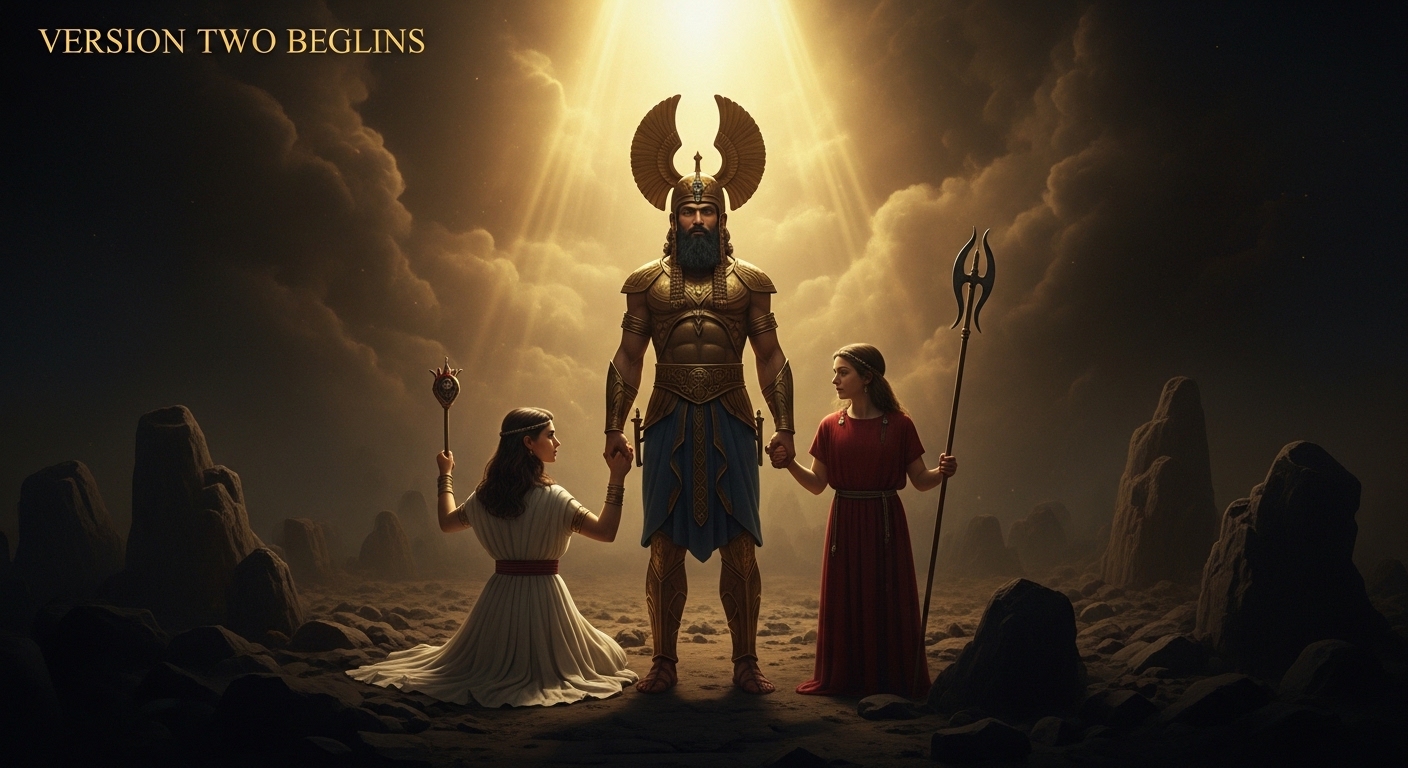
Version Two begins differently. In Version Two, Illuyanka defeats Teshub in the first battle and takes from him his eyes and his heart — as before — but the path of recovery runs through Teshub’s own family.
Teshub fathered a son by the daughter of a poor man, a mortal woman. This son grew up and eventually married Illuyanka’s daughter, entering the dragon’s family. Once inside that family, the son asked, as a bride-price, as a gift from his new father-in-law, for the organs that the dragon had taken from the storm god. He asked for the eyes. He asked for the heart.
Illuyanka gave them.
The son brought them back to his father. Teshub’s eyes were restored. His heart was restored. He was again the complete storm god, the full and terrible power of the sky.
Then Teshub went down to the sea.
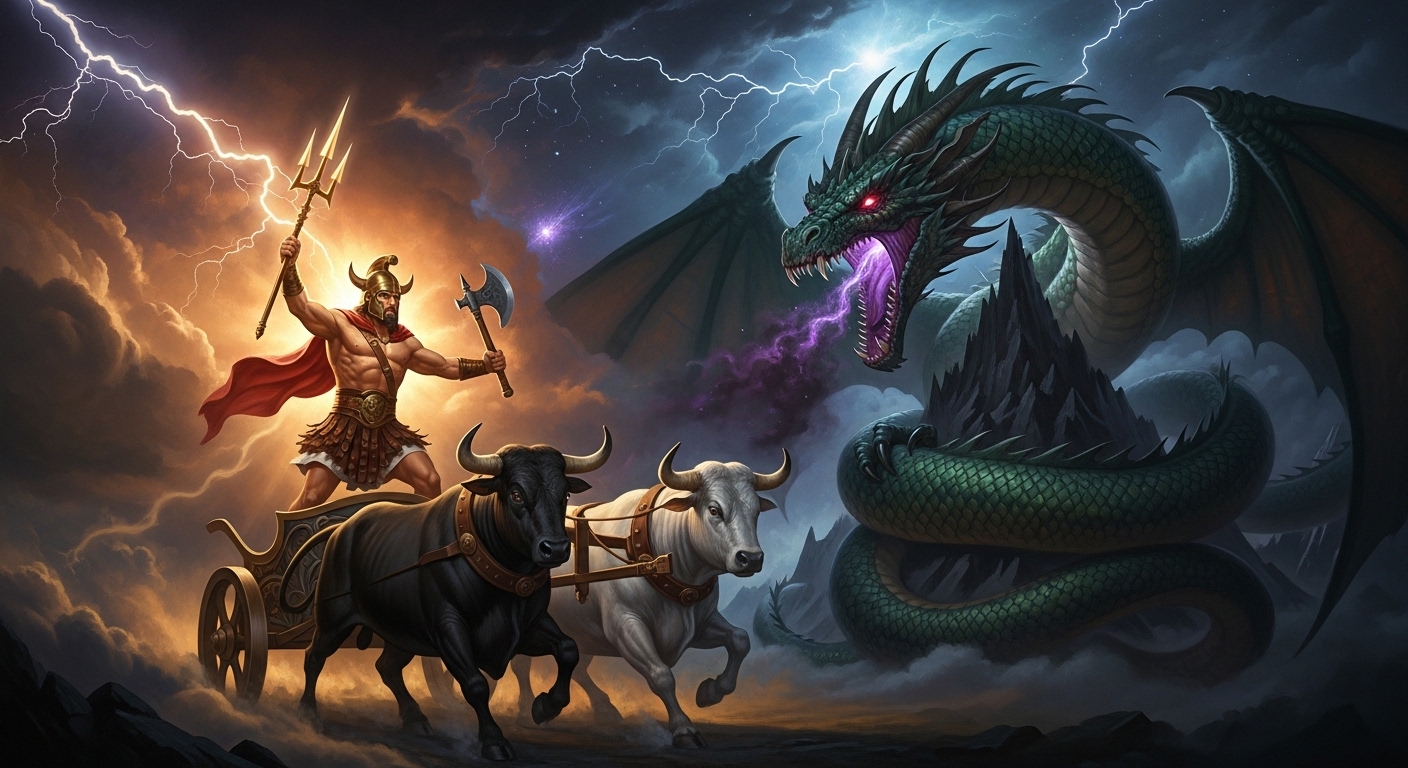
The sea, in the Hittite tablets, is where the final battle happens in Version Two. The dragon Illuyanka was in the sea — the element opposite to Teshub’s sky, the wet chaos that the Hittites associated with everything the storm god’s power was arrayed against. Teshub went to the sea to fight Illuyanka again, and this time he was complete, and this time he was going to win.
But his son was there.
Teshub’s son had married into Illuyanka’s family. He had betrayed that family, had taken the eyes and the heart from his father-in-law. And now his father was going to kill his father-in-law. The son called out to Teshub: Include me in the killing. Kill me too.
Teshub killed the dragon.
He also killed his son.
The tablet presents this without commentary. The son asks to be killed alongside his grandfather-in-law, and Teshub obliges. Whether this is honor — the son refusing to live after betraying the family he married into — or tragedy, or both, the text declines to specify. The dragon dies. The son dies. The storm god stands alone by the sea with his organs restored and his son dead.
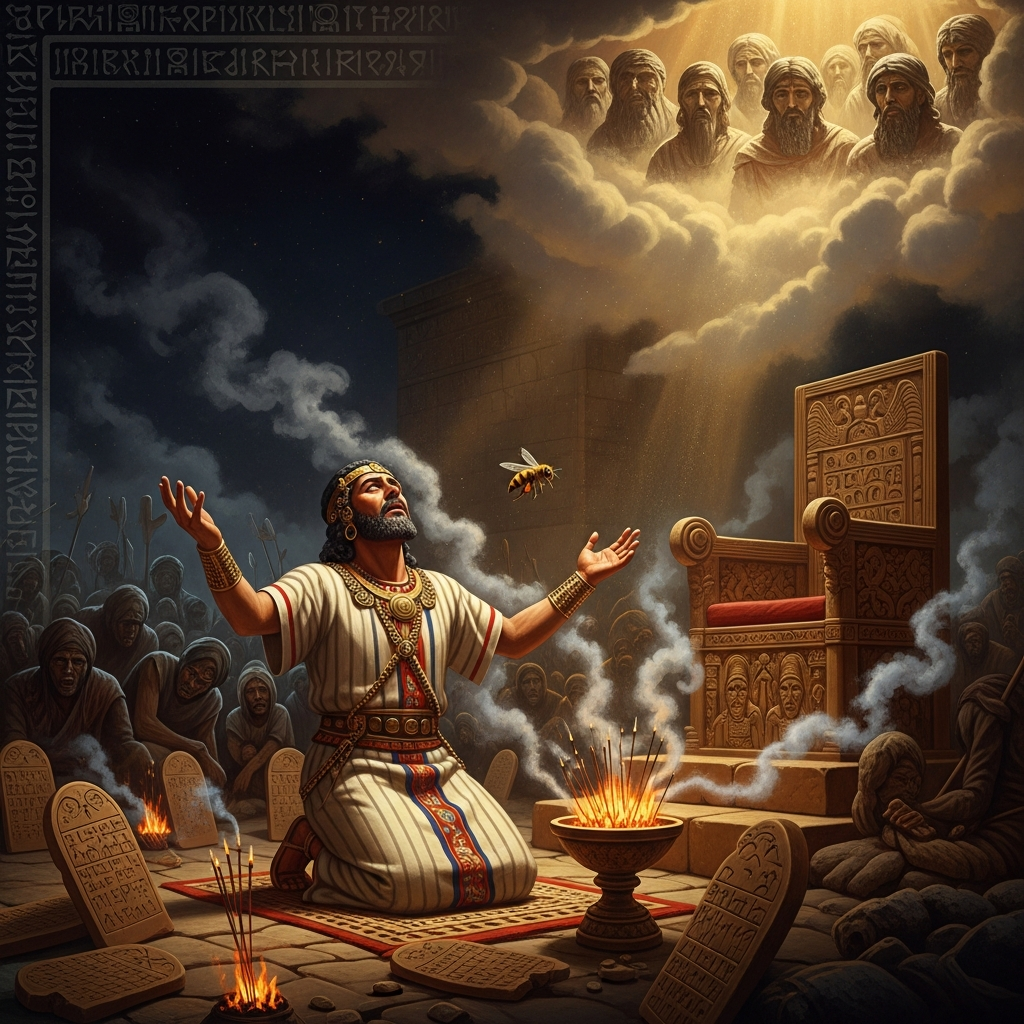
The scribe who recorded these two myths was a man named Kella, and he worked at Hattusa — the Hittite capital — sometime around 1400 BCE. He worked from an older original. He wrote at the end of his tablet that the myth was recited at the Puruli festival, the great Hittite spring celebration dedicated to the storm god, the celebration that marked the beginning of the agricultural year and the restoration of divine order.
Every year the Hittites gathered and heard both versions.
Every year the dragon was defeated. Every year the cost was different — a mortal’s life in Version One, a son’s life in Version Two — but the cost was always present. The Hittites, who were careful theologians, did not want a myth in which divine power was simply sufficient. They wanted a myth that told them what it cost.
The tablet is in the Museum of the Ancient Orient in Istanbul. The clay is dry. The cuneiform is intact. The dragon is still being killed every time someone reads it.
Scenes
Echoes Across Traditions
Entities
- Teshub (storm god)
- Illuyanka (the dragon)
- Inara (daughter of Teshub)
- Hupashiya (mortal hero)
- Shaushka (Ishtar of the Hittites)
Sources
- Harry A. Hoffner Jr., *Hittite Myths*, 2nd ed. (Scholars Press, 1998)
- Gary Beckman, 'The Myth of Illuyanka' in *The Context of Scripture*, vol. 1, ed. William Hallo (Brill, 2003)
- Itamar Singer, *Hittite Prayers* (Scholars Press, 2002)
- Trevor Bryce, *The Kingdom of the Hittites*, 2nd ed. (Oxford University Press, 2005)
- Calvert Watkins, *How to Kill a Dragon: Aspects of Indo-European Poetics* (Oxford University Press, 1995)