Erlik: The Lord of the Dark World Below
Oral tradition of the Turkic peoples; documented by Radloff and others, 19th century CE · The Lower World; the iron palace beneath the roots of the World Tree
Contents
In Turkic and Siberian shamanic tradition, Erlik was once a being of light — cast down by Tengri for his pride. In the Lower World, he became the lord of the dead, ruling a shadowy realm from his black iron palace, attended by demons with iron faces. When a person's soul is stolen by illness, the shaman must descend and negotiate with Erlik — bringing gifts, outwitting him, and retrieving the soul before it becomes part of his kingdom.
- When
- Oral tradition of the Turkic peoples; documented by Radloff and others, 19th century CE
- Where
- The Lower World; the iron palace beneath the roots of the World Tree
He was there at the beginning, before the worlds were separated.
In the Altaic creation myths that Radloff and later ethnographers recorded from Siberian peoples, the being who would become Erlik was not cast into darkness from the start. He was present when Tengri — the Eternal Blue Sky, the supreme principle — moved across the primordial waters. He was made from the same creative act that made the world. He dove to the bottom of the ocean to bring up the earth that Tengri used to build the dry land.
Some versions say he held back a portion of the earth in his own mouth, intending to build a separate world of his own.
Some versions say he wanted to be Tengri’s equal rather than his instrument.
The variations agree on the outcome: Tengri expelled him. He fell from the high world — from the realm of light and sky and the clean wind of the celestial layers — down through the Middle World, down through the earth’s floor, into the deep place where light does not reach. He fell all the way to the bottom.
And at the bottom, he made his palace of black iron.
The Lower World he rules is not chaos.
This is the important thing about Erlik that the shamanic traditions preserve with care: the underworld is organized. It has levels, like the Upper World — nine in most Altaic versions — each level darker than the last, each governed by specific beings who answer to Erlik’s authority. The dead who arrive in his realm are assigned their place in the order. There is judgment of a kind, though not the formalized weighing of the Egyptian system; there is simply the sorting that Erlik and his administrators perform as a matter of cosmic housekeeping.
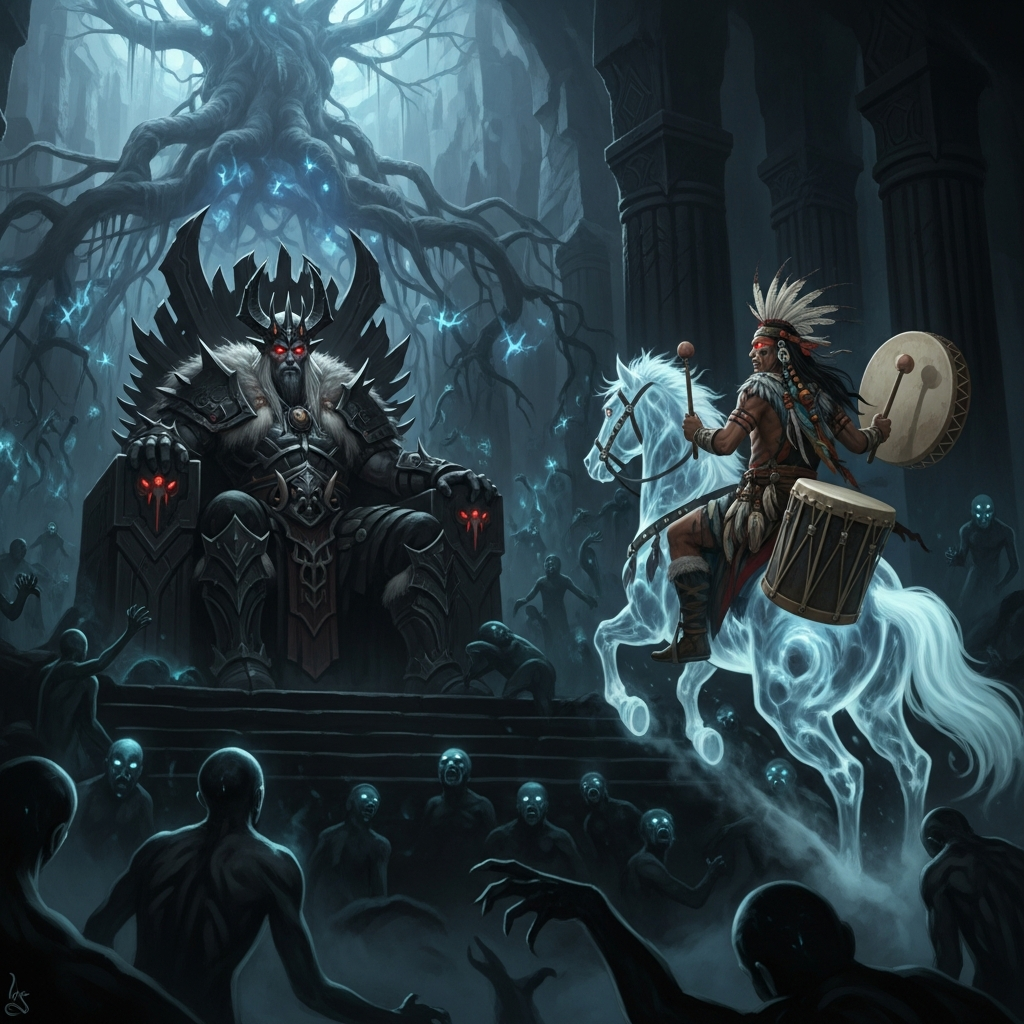
He sits in his palace — which the epics describe in considerable detail: black iron walls, a black iron throne, light that is not quite darkness but is nothing like the sky — and he adjudicates. His face is that of an old man with a long beard and eyebrows so heavy they have to be lifted to see from beneath them. He wears dark robes. He is attended by demons with iron masks who carry out his instructions.
His daughters — whose names vary by tradition but who appear consistently — serve as a kind of aristocracy of the Lower World. They are beautiful in the way that underworld figures are often beautiful in myth: dangerously, with an attractiveness that is inseparable from the danger of the realm they inhabit. The shaman who descends to Erlik’s palace often encounters the daughters first, and they can be allies or obstacles depending on how the shaman approaches them.
The shaman arrives at Erlik’s court bearing gifts.
This is not metaphor. The shaman descending to retrieve a stolen soul brings specific offerings — described in the oral epics that preserve the shamanic journey-songs — and presents them to Erlik as a diplomatic approach. Wine, specifically; the Altaic shamanic texts describe the offering of wine (araka) to Erlik, who receives it and is, if not placated, at least engaged.
The negotiation that follows has the quality of a formal audience: the shaman states their purpose, identifies the soul they seek, argues for its return. Erlik is not automatically hostile. He is an administrator with a bureaucratic interest in maintaining correct procedure, and if the shaman can demonstrate that the soul in question has been improperly taken — before its proper time, by a lower spirit acting without Erlik’s authorization — he may simply order its release.
If the soul was taken legitimately — if the person’s time was genuinely complete — the negotiation is harder. The shaman must argue, must offer something of value, must sometimes promise things on behalf of the patient that will bind them to a future obligation. The oral epics record some of these negotiations in full, and they have the tonal quality of skilled diplomacy: respect without submission, firmness without provocation, the willingness to trade but not to surrender.
Erlik’s most distinctive characteristic, across the traditions that describe him, is that he can be outwitted.
He is not omniscient. He is powerful within his domain and sovereign over it, but he does not see everything, and the clever shaman — or the person who has earned certain protections through correct behavior in the Middle World — can sometimes slip past his notice or exploit a gap in his knowledge.
The shamanic epics often end with the shaman emerging from the Lower World with the soul piece hidden in a vessel, or held inside a piece of clothing, while Erlik’s administrators search for it one step behind. The escape is always close. The gate of the Lower World closes just after the shaman exits.
This is part of what makes Erlik theologically interesting: he is not invincible, not absolute, not the omega point of the cosmos. He is a formidable administrator of a necessary domain who can be reasoned with, traded with, and sometimes fooled. The cosmos requires him — without the Lower World, where does the dead go? who sorts the souls? what happens to the forces that have been expelled from the sky? — but the cosmos also allows for a way around him, in the hands of the right specialist.
He is not Satan.
When Christian missionaries reached the Altaic and Siberian peoples, they identified Erlik as the devil and attempted to map the local cosmology onto their own. The identification is seductive in its surface features — the lord of the lower realm, the fallen being, the adversary of the sky god — but it obscures what is most interesting about Erlik.
Satan in the Christian tradition is the source of evil, the corrupter of creation, the enemy of all good. His existence is a theological problem: why does God permit him? Erlik is not a theological problem in the Altaic tradition. He is a solution. The souls of the dead have to go somewhere. Someone has to administer that somewhere. Erlik fell from the sky, yes, but the result of his fall was not chaos — it was the organization of the underworld.
He took what Tengri expelled him into and built a kingdom from it.
The shamanic traditions note, in their way, that this is not nothing. That the being who fell further than anyone else also built the most enduring structure from the fall. That there is a kind of power in the depths that the heights do not have.
The shaman who descends to Erlik’s palace and returns with the soul they went to find has been somewhere the sky cannot reach. They carry that knowledge back up the World Tree. The light they return to is the same light as before, but they see it differently now.
Erlik’s palace stays below them, organized and permanent and attended by its iron-masked servants, waiting for the next arrival.
Echoes Across Traditions
Entities
- Erlik
- Tengri
- the shaman
- Erlik's daughters
- the dead souls
Sources
- Wilhelm Radloff (Radlov), *Aus Sibirien* (1884) — primary 19th-century documentation of Altaic shamanic myth
- Annemarie von Gabain, *Das Uigurische Königreich von Chotscho* (1961)
- Mircea Eliade, *Shamanism: Archaic Techniques of Ecstasy* (Bollingen/Princeton, 1951/1964)
- Nora K. Chadwick and Victor Zhirmunsky, *Oral Epics of Central Asia* (Cambridge University Press, 1969)
- Uno Harva (Holmberg), *Die Religiösen Vorstellungen der altaischen Völker* (Academia Scientiarum Fennica, 1938)
- Anna-Leena Siikala, *Siberian and Inner Asian Shamanism* in *The Encyclopedia of Religion* (Macmillan, 1987)