Umai: The Divine Mother Who Guards Children
Oral tradition of the Turkic peoples; documented from inscriptions c. 8th century CE (Orkhon inscriptions) · The sky; the cradle; wherever children are born and grow
Contents
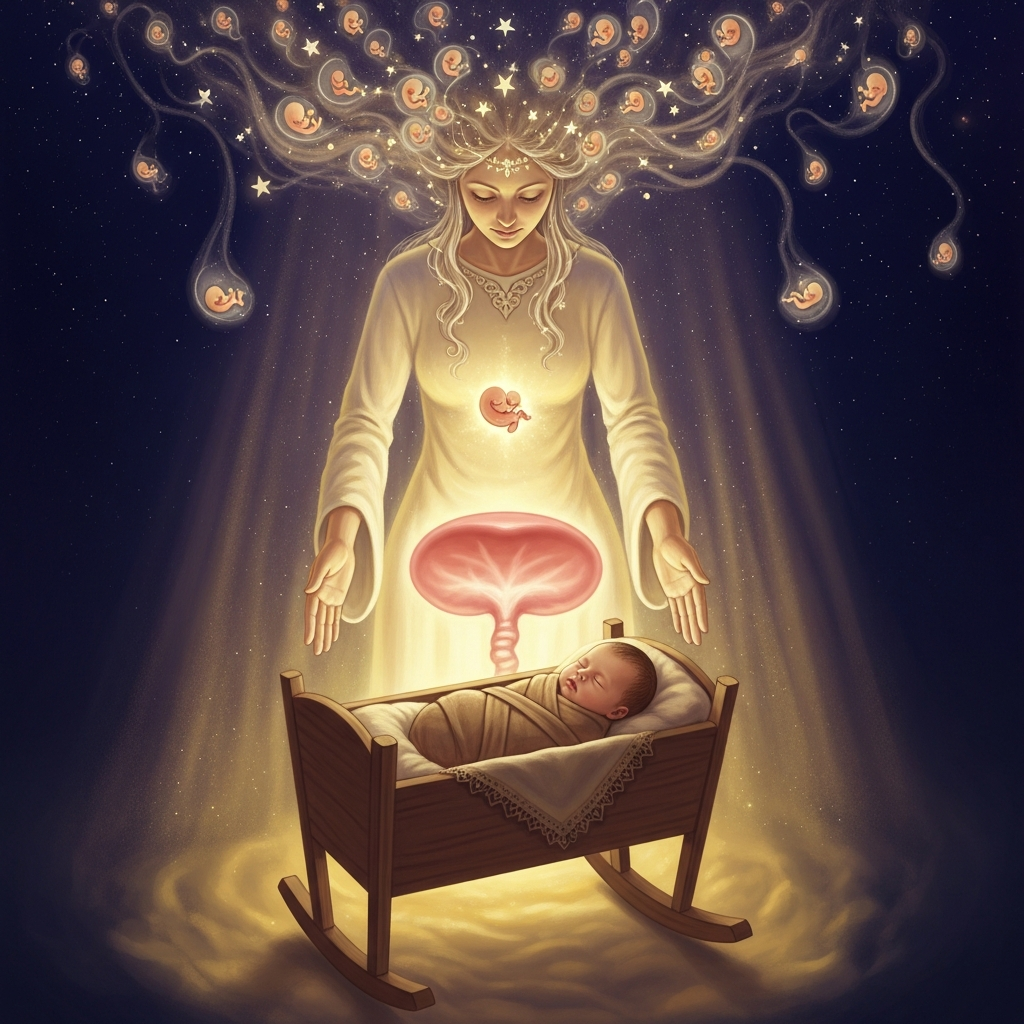
Umai is the Turkic and Mongolian goddess who catches souls from the sky and brings them to be born. She lives in the placenta (called her 'cradle') and departs when the child grows strong. She protects children, sits at the foot of the bed where babies sleep, and is the reason a baby's first smile is called 'Umai smiling.' When a child sickens, Umai has turned away — and must be called back.
- When
- Oral tradition of the Turkic peoples; documented from inscriptions c. 8th century CE (Orkhon inscriptions)
- Where
- The sky; the cradle; wherever children are born and grow
When a child is about to be born, Umai descends from the sky.
She does not come empty-handed. She carries the child’s soul — the soul-stuff that will enter the body and make it alive — and she places it at the moment of birth. The soul she carries is part of the sky’s substance; it is made of the same material as Tengri, bright and without origin, and she is the one who knows how to carry it from that brightness down into a body that cannot yet hold it by itself.
After the birth, she stays.
She lives in the afterbirth — in the placenta, which the Turkic tradition calls her cradle. This is why the placenta must be treated carefully: buried properly, or disposed of with specific ritual attention, because Umai’s dwelling-place is in it and to treat it carelessly is to insult the goddess who arrived with your child.
The Orkhon inscriptions — carved into stone steles in the Mongolian steppe in the 8th century CE, among the oldest surviving texts in any Turkic language — name Umai alongside Tengri and the sacred earth-water spirits as the triad of protective powers. The inscription of Köl Tigin reads: Tengri above, the holy Umai below and the sacred Earth-Water — through their favor we were victorious.
She is not secondary. She is not the lesser partner in a male-dominated divine hierarchy. She stands beside Tengri as a co-principle of the world’s ordering: the sky gives its mandate to rulers, the earth and water give their substance to the living, and Umai gives the children who will carry both into the future. Without her function, the sky’s mandate dies with the generation that holds it.
She stays with the child until the child no longer needs her.
The tradition holds that she is most present in the first years of life — the years when a child’s soul is not yet fully bound to the body, when illness can more easily steal the soul back toward the sky it came from, when the child is in the greatest danger. Her presence at the cradle-side is protective in a specific cosmological sense: she is holding the soul in place, keeping it from drifting back up toward its origin before the body is strong enough to hold it on its own.
This is why the baby’s first smile is called Umai smiling.
The infant who smiles in sleep is not having a pleasant dream in the ordinary sense. They are in contact with Umai, who is still there at the cradle’s foot, and the smile is her smile passing through the child’s face. This is the tradition’s way of saying that the boundary between the goddess and the child she guards is not yet fully drawn — she is still inside the process of making this new person a person, still holding the soul-stuff in position, still present in the smiles and the small movements of the not-yet-conscious.
When the child sickens — when high fever comes, when the color drains from a face that was rosy yesterday, when the eyes go distant — the explanation the tradition reaches for first is this: Umai has turned away. Something has offended her, or the child’s soul has begun to drift back toward the sky without her restraint, and the illness is the body’s response to the partial absence of its animating principle.
The shaman is called. The shaman calls Umai.
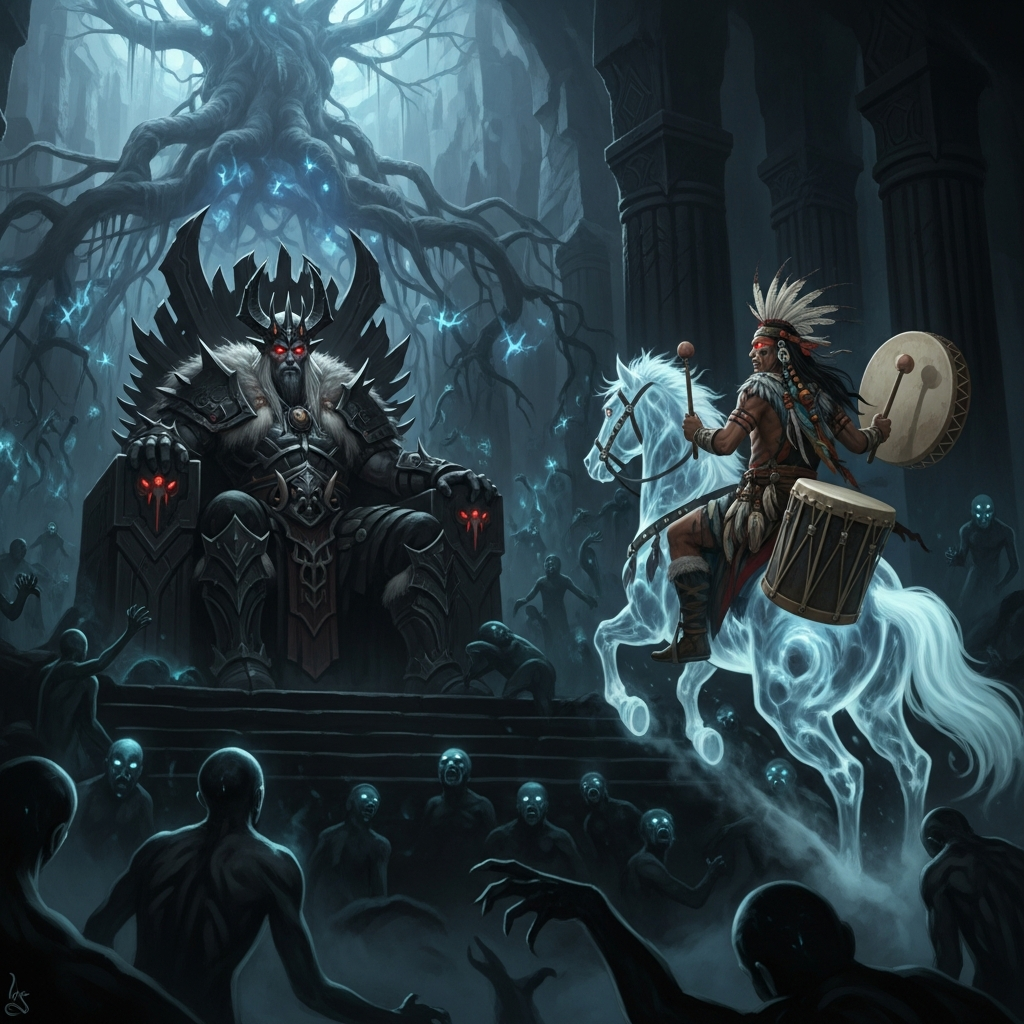
The invocation of Umai is a specific ritual technology. Different traditions across the Turkic and Mongolian world preserve versions of it: a ceremony held at the sick child’s side, usually at night, in which a female shaman (or the shamans who specialize in birth and childhood spirits, rather than the death-dealing specialists who deal with Erlik) calls Umai back to the bedside.
The offering is white — white food, white cloth, the color of the sky at its most luminous. Fire is involved: a small fire, a clean fire, because Umai is associated with light and warmth and the first fire that was lit in the new home to receive a newborn child. The shaman’s song addresses her by title and by the specific quality of her relationship with the sick child — not Umai in general but Umai-who-came-with-this-child, Umai-who-sat-at-this-cradle.
If the ceremony is successful, the child recovers.
If not, the tradition reads the outcome as a message: Umai has taken the child’s soul back to the sky because the body could not hold it. The death of a young child is not Erlik’s work — it is Umai’s return. She gave the soul and she has taken it back. The grief of this is acknowledged, but the theology does not make it a punishment. Some souls arrive in bodies that cannot sustain them. Umai is the one who knows the difference.
She is specifically associated with women who give birth.
The midwives who assisted at births in the Turkic world were not merely medical practitioners; they were invokers of Umai. The first words spoken to a newborn child included her name. The first bath was given in water that had been prayed over in her name. The first clothing was placed on the child with her invoked as witness.
This cluster of practices created what might be called a liturgy of the threshold — a set of ritual moments organized around the recognition that a new person was crossing from one state of existence to another, and that this crossing required divine attention. Umai was the divine attention at this specific threshold: the crossing from not-yet-born into born, from sky-substance into body-substance, from the invisible into the visible.
The placenta-cradle was buried or disposed of. The child grew. The months passed. The soul settled into the body the way a bird settles onto a branch — tentatively at first, then with increasing confidence.
And one morning the child stood up without falling, and ran across the floor, and Umai smiled her last smile through a face that was entirely its own now.
She went back to the sky.
There was another child coming.
Echoes Across Traditions
Entities
- Umai
- Tengri (the sky father)
- the children she guards
- the shamans who invoke her
Sources
- Talat Tekin (trans.), *A Grammar of Orkhon Turkic* (Indiana University Press, 1968)
- Ötüken inscriptions and Köl Tigin inscription, 8th century CE (primary sources mentioning Umai)
- Uno Harva (Holmberg), *Die Religiösen Vorstellungen der altaischen Völker* (Academia Scientiarum Fennica, 1938)
- Mircea Eliade, *Shamanism: Archaic Techniques of Ecstasy* (Bollingen/Princeton, 1951/1964)
- Jean-Paul Roux, *Faune et Flore Sacrées dans les Sociétés Altaïques* (1966)
- Radloff (Radlov), *Proben der Volksliteratur der türkischen Stämme* (1866–1904)