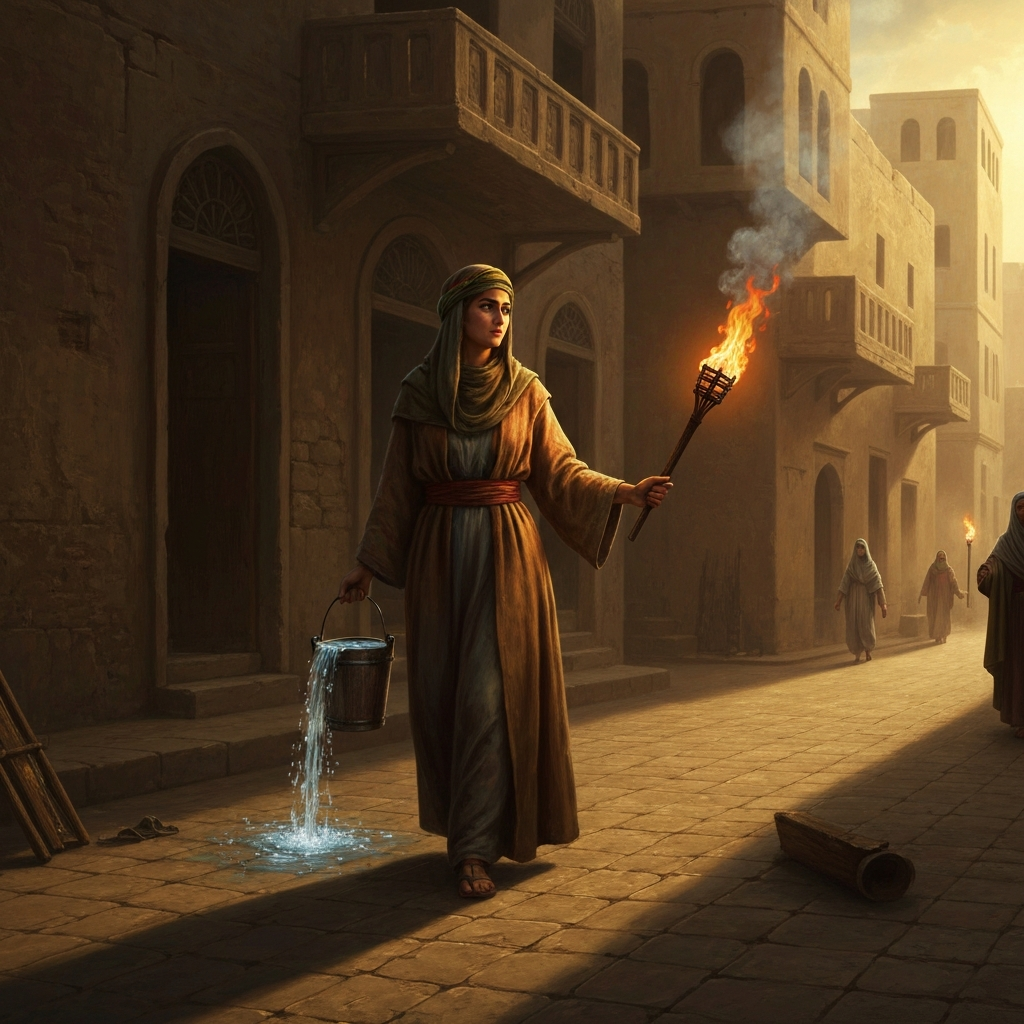
Tawakkul: Ibrahim ibn Adham Walks into the Desert
c. 718–782 CE — Balkh (in modern Afghanistan) and Khurasan; later Syria and Palestine · Balkh, Bactria (northeastern Afghanistan) — the wealthy city from which Ibrahim departed, and the Syrian desert to which he traveled
Contents
Ibrahim ibn Adham, the prince of Balkh who left his throne after a divine encounter, walks into the desert with nothing and becomes the embodiment of tawakkul — complete trust in God's provision — the station on the Sufi path where planning and God's care meet, and God's care wins.
- When
- c. 718–782 CE — Balkh (in modern Afghanistan) and Khurasan; later Syria and Palestine
- Where
- Balkh, Bactria (northeastern Afghanistan) — the wealthy city from which Ibrahim departed, and the Syrian desert to which he traveled
He is on the throne of Balkh when it happens.
Ibrahim ibn Adham is, by the accounts, the prince of Balkh — the wealthy city in Bactria, the historical crossroads of Persian and Central Asian cultures. He is rich, young, powerful, and sleeping in his palace when the sound begins. A voice. Not from a person — from the roof above him, from inside the architecture, from the kingdom itself asking a question: Is this why you were created? Is this what you were for?
He rises. He goes to the window. There is a figure on the roof — depending on the account, an angel, a wise man, a divine messenger in human form. The figure says the same thing in a different form: You were not created for this. And then the figure is gone.
Ibrahim ibn Adham gets off the throne, walks out of the palace, and does not come back.
The theological content of the departure is precisely tawakkul.
Tawakkul is the Sufi station of trust in God — complete, non-anxious reliance on divine provision. It is not passivity. It is not fatalism. It is the active and total reorientation of the relationship between human effort and divine care. The person who has tawakkul still acts, still works, still uses the faculties God gave them — but their actions arise from what is needed now, not from anxiety about what might be needed later. They do not plan because they have stopped trusting God and started trusting their plans.
Ibrahim’s departure from Balkh is the physical enactment of this principle. He leaves behind everything that would make him safe by the ordinary measure of safety: wealth, soldiers, walls, food stores, political allies. He walks into the road with nothing. And the tradition records that he is not hungry. When he needs food, work appears — a laborer on the road who needs help harvesting, a craftsman who needs an assistant. He works for a day, receives enough to eat, and moves on.
This pattern — the one who trusts completely being provided for completely, without hoarding, without planning, without anxiety — is the practical demonstration of what the doctrine of tawakkul claims.
The masters argue about how literally tawakkul should be implemented.
Al-Ghazālī devotes careful analysis to this question. He says: tawakkul does not mean refusing all effort. The Prophet said tie your camel and trust God — tie the camel first, then trust. Complete trust does not mean refusing to tie the camel. It means tying it without the knot-tying being the source of security. The camel may still be stolen. The food store may still run out. The walls may still fall. Tawakkul is the interior state of the person who has done everything reasonable and then released the outcome.
But Ibrahim ibn Adham’s extreme version — no throne, no army, no stores, no plan — was also honored by the tradition as a legitimate and high expression of tawakkul. Not for everyone. Not as a command. But as a demonstration of the station’s full extension.
He eventually settles in Syria and Palestine, where the hagiographies follow him through a series of encounters that demonstrate the practical wisdom that accompanies complete trust.
He is approached by students. He takes some and not others. He is asked why. He says: the ones I took were not looking for security. The ones I did not take were looking for a different kind of palace with spiritual decor.
He works as a laborer, a shepherd, a sailor. He prays on the water, is seen by sailors to be standing on the surface of the sea. He fasts for long periods. He dies in Syria, probably in the late eighth century, still working, still walking, still without the throne’s weight.
The kingdom of Balkh passed to another king. The demonstrations of trust have been circling the tradition for thirteen centuries, still asking the question the voice asked on the roof:
Is this why you were created?
Echoes Across Traditions
Entities
- Ibrahim ibn Adham
- the divine voice from the throne
- the laborer by the road
Sources
- Farid ud-Din Attar, *Tadhkirat al-Awliya* (Memorial of the Saints), section on Ibrahim ibn Adham
- A. J. Arberry, *Muslim Saints and Mystics* (Routledge, 1966)
- Annemarie Schimmel, *Mystical Dimensions of Islam* (UNC Press, 1975)
- Peter Awn, *Satan's Tragedy and Redemption: Iblis in Sufi Psychology* (Brill, 1983)