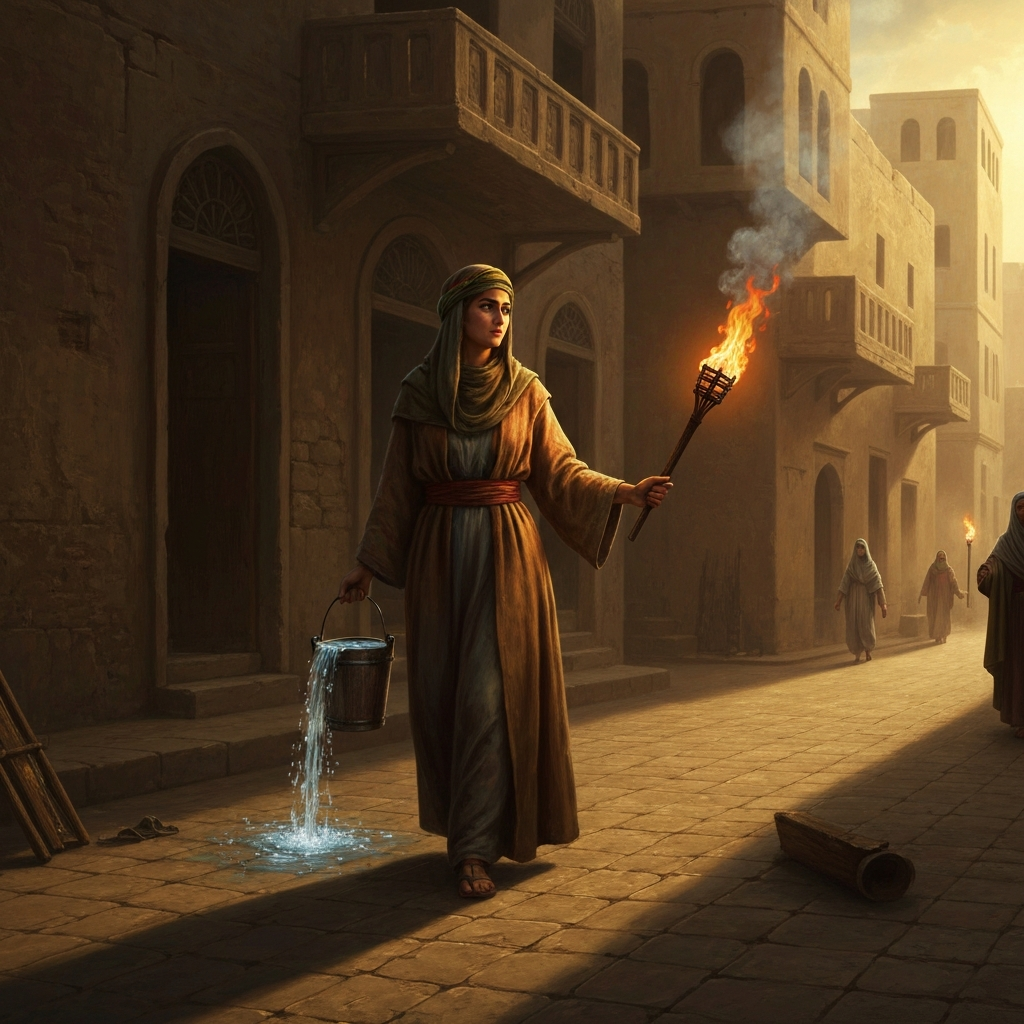
Ibrahim ibn Adham: The King Who Gave Up His Kingdom
c. 718–730 CE — Balkh, Bactria · Balkh, Bactria (northeastern Afghanistan) — city at the crossroads of Persian, Central Asian, and Indian routes
Contents
The three knocks that shook Ibrahim ibn Adham's sleep — a noise on the roof, a man with a whip, a voice in the sky — form one of the most elaborated conversion narratives in Sufi hagiography, the story of renunciation as response to an encounter that could not be answered by staying a king.
- When
- c. 718–730 CE — Balkh, Bactria
- Where
- Balkh, Bactria (northeastern Afghanistan) — city at the crossroads of Persian, Central Asian, and Indian routes
The first knock is in the night.
He is sleeping in the palace of Balkh — or sitting on the throne, the accounts vary — and there is a sound from the roof. Not a human sound. He rises. He calls a guard. The guard goes to the roof and returns: nothing. He returns to sleep.
The second knock comes louder. This time a figure is reported — a man on the roof with a whip, searching for something. Ibrahim calls out: what are you doing on the roof of the palace of the king? The figure replies: I have lost my camel and am looking for it. A camel on the roof of a palace is impossible. The visitor is delivering a teaching in the tradition of divine messengers who appear in impossible situations to force the questioner to ask why an impossible thing is happening.
Why are you looking for your camel on a palace roof? Because you are looking for God on a palace throne. Neither location is right.
He returns to sleep.
The third encounter is not imageable. It is a voice — from the throne, or from the sky over the throne, or from inside him — that says: You were not born for this. And then, some versions say: You will die. The throne will pass to another. This is not what you are.
By morning he has made a decision.
The hagiographers present the decision as sudden and total — typical of the Sufi conversion narrative, which favors the clean break over the gradual change because the clean break is theologically cleaner. But there is also historical evidence: Ibrahim ibn Adham appears in Syrian and Palestinian accounts as a scholar and a laborer, his Balkh origins remembered but his royal life already decades in the past. The timeline suggests a gradual departure that the tradition crystallized into a single night.
What matters theologically is not the tempo but the direction.
Zuhd — renunciation — in the Sufi vocabulary does not primarily mean material poverty. It means the detachment of desire from everything that is not God. The person who has zuhd can own things — can be wealthy, by some accounts, as long as the wealth does not own them. But Ibrahim ibn Adham’s story became the tradition’s exemplar because his material departure made the interior departure visible. He did not achieve detachment while sitting on the throne, maintaining the outward appearance of the king while harboring an inward spirituality. He stood up and left.
The hagiographic detail that follows is instructive.
After leaving the palace, Ibrahim is given a shepherd’s cloak by a man on the road. He accepts it. He begins working as a shepherd in Khurasan, then as a laborer, then as a craftsman in Syria. He is reported to have sought out teachers — to have studied under Sufyan al-Thawri, the great ascetic and jurist of the second generation, who taught in Kufa and Mecca. He acquires a complete Islamic education, including the transmission of hadith, which he later passes to students in the traditional scholarly manner.
This is the point the Sufi tradition makes consistently: renunciation is not the end of the path. It is the beginning. Ibrahim leaves the palace not because the palace was uniquely corrupt or because material life is inherently evil, but because the attachment to the palace had become the obstacle. Once the obstacle is removed, the real work begins.
He spends the rest of his life as a scholar, a laborer, and an occasional teacher. Students seek him out on the road. He gives them what he has.
He dies, probably in Syria on a sea expedition, as an ascetic laborer who had once been a king of Balkh.
The throne passed to someone else. It always does.
The question the voice asked from the roof is still in the tradition, still awake at 3 a.m., still asking the people who have palaces whether the palace is what they were made for.
Echoes Across Traditions
Entities
- Ibrahim ibn Adham
- the three divine messengers
- Sufyan al-Thawri
Sources
- Farid ud-Din Attar, *Tadhkirat al-Awliya*, section on Ibrahim ibn Adham
- A. J. Arberry, *Muslim Saints and Mystics* (Routledge, 1966)
- Jawid Mojaddedi, 'Ibrahim b. Adham' in *Encyclopaedia Iranica*
- Annemarie Schimmel, *Mystical Dimensions of Islam* (UNC Press, 1975)