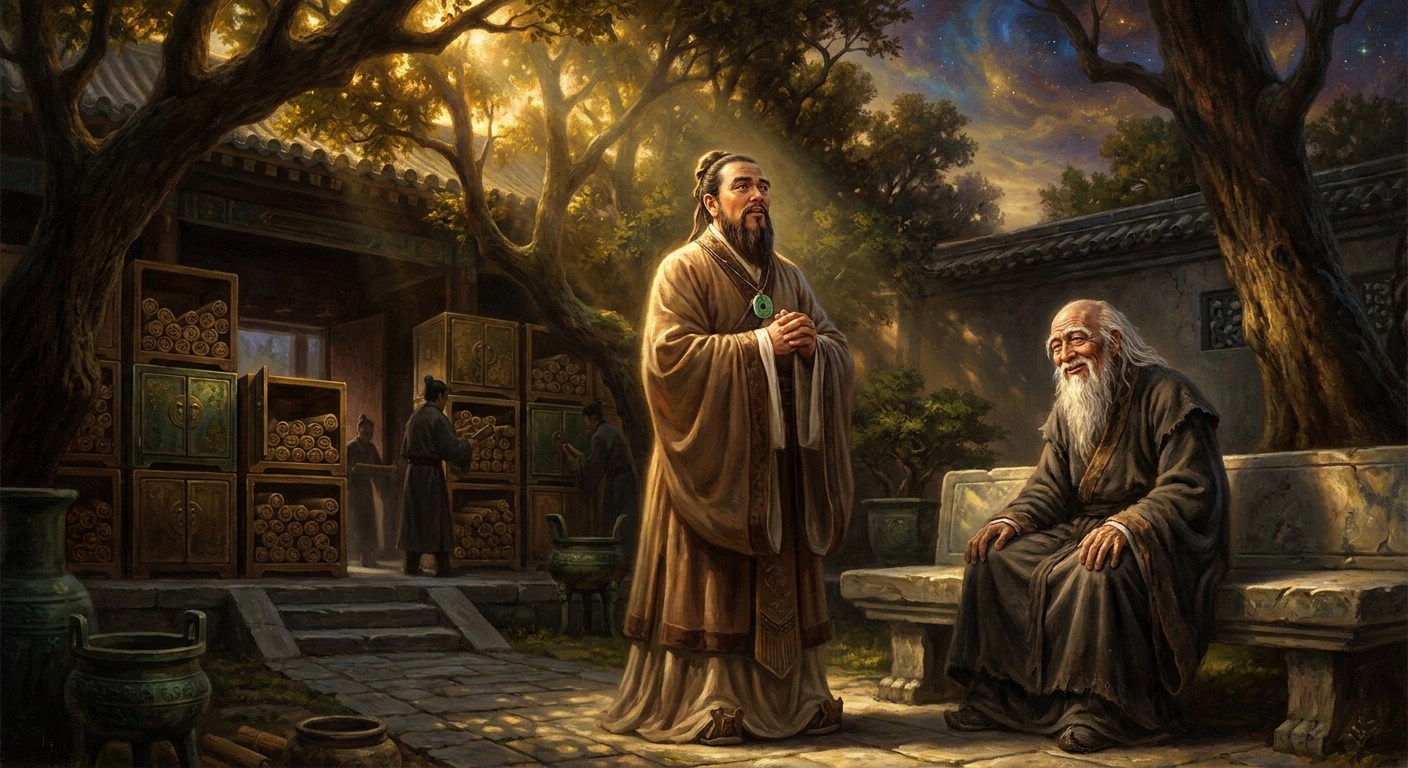
The Yellow Millet Dream: A Life in an Instant
Tang dynasty setting — c. 8th century CE, the canonical literary version · An inn in Handan, in what is now Hebei Province — on the road to the capital
Contents
A young scholar dreams an entire lifetime — examinations, career, marriage, political rise and fall, exile, old age — while waiting for a pot of millet to cook, and wakes to find that the millet is not yet done.
- When
- Tang dynasty setting — c. 8th century CE, the canonical literary version
- Where
- An inn in Handan, in what is now Hebei Province — on the road to the capital
The scholar Lu Sheng arrives at the inn in Handan hungry and tired.
He is on the road to the capital for the imperial examinations. He is young and ambitious in the way that young men are ambitious when they believe their talent entitles them to everything. He sits at a table. He complains to the Taoist sitting across from him — an old man who may be Lü Dongbin in disguise or simply an old Taoist, which in China is often the same thing — about how unsatisfied his life is, how little he has been given that matches his abilities, how the examination will open the doors that circumstance has closed.
The old Taoist takes a ceramic pillow from his bag and sets it on the table. He says: you may sleep on this while you wait.
The innkeeper has just put a pot of millet on the fire. The cooking will take a while.
Lu Sheng puts his head on the jade pillow and is immediately somewhere else.
He passes the examination. First in his class. The Emperor reads his essay. He is appointed to position. He distinguishes himself. He receives a promotion. He marries a woman of excellent family. He has children who do well. He is promoted again. He accumulates the goods of the successful life: a house, a reputation, the respect of colleagues, the deference of subordinates.
Then a political enemy accuses him of corruption.
He is investigated. The investigation drags on. His allies keep their distance. He is demoted. He is exiled. He spends years in a remote province. He is recalled — the political winds shift, his enemy falls — and he is promoted again, higher than before. He serves the Emperor well for another decade. He is given great authority.
He grows old. His children preoccupy him in the way that children who have been well-provided for are preoccupied with their inheritance. His wife dies. He begins to review his life with the retrospective attention of the very old. He sees what he missed. He thinks about what he would change. He dies in his bed at eighty, surrounded by his children and grandchildren, having had, by every external measure, the life he wanted at the inn in Handan.
He wakes.
He is at the table. He has not moved. The jade pillow is under his cheek. The old Taoist is across from him, watching.
The innkeeper appears from the kitchen. The millet is not yet done. It has been cooking since Lu Sheng lay down. It is still cooking now.
The time required for the millet to cook is the time required for a full human life — examinations, career, marriage, children, exile, return, old age, death, the complete arc of the biographical self.
Lu Sheng looks at the old man. The old man looks at Lu Sheng. Between them on the table is the jade pillow and the unanswerable question: if a life fits inside the cooking time of a pot of millet, what is the difference between the life lived and the millet cooking? The life felt long from inside. The millet timer has not run down.
The old Taoist does not explain further. He picks up his pillow. He may be paying for his meal, or he may be a god, or both.
Lu Sheng sits with the millet. When it is ready, he eats it. He does not go to the capital that day. The texts do not say what he does instead. But the millet feeds him, and it is the same millet it would have been if he had never slept, and he knows something now that he did not know when he arrived: that the life on the road to the capital fits inside the life at the inn table, and both of them fit inside whatever fits inside the cooking time, and the question is not how long you live but what you are while you are living it.
Echoes Across Traditions
Entities
- Lu Sheng (the dreaming scholar)
- Lü Dongbin (or the Taoist host)
- the inn at Handan
- the jade pillow
Sources
- Pillow Story (枕中記), Shen Jiji, c. 793 CE — original Tang dynasty literary version
- Pai Pu (Bai Pu), opera version Yuan dynasty
- Robert Ashmore, 'The Pillow Story and Its Reader,' T'ang Studies, 2001
- Eva Wong, *Taoism: An Essential Guide* (Shambhala, 1997)