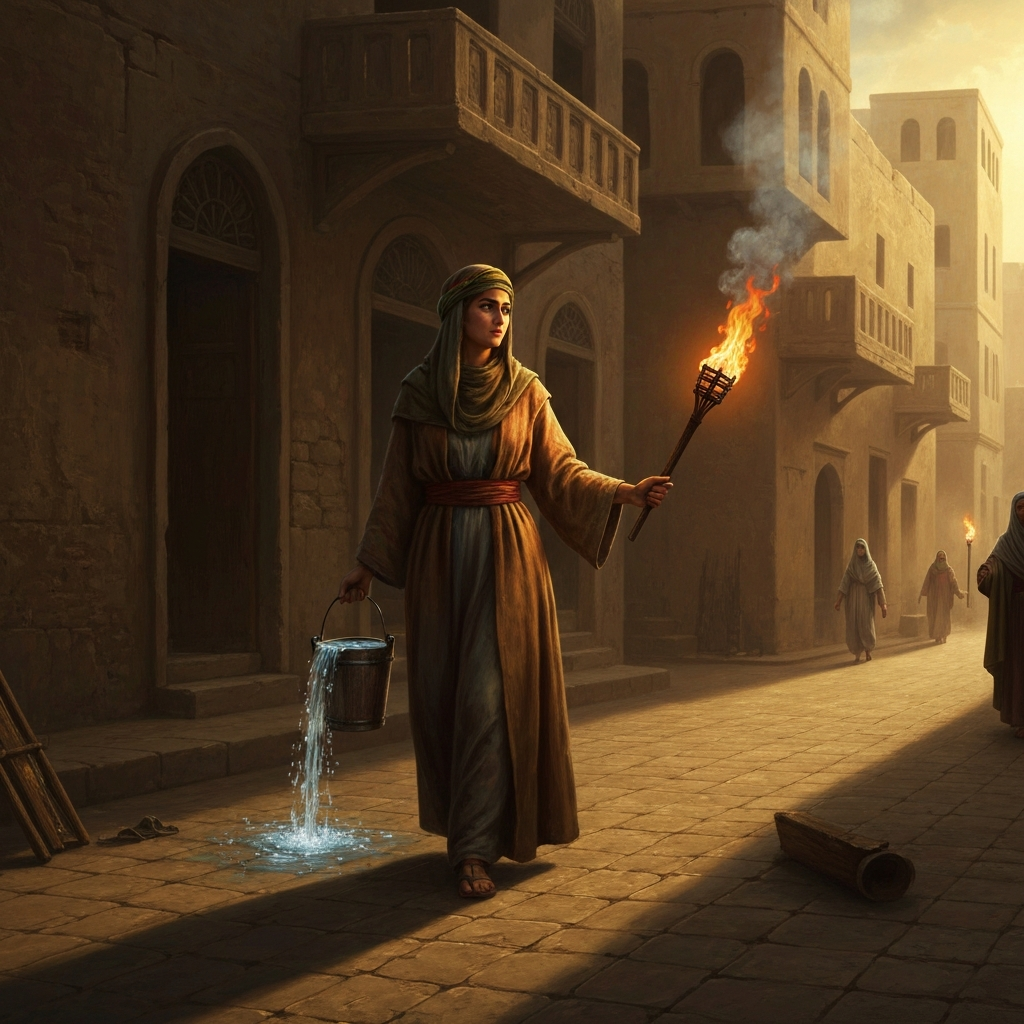
Bayāzīd Turns Back Before Reaching Mecca
c. 830–860 CE — the road from Bastam to Mecca, during the early Abbasid period · The road from Bastam (Khurasan, northeastern Iran) westward toward Mecca — the long overland pilgrimage route
Contents
Bayāzīd Bastāmī sets out on pilgrimage to Mecca three times. On the first journey, an old man stops him in the road with a single question that turns him back home. The inner Kaaba, he learns, is more difficult to circumambulate than the stone one.
- When
- c. 830–860 CE — the road from Bastam to Mecca, during the early Abbasid period
- Where
- The road from Bastam (Khurasan, northeastern Iran) westward toward Mecca — the long overland pilgrimage route
He sets out from Bastam on the hajj road and meets a man sitting by the roadside.
The man is old, or appears to be. He is sitting in the dust at the edge of the road with nothing — no pack, no staff, no provisions — and he looks at Bayāzīd with eyes that the accounts say were not ordinary eyes. Bayāzīd stops, because Bayāzīd knows eyes that are not ordinary eyes. He has spent enough time with his own teachers to recognize the look.
The old man asks: where are you going?
To Mecca, on the hajj.
The old man is quiet for a moment. Then he says: how much money do you have for the journey?
Bayāzīd answers: three hundred silver dirhams.
The old man says: circumambulate me seven times and give me the money. That will serve you better than the journey to Mecca.
The instruction is preposterous by any normal measure. The hajj is one of the five pillars of Islam — one of the obligatory religious duties of every Muslim who has the physical and financial capacity to perform it. To refuse the hajj because a stranger by the road suggested an alternative is not piety. It is, by the standards of Islamic law, disobedience.
But Bayāzīd’s tradition is precisely the tradition that goes behind the standards of Islamic law to the purpose those standards serve. And the question the old man is implicitly asking is: what makes the physical Kaaba sacred? Not its stones. The stones are stones. What makes the circumambulation holy is the one doing it and the state they are in while doing it. If you circumambulate the stone Kaaba with a distracted mind, a self-centered heart, and an eye for what you will gain spiritually from having performed the ritual correctly, you have made seven circuits around a black cube and returned home. The ritual was technically valid and spiritually empty.
What if, says the old man, you circumambulated a human being in whom God was more fully present than in any stone building in Arabia?
Bayāzīd walks around the old man seven times.
The accounts do not record what he felt during the circumambulation. They record what happened afterward. He gave the man the three hundred dirhams, which was everything he had for the journey. He turned around and walked back toward Bastam. And from that day forward, according to Attar’s hagiography, something in him was different — not closed, but opened.
The story is told with variations in dozens of later sources. In some versions, the old man disappears as soon as the money changes hands, proving he was divine. In some versions, Bayāzīd later learns that the man was his own teacher in disguise. In some versions, the man is simply a human being who happened to be a living Kaaba — qalb, the Arabic word for heart, is etymologically related to Kaaba, both implying something that must be turned around and approached from all sides.
What all versions share is the inversion of the outward and inward journey. The Mecca pilgrimage is outer. The living human being by the road — if that human being has completed the inner journey and now contains what Mecca points toward — is inner. The outer is a school for the inner. When the inner is available directly, the outer becomes redundant.
Bayāzīd does eventually complete the hajj. He makes the journey multiple times by the accounts. He is not anti-law. He is anti-literalism. The distinction is everything in Sufi thought.
The great tension within Islam — between the shariah, the outward law, and the haqiqa, the inner truth — runs through every Sufi thinker from Rabia to Rumi. The mainstream position, which the Sufis technically accept, is that both are required: the outward law is the vessel that carries the inner truth, and abandoning the vessel because you think you’ve reached the wine leads to chaos and self-deception. Most Sufi masters, including Bayāzīd, maintained rigorous ritual practice alongside their ecstatic states.
But the story of the old man by the road is told specifically to puncture religious complacency — the assumption that performing the outer ritual correctly satisfies the requirements of the inner journey. Bayāzīd, in this story, is not told to skip the hajj forever. He is told to look at who is telling him where to go. Is the one commanding you inward or outward? Is the command coming from God or from your reputation as a pilgrim?
He circles the man. He gives the money. He turns back.
Three hundred silver coins for the knowledge that the Kaaba you’re looking for is not in Arabia.
Echoes Across Traditions
Entities
- Bayāzīd Bastāmī
- the old man of the road
Sources
- Farid ud-Din Attar, *Tadhkirat al-Awliya* (Memorial of the Saints), c. 1220
- A. J. Arberry, *Muslim Saints and Mystics* (Routledge, 1966) — translation of Attar's Bayāzīd section
- Annemarie Schimmel, *Mystical Dimensions of Islam* (UNC Press, 1975)
- Paul Losensky, introduction to *Farid ud-Din Attar's Conference of the Birds* (Penguin, 1984)