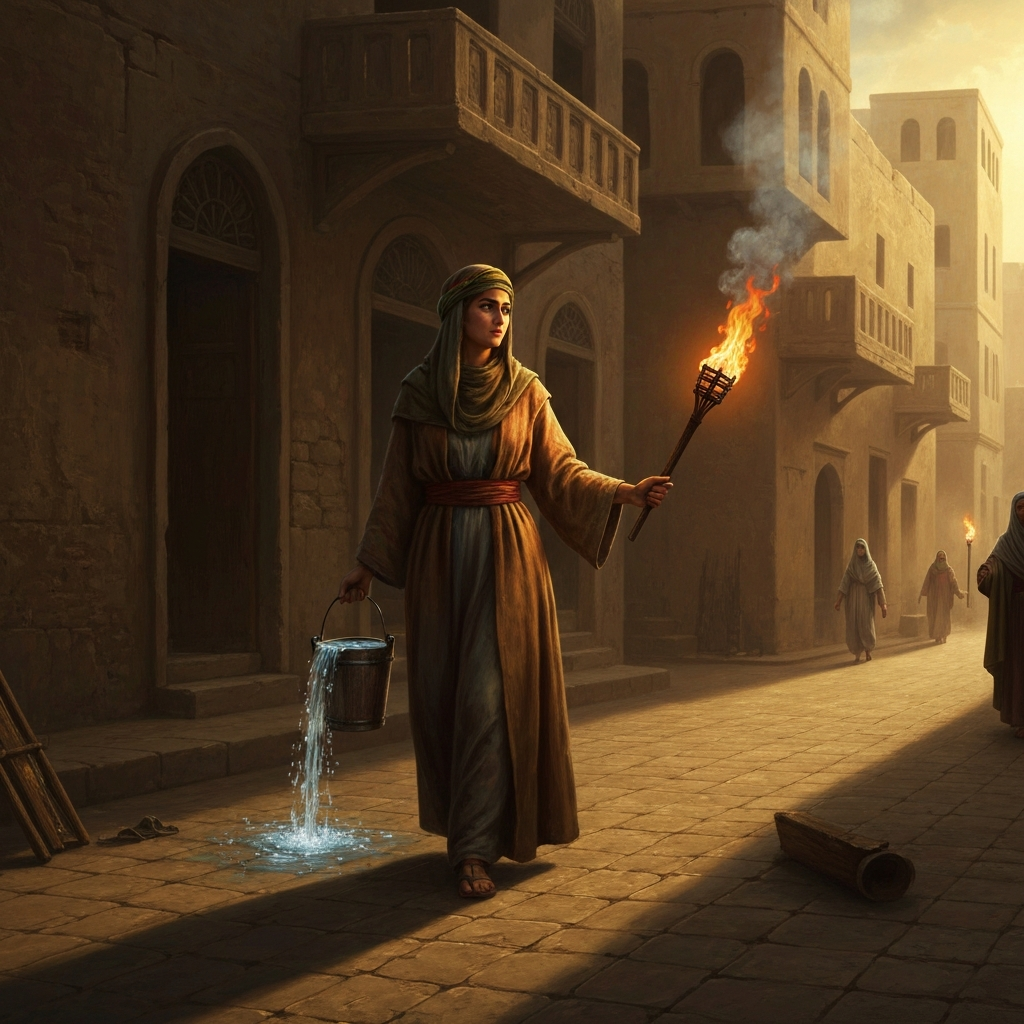
Muḥāsaba: The Nightly Accounting of the Soul
c. 781–857 CE — Baghdad, the Abbasid Caliphate · Baghdad, Iraq — the center of Islamic intellectual life in the early Abbasid period
Contents
Al-Muhasibi, the ninth-century Baghdad mystic whose name means 'the one who accounts,' developed the practice of nightly self-examination into a systematic psychology of self-deception — and showed that the greatest obstacle to God is not sin but the soul's capacity to present sin as virtue.
- When
- c. 781–857 CE — Baghdad, the Abbasid Caliphate
- Where
- Baghdad, Iraq — the center of Islamic intellectual life in the early Abbasid period
His name means the accountant.
Al-Harith al-Muhasibi adopted the practice before he adopted the name — the name came from what he was already doing, the nightly review of the day’s deeds in the way a merchant reviews the day’s transactions. Not an occasional examination, not a seasonal confession, but a daily practice as regular as the five prayers: every night, before sleep, sitting with the day.
He begins with the practice that his teachers transmitted and finds it insufficient. The daily examination as transmitted to him asks: did I commit any prohibited acts today? This is a useful question but too limited. The significant spiritual events of most people’s days are not clear-cut violations of Islamic law. They are subtler: the praise that was accepted a moment longer than honesty required, the help offered in a way that ensured it would be noticed, the prayer performed with the right form but a wandering mind, the charitable act calculated for spiritual credit.
These are not sins by the legal definition. They are, by al-Muhasibi’s analysis, far more dangerous than legal sins, because they are invisible to ordinary self-examination. The legal sinner knows they have sinned. The person who has subtly manipulated a virtuous act for self-promotion does not know. The soul has presented the act to itself as virtue, and the self-examination that only looks for obvious violations will not catch it.
His major work, the Riaya, is a manual for the practitioner of muhasaba.
Its structure follows the architecture of self-deception. He begins with the most foundational question: what is the state of your intention? Not just before major decisions, but before every act. The act of prayer: is it offered to God or to the audience? The act of teaching: is it service to the student or to the reputation? The act of fasting: is it for God or for the credit of being seen to fast?
He demonstrates that the same external behavior — prayer, charity, scholarship, fasting — can arise from a wide range of interior states, ranging from genuine love of God to sophisticated performance of piety. And he demonstrates that the soul, left to its own resources, will consistently misidentify the performance as genuine. This is not malice. It is structural. The soul has a powerful interest in believing itself virtuous, and it will edit its own experience to maintain that belief.
Muhasaba is the practice that counteracts this editing.
The technique he describes is a two-stage nightly review.
First, before sleep, the practitioner reviews the day’s acts in sequence: morning, afternoon, evening, night. For each significant act, the question is not was this sinful? but what was the actual motive? The motive is not the stated motive — the story the self told itself about why it acted — but the motive that produced the emotional residue. If the act of charity produced a feeling of superiority over the person helped, the motive contained superiority. If the act of prayer produced irritation at being interrupted by a visitor, the motive contained more interest in personal comfort than in God. These are the data.
Second, the practitioner brings the data before God without editorial. Not in a spirit of self-condemnation — al-Muhasibi is explicit that excessive self-condemnation is another form of self-absorption — but in the spirit of honest witness. This is what I was today. This is what I actually wanted. This is the gap between what I said I was doing and what I was doing.
The gap is not the problem. The gap is the material of the practice. You cannot work on a self-deception you haven’t identified. The muhasaba surfaces the deceptions that would otherwise remain invisible.
Al-Muhasibi’s father was a Mutazilite theologian whose estate he refused to inherit on religious grounds — a public act of principle that followed naturally from his interior practice. A man who examined his motives nightly could not take money he believed was earned through theological error. The practice and the life were not separate.
Junayd studied with him. Al-Ghazālī incorporated him into the Ihya so thoroughly that later readers sometimes forgot Muhasibi was a separate figure. The tradition he founded — careful interior examination as the foundation of Sufi practice — continues in every order that takes the inner life seriously.
Every night: sit with the day. Look at what you were.
Tomorrow: try to be more honest about what you are.
The gap between the two is where God can enter.
Echoes Across Traditions
Entities
- Al-Harith al-Muhasibi
- Junayd al-Baghdadi
- Al-Ghazālī
Sources
- Al-Muhasibi, *Kitab al-Riaya li-Huquq Allah* (Book of the Observance of the Rights of God), 9th century
- Al-Muhasibi, *Kitab al-Mustarshidin* (Book of the Seekers of Right Guidance)
- Joseph van Ess, *Theologie und Gesellschaft im 2. und 3. Jahrhundert Hidschra*, vol. 4 (de Gruyter, 1997)
- Annemarie Schimmel, *Mystical Dimensions of Islam* (UNC Press, 1975)