Tsukuyomi and the Killing of the Food Goddess
c. 720 CE (recorded in Nihon Shoki; mythic time) · The high heavens of Shinto cosmology, where Amaterasu rules; the lower realm of Uke Mochi's hall; the sky thereafter, where sun and moon move on opposite schedules
Contents
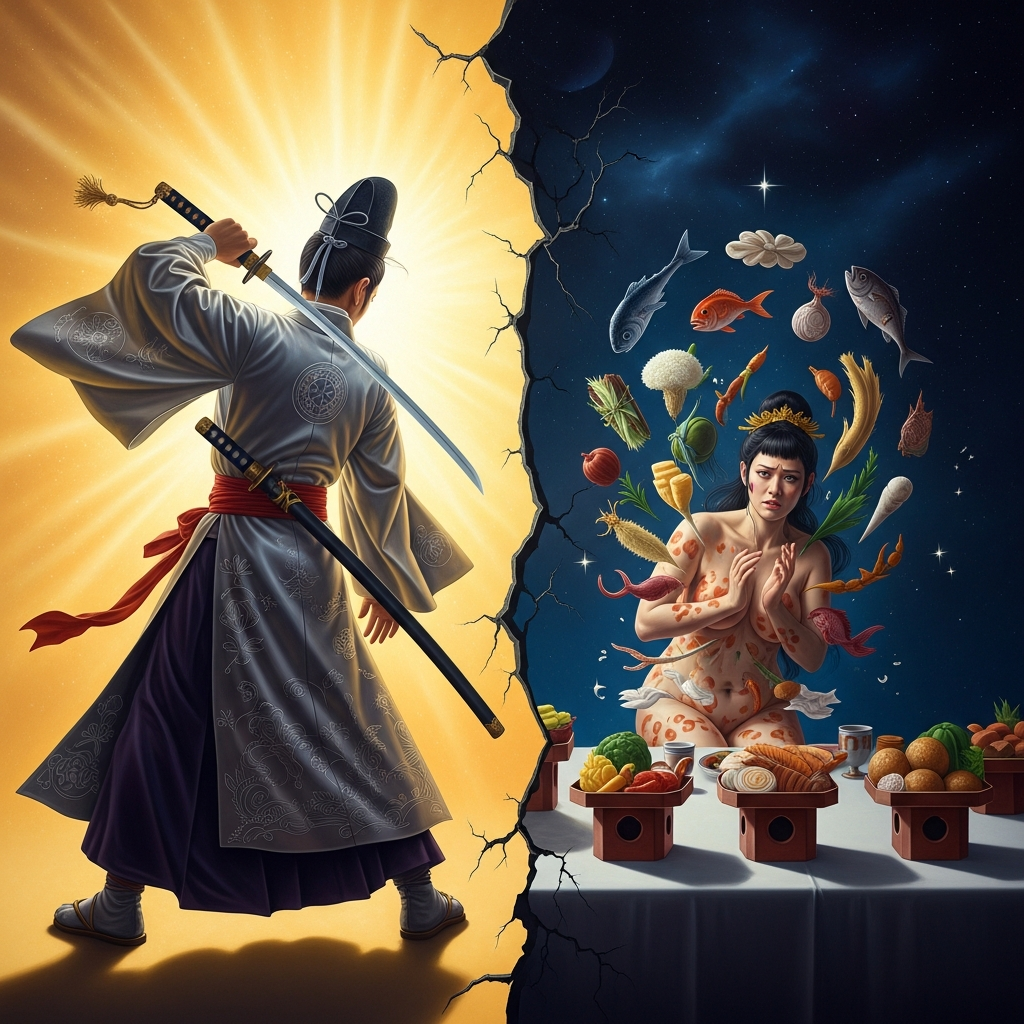
The moon-god Tsukuyomi is sent by his sister Amaterasu to visit the food goddess Uke Mochi. She honors him with a feast — pulling rice from her mouth, fish from the ocean of her ear, game from the forest of her hair. Tsukuyomi is disgusted that she serves him food from her body. He draws his sword and kills her. When Amaterasu hears what he has done, she will never look at him again — and that is why the sun and moon are never in the sky together.
- When
- c. 720 CE (recorded in Nihon Shoki; mythic time)
- Where
- The high heavens of Shinto cosmology, where Amaterasu rules; the lower realm of Uke Mochi's hall; the sky thereafter, where sun and moon move on opposite schedules
In the beginning of the Japanese cosmos, after the islands themselves had been formed by the primordial couple Izanagi and Izanami and after Izanagi had returned from the underworld and washed himself in a river to purify himself of his wife’s death, three children were born from the washing.
From his left eye was born Amaterasu, the sun goddess. She was the most important. She was given dominion over the high heavenly plain.
From his right eye was born Tsukuyomi, the moon-god. He was given dominion over the night.
From his nose was born Susanoo, the storm-god — but Susanoo’s troubles, his terrorizing of his sister Amaterasu, the famous incident of Amaterasu hiding in the cave and refusing to come out, are stories for another telling.
This is the story of Tsukuyomi.
He is, as Shinto deities go, an underdeveloped figure. Of the three primary children of Izanagi, he gets the least narrative attention. The Kojiki (712 CE) and the Nihon Shoki (720 CE) — Japan’s two oldest written texts, both compiled at the imperial court to record the divine ancestry of the imperial line — both note his existence and his rule of the night, but neither gives him much of a personality. He is the moon. He is generally calm. He has a small number of stories.
Of those few stories, the most consequential is this one.
—
Amaterasu, ruling the high heavens, learned of the existence of a goddess in the lower world named Uke Mochi.
Uke Mochi was the goddess of food. She lived in a great hall in a fertile region, and she was, by reputation, the most generous host in the cosmos. She fed her visitors lavishly. Travelers spoke of her hospitality. Amaterasu, hearing the reports, grew curious.
She decided to send a representative.
Some texts have her send Susanoo; the Kojiki version of this myth is told with Susanoo as the visitor and the food goddess called Ogetsu-hime. The Nihon Shoki version, the one I am following here, has Amaterasu send Tsukuyomi to visit Uke Mochi. The two versions are clearly variants of the same underlying story; the variation tells you something about how unstable the early Japanese narrative tradition was as it crystallized in writing.
Amaterasu instructed Tsukuyomi: Go down to Uke Mochi. Be my eyes. Visit her hall. Receive her hospitality. Report back to me what you find.
Tsukuyomi accepted the mission.
He descended.
He arrived at Uke Mochi’s hall — a long building of cypress wood, set on stilts, surrounded by rice paddies on one side, by a thick forest on another, and by the open sea on a third. Lanterns were lit. The shoji screens were open to the warm evening air. Uke Mochi herself, when she came to the door, was a goddess of remarkable presence: round-faced, smiling, in the long sleeves and embroidered hems of a celestial woman of high rank.
She bowed to Tsukuyomi. She invited him in.
She prepared, the texts say, a feast worthy of the moon-god of the high heavens.
—
The feast was where things went wrong.
Uke Mochi did not have her food prepared in advance. She did not have servants going to and fro from kitchens. She did not have storerooms full of pickled vegetables and salted fish. She had something else.
She turned, at the open shoji facing the rice paddies, and from her own mouth she pulled out cooked rice. She pulled it out in handfuls, soft and steaming, and arranged it in lacquered bowls on the table.
She turned, at the shoji facing the sea, and from her own ear she pulled out fish — silver fish, freshly caught, gleaming. She arranged them on platters.
She turned, at the shoji facing the forest, and from her own hair she pulled out game — small pieces of cooked venison, of wild boar, of pheasant — and arranged them on a third platter.
This was, the texts emphasize, how she fed her guests. Her body was, in some sense, the source of all food. She was not merely a goddess of food in the way that some deities are in charge of their domain — she was food, structurally, and her hospitality was the offering of her own substance.
She set the bowls before Tsukuyomi. She invited him to eat.
—
Tsukuyomi did not eat.
He sat at the table. He looked at the food. He looked at Uke Mochi, who was smiling, who was waiting, who was — by her own lights — being maximally generous to an honored guest.
The texts describe Tsukuyomi’s reaction with an emotional precision unusual for the Nihon Shoki. He was, the chronicle says, filled with anger. Specifically, he was disgusted. He felt that food which had emerged from a goddess’s body was contaminated — that to be served rice from someone’s mouth, fish from someone’s ear, game from someone’s hair was a violation of the dignity of the celestial guest. He read, in Uke Mochi’s offering, an implicit insult: you are being given garbage from my person.
This was, the texts make clear, a misreading. Uke Mochi was not insulting him. She was honoring him. She was offering him the most intimate possible hospitality — the food of her own body — and she was doing so freely, as the food goddess does for all her guests. There was no insult in her gesture. There was, in fact, the opposite: the deepest possible welcome.
But Tsukuyomi did not see it that way.
He stood up. He drew his sword.
Uke Mochi looked at him in surprise.
He cut her down.
—
He killed her where she stood. The texts give the action briefly — a single stroke. She fell across her own table, scattering the bowls of rice she had drawn from her mouth.
Tsukuyomi cleaned his sword. He left her hall. He flew back up to the high heavens to report to his sister.
He found Amaterasu in her chamber. He told her what had happened. He told her, with the somewhat self-righteous tone of someone who believes he has just done a difficult but necessary thing, that he had visited Uke Mochi as instructed; that he had been insulted by her offering of food from her own body; and that he had killed her in response.
He waited for his sister’s approval.
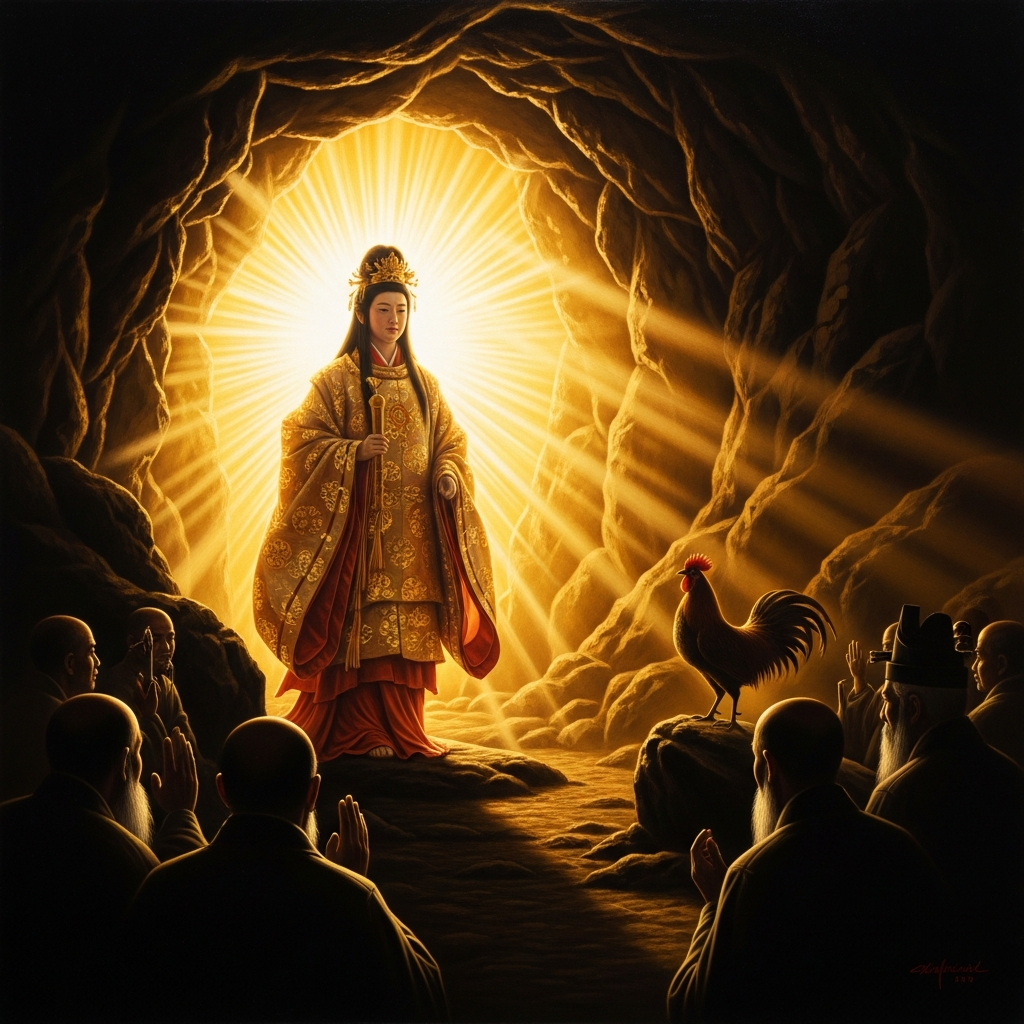
Amaterasu went still.
She looked at her brother for a long time. Then she said — and the Nihon Shoki records this — You are an evil god. You have killed the goddess of food. I will never look at you again.
She turned her face away from him. She walked out of the chamber. From that day forward — and this is one of the most quietly powerful aetiologies in any mythology — Amaterasu has refused to share the sky with her brother. She rises by day. He rises by night. They are never in the heavens at the same time. The brief overlaps of dawn and dusk are the unwilling moments when one is rising as the other is setting; even then, they do not face each other.
This is why the sun and the moon are not visible in the sky together.
In the older Japanese cosmology, before the introduction of more detailed astronomy from China, the absolute opposition of solar and lunar timing was understood through this story. Amaterasu had decided. She would not look at her brother. The cosmos would arrange itself around her decision.
—
Meanwhile, Uke Mochi’s body had begun to do something strange.
Down in her hall, where she lay across her own table, the corpse of the food goddess was undergoing a transformation that the texts describe with an almost botanical precision.
From her belly, rice began to grow — long green stalks pushing up through the wood of the table, ripening as they grew, producing heavy heads of grain. The first rice plants in the world.
From her genitals, beans and wheat began to grow — the staple legumes and grains, the rotation crops that the rice farmer would plant alongside his rice paddies for nitrogen and seasonality. The first beans. The first wheat.
From her eyebrows, silkworms emerged — small white silkworms that began, immediately, to spin their cocoons. The first silk-producing insects, the foundation of one of Japan’s most enduring crafts.
From her eyes, millet emerged — another grain crop, the staple of the dry uplands where rice would not grow.
From her ears, more rice — different varieties of rice from the ones that had emerged from her belly. Japan’s rice diversity, the texts say, comes from the multiple sites of her body that produced grain.
From her nose, red beans — the azuki that would become so central to Japanese cuisine.
From her head, oxen and horses — the draft animals that would later be used for plowing the rice fields and hauling produce. Some texts add cattle, water buffalo, and other large livestock.
The body of the food goddess, in dying, became the source of all Japanese agriculture. Every staple crop — rice, wheat, beans, millet, azuki — every textile fiber — silk — every draft animal that the Japanese farmer would ever need was already present in her body. The killing of Uke Mochi released them into the world.
—
The high gods learned of what had happened.
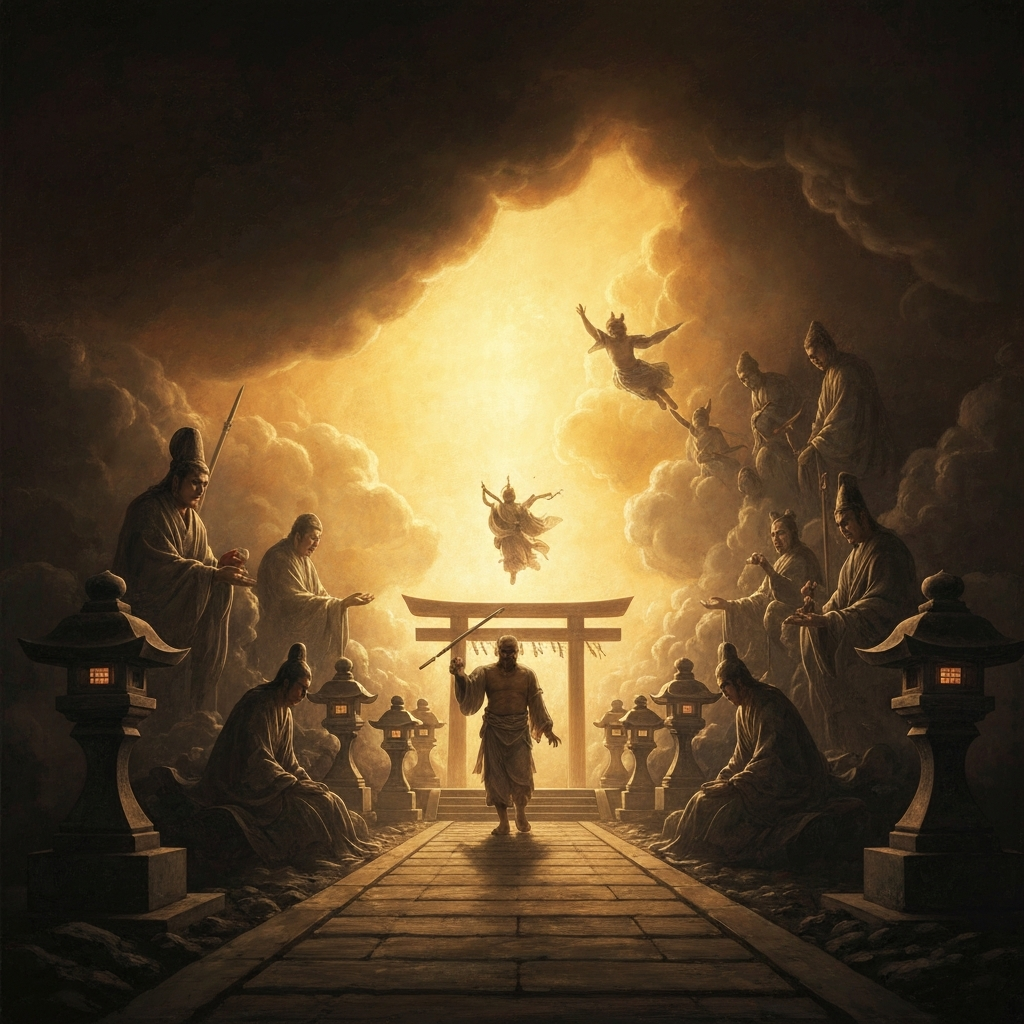
The Kami-Musubi, one of the great primordial deities of the Shinto pantheon, descended to Uke Mochi’s hall. He saw the dead goddess. He saw the crops growing from her body. He understood, immediately, what was on offer. He gathered the seeds — the rice, the wheat, the beans, the millet, the silkworm eggs — and brought them up to Amaterasu.
Amaterasu received the seeds. She gave them to her grandson, Ninigi, who would in time descend to earth and become the founder of the Japanese imperial line. She told him: Take these to the islands below. Plant them. Feed the people of Japan with them. They are the gift, however unwillingly given, of a goddess who was killed for her hospitality.
Ninigi descended to Mount Takachiho in southern Kyushu. He carried with him the rice. The first rice paddies of Japan were planted from the seeds that had grown in Uke Mochi’s belly. The first farmers were taught by Ninigi’s followers. Japanese agriculture began.
This is, in the imperial mythology, the foundational moment of Japanese civilization. The rice that feeds the country, the silk that clothes the court, the cattle that work the fields — all of it traces back, by direct genealogy, to the body of the murdered food goddess.
—
The Shinto tradition has held this story without trying to soften it.
Tsukuyomi remains, in the cosmology, the murderer of Uke Mochi. He is not redeemed. The few shrines that are dedicated to him — there are some, particularly in the older imperial centers — present him as a calm and somewhat melancholy figure, but they do not pretend he did not commit the crime. The crime is structural to the cosmos: it is why the sun and moon do not share the sky, why the imperial line has rice to plant, why the food chain begins with a killing.
The deeper teaching of the myth, the older Shinto priests say, is that food is never given for free. The lavish spread on the table — even when it is generously offered — has always come from the death of something. The rice in the bowl was once a green plant that was cut. The fish on the platter was once swimming. The vegetables were once growing. The animal was once breathing. To eat is, in the Shinto reading, always to participate in a small chain of killing.
The myth makes this explicit at the cosmic level. Even the highest food, even the food given by a goddess from her own body, requires her death to be released into the world. There is no agriculture without sacrifice somewhere in the lineage. The Japanese custom of saying itadakimasu before a meal — I humbly receive — is, in the older readings, a small gesture toward this: a recognition that the food has been given by something that paid for it.
Tsukuyomi did not understand the gift. He drew his sword. The world has been eating Uke Mochi’s body ever since, and the moon, in the night sky, is permanently averted from his sister’s gaze. The cost of the rice in the bowl is, in the depths of Shinto memory, exactly that high.
Scenes
In a great hall lit by paper lanterns, the food goddess Uke Mochi turns toward the sea outside her open shoji and pulls fish from her ear; toward the mountains and pulls game from her hair; toward the rice fields and pulls rice from her mouth
Tsukuyomi stands frozen at the table, the food laid out before him in lacquered bowls
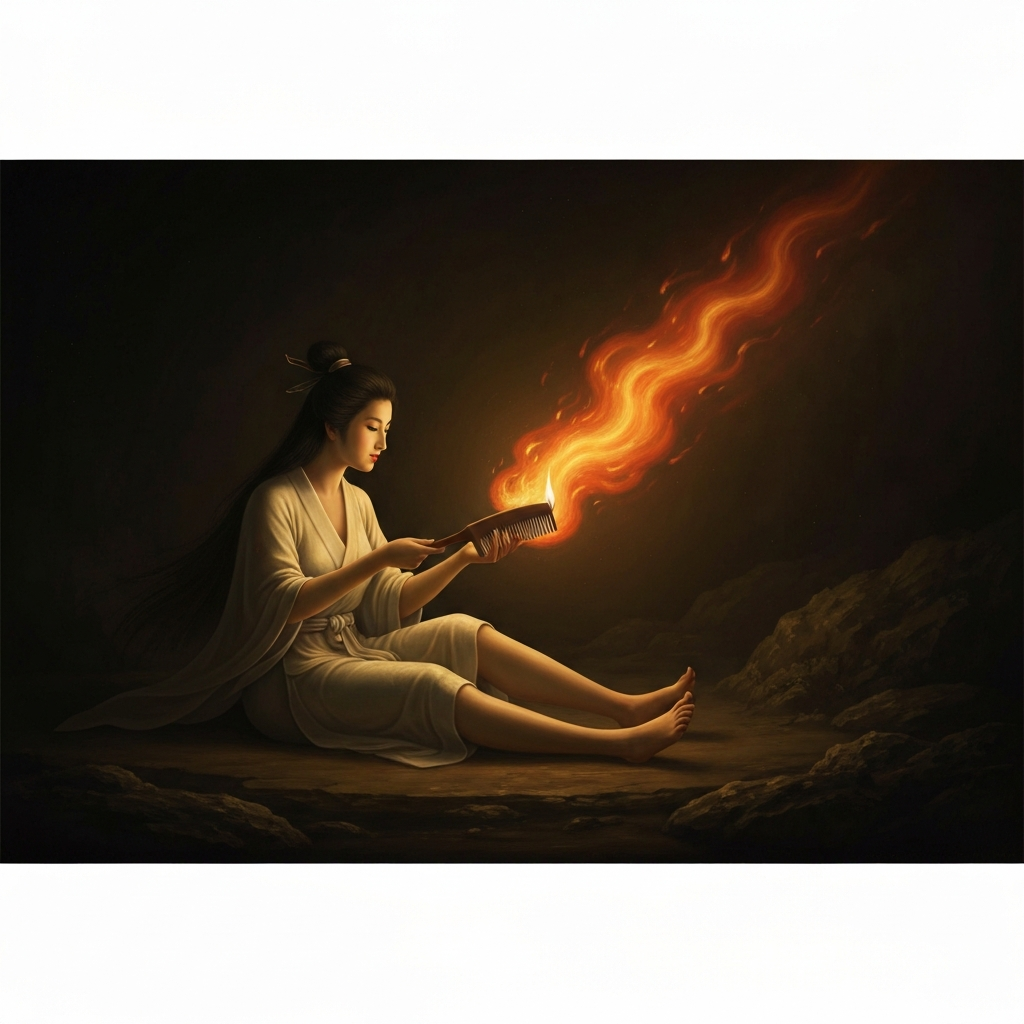
On her hill, the dying body of Uke Mochi has begun to transform
Echoes Across Traditions
Entities


Sources
- *Nihon Shoki* (720 CE)
- *Kojiki* (712 CE) — parallel story with Susanoo and Ogetsu-hime
- Donald Philippi (trans.), *Kojiki* (1968)
- W. G. Aston (trans.), *Nihongi: Chronicles of Japan* (1896)
- Michael Ashkenazi, *Handbook of Japanese Mythology* (2003)