Garuda's Impossible Task
Mahabharata, Adi Parva; Javanese Kakawin tradition · The sea; Indra's heaven; the realm of the Nagas
Contents
Garuda the eagle-god must steal the amrita (nectar of immortality) from Indra's heaven to free his mother Vinata from slavery — a mission that earns him divine status and the hatred of every serpent on earth.
- When
- Mahabharata, Adi Parva; Javanese Kakawin tradition
- Where
- The sea; Indra's heaven; the realm of the Nagas
It begins with a bet about the color of horses.
Two sisters — Kadru, mother of the Nagas, and Vinata, mother of birds — are watching Ucchaishravas, the divine horse that rose from the churning of the cosmic ocean, gallop across the sky. Kadru says the horse’s tail is black. Vinata says white. They wager their freedom: whoever is wrong becomes the other’s slave.
Ucchaishravas’ tail is white. Kadru knows it is white. So she calls her thousand serpent sons to her and tells them to transform themselves into black hairs and cling to the horse’s tail. The serpents are horrified — this is deception, this is adharma — but they obey. Vinata loses. She becomes her sister’s slave.
She serves Kadru for years.
Her son Garuda is not yet born when this happens. He hatches later, from the egg that Vinata had set aside with such hope — he bursts from the shell in a blaze of golden light so brilliant that the gods mistake him for Agni and prostrate themselves. He is the king of birds, the vehicle of Vishnu, the great eagle. He is born free. And then he finds his mother in the house of his aunt, carrying Kadru’s water and fanning Kadru’s face, and he understands what he was born into.
He asks the Nagas: what ransom will buy my mother’s freedom?
They say: bring us the amrita.
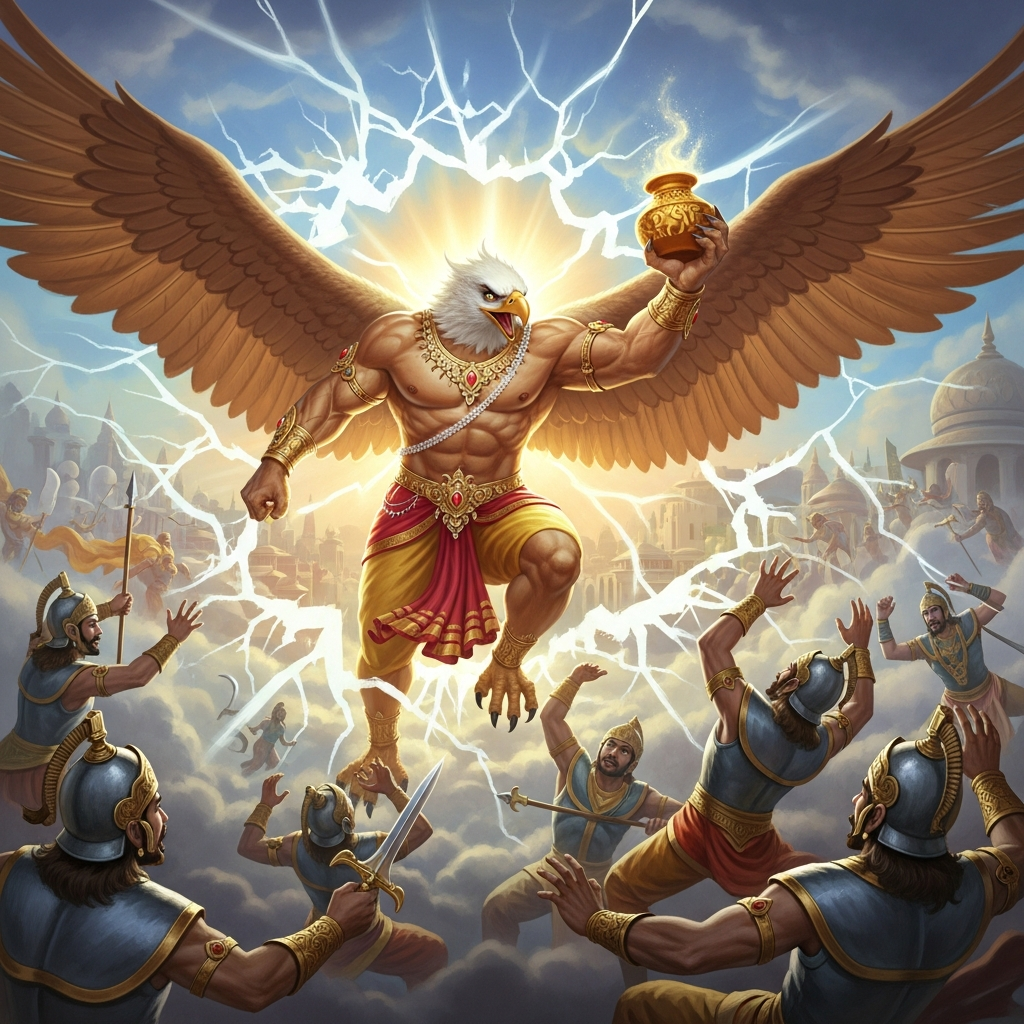
The amrita is the nectar of immortality. It lives in Indra’s heaven, guarded by a spinning wheel of razor-bladed fire, flanked by two venomous serpents, protected by an army of devas. It has never been taken. It is not intended to be taken. The gods would sooner dismantle the cosmos than allow the amrita to fall into the wrong hands — because whoever drinks it becomes immortal, and immortality in the wrong hands is the end of the world’s order.
Garuda goes anyway.
He stops first at the ocean, drinks it dry, quenches the fire with the water he holds. He closes his eyes against the razor wheel and spins through it, contracting his vast body to the smallest size possible, feeling the blades on his feathers but not cutting deep. He faces the two guardian serpents. His eyes — the Mahabharata is precise about this — shine like fire themselves, and he blinds the serpents with his gaze, and kills them. He takes the vessel of amrita.
He is leaving heaven with the nectar when Vishnu appears.
The encounter is strange and brief and decisive. Vishnu does not try to stop him. He looks at Garuda and sees something — some quality of purpose, some absence of selfishness in the theft, some action performed entirely on behalf of another — and he is moved by it. He offers Garuda a boon.
Garuda says: I want to be immortal without drinking the amrita.
Vishnu gives it. Then he asks for a boon in return: that Garuda become his vehicle, carry him on his back through all the ages of the world. Garuda agrees. From that moment forward he is the vahana of Vishnu — the golden eagle who carries the preserver of the universe on his wings, whose image decorates every Vishnu temple, whose spread-winged silhouette became the symbol of a nation.
Then Indra appears.
Indra is angry — this is Indra’s characteristic state when something is taken from him — and he strikes Garuda with his thunderbolt. It does him no injury. Garuda sheds one feather in polite acknowledgment of the blow, and the feather is so beautiful that Indra is briefly stunned. He asks the eagle’s name.
When Garuda tells him, Indra makes a proposal of his own: let the Nagas not drink the nectar. Let Garuda set it on the ground for them but let Indra take it back before they can drink. Garuda has never intended the serpents to become immortal — he is buying his mother’s freedom, not giving away eternal life — and so he agrees. He has kept his word. He will deliver the amrita to the Nagas.
He finds the Nagas waiting.
He sets the amrita on the sacred kusha grass and tells them: go purify yourselves first, bathe and prepare yourselves properly for such a gift. The serpents go. Indra comes and takes the amrita back to heaven. When the Nagas return, there is only the kusha grass. They lick it desperately — the sacred grass is sharp and cuts their tongues, and this is why, the myth tells us, snakes have forked tongues.
Vinata is free.
But Garuda remembers who made his mother a slave, and the Nagas remember who tricked them, and from that day forward the great eagle and the serpents are eternal enemies — the eagle circling the sky, the serpents waiting in the grass, neither one forgetting.
In Java, this story was elaborated in the Kakawin tradition — the court poetry in Old Javanese that adapted Sanskrit epics into a distinctly Southeast Asian idiom. The Javanese Garuda is an even more complex figure: champion of dharma, devoted son, divine mount, cosmic adversary of the Nagas who are also the foundation spirits of the earth. The wayang kulit shadow puppet theater of Java still performs the Garuda story. His puppet-figure has golden wings that fill the screen when he flies.
On the presidential seal of Indonesia, Garuda’s wings spread across the nation’s coat of arms. He is holding a shield with the five principles of Pancasila in his talons. His chest has seventeen feathers, his wings forty-five, his tail eight — the date of independence, August 17, 1945, encoded in the eagle’s body.
The impossible task completed, the mother freed, the nectar delivered and taken back, the enemy made and kept forever: all of it is there in those extended wings, if you know the story.
Echoes Across Traditions
Entities


Sources
- *Mahabharata*, Adi Parva, sections 14–30 (Astika Parva)
- J.A.B. van Buitenen, trans., *The Mahabharata*, Volume 1 (1973)
- Suniti Kumar Chatterji, *The Ramayana and the Mahabharata* (1951)
- Adrian Snodgrass, *The Symbolism of the Stupa* (1985) — on Garuda in Southeast Asian temple architecture
- Soewito Santoso, *Sutasoma: A Study in Javanese Wajrayana* (1975)