Genghis Khan and the Eternal Blue Sky
Genghis Khan, 1162–1227 CE; Mongol conquest 1206–1294 CE · The Mongolian steppe; the sacred mountain Burkhan Khaldun; the sky
Contents
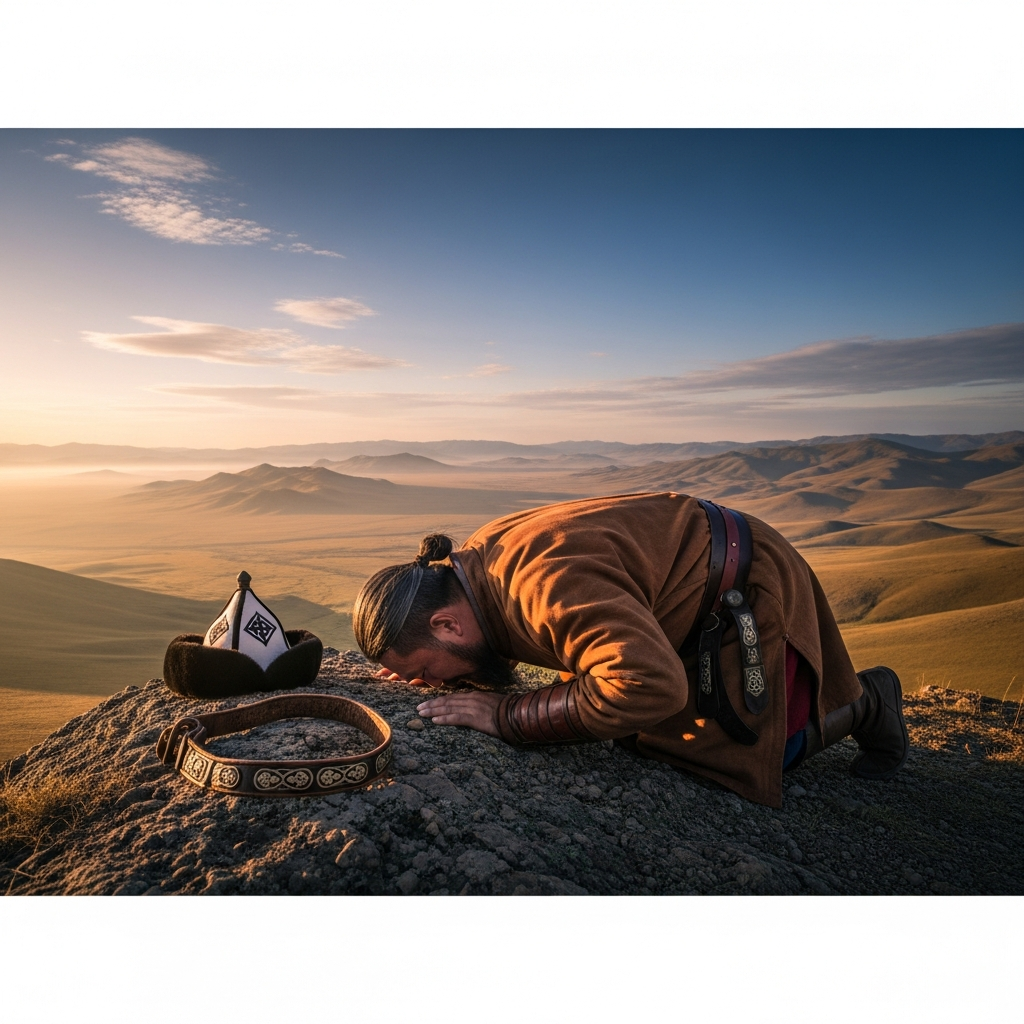
Before every campaign, Genghis Khan climbed a mountain alone, removed his hat and belt (marks of authority), bowed to the sun, and prayed to Eternal Blue Sky (Möngke Tengri) for three days. He believed he was mandated by Heaven — not as a god himself, but as Heaven's instrument. His generals were ordered to allow freedom of religious practice because all prayers, he said, went to the same sky. The largest land empire in history was built on this theological principle.
- When
- Genghis Khan, 1162–1227 CE; Mongol conquest 1206–1294 CE
- Where
- The Mongolian steppe; the sacred mountain Burkhan Khaldun; the sky
He climbed the mountain barefoot.
Not always Burkhan Khaldun — the sacred mountain of his birth-region in northeastern Mongolia — but always a mountain, always alone, always without his hat and belt, the two objects that marked his authority over everyone beneath the sky. To remove them was to make himself temporarily nothing: not the Khan, not the unifier of the tribes, not the instrument of conquest, but a single man on a hillside with his face turned upward.
He would stay three days, sometimes. The Secret History of the Mongols, the document his heirs compiled shortly after his death, records this as a practice he maintained throughout his campaigns — before major engagements, before decisions that would reshape the known world, before the moves that his generals could not understand until they were already made.
He prayed to Möngke Tengri.
The Eternal Blue Sky.
Tengri was not a god in the Greek or Abrahamic sense — not an anthropomorphic figure with a biography and a personality and specific preferences about sacrifice. Tengri was the sky itself, understood as sentient, as ultimate, as the ground of all authority. The blue of the Mongolian sky — which on the steppe is an absolute blue, unobstructed by trees or mountains for hundreds of miles — was not a symbol of Tengri. It was Tengri. You could look up and see the deity directly, any day that was not overcast.
This gave the Tengrist cosmos a quality that the priest-mediated traditions did not have: directness. There was no temple. There was no liturgy that required special training. There was the sky and you were beneath it. Prayer was not an institution; it was a posture. You looked up.
Genghis Khan’s mountain retreats formalized this directness into something that looked, from the outside, like ritual. But the form of the ritual was radical simplicity: remove the marks of human authority, acknowledge the smallness of the self, speak to the sky.
The shamans were his counselors but not his priests.
The böö and the udgan — the male and female shamans of the Mongolian tradition — served as intermediaries with the spirit world, healers, diviners, and keepers of the ritual calendar. Genghis Khan consulted them, respected them, and did not allow them to replace his personal relationship with Tengri.
This created a theological tension that the Secret History records honestly: the shaman Teb Tengri, who claimed to speak for the sky directly and whose influence over the tribal confederation Genghis Khan had built became politically threatening, was eventually killed — allegedly at Genghis Khan’s orchestration. The incident is ambiguous. What it shows clearly is that the Khan considered his covenant with Tengri to be his own and not transferable to any intermediary, no matter how powerful.
The sky spoke to Genghis Khan. He heard it. He acted on it. The shamans could advise about the spirit world, but the sky was his interlocutor.
His generals were ordered, when they conquered cities, to find the religious scholars and exempt them from taxation and conscription.
This is documented across sources that have no reason to coordinate their testimony: Chinese chronicles, Persian accounts, the records of Friar William of Rubruck who visited the Mongol court in 1253 and reported in astonishment that the tent of the Great Khan contained a Buddhist monk, a Muslim mullah, a Nestorian Christian bishop, and a Taoist priest simultaneously, each of them believing they had the Khan’s particular favor, none of them wrong.
The reasoning Genghis Khan is reported to have given was consistent across accounts: all prayers go to the same sky. The sky does not care which language the prayer is in. The sky is the sky. What matters is the sincerity of the turning upward.
This was not a sophisticated interfaith dialogue. It was a straightforward extension of Tengrist theology: if the sky is the ultimate authority and the sky covers everyone, then everyone who speaks to the sky sincerely is doing the right thing. The specific traditions — the liturgies, the dietary laws, the calendar of observances — were human elaborations on a single fundamental act. Exempt the people who maintain those elaborations; you are not exempting them from the sky.
The political genius of this position is obvious in retrospect. An empire that conquered Persians, Chinese, Russians, Hungarians, Tibetans, and a dozen other peoples with deeply incompatible religious identities could only be administered if the administration did not require religious conversion. Forced conversion breeds resentment and underground practice. Benign indifference to religious specifics breeds, at minimum, compliance, and sometimes genuine loyalty.
But Genghis Khan’s position was not primarily strategic. The Secret History records his personal devotion to Tengri as the formative experience of his life — older than his military genius, older than his political vision, rooted in the years of childhood hardship on the steppe when the sky was genuinely the only constant.
He was born into poverty and exile. His father was poisoned when he was nine. He was enslaved as an adolescent. The sky was there for all of it — the only uncorrupted absolute in a world that had otherwise taught him that everything could be taken from you.
When he said that all prayers went to the same sky, he was not making a political calculation. He was reporting his experience.
He climbed the mountain barefoot because Tengri would know he was coming anyway, and the barefoot climb was the acknowledgment: I know that you know. I am not hiding my humanity from you. I come as what I am.
The hat and the belt — the marks of authority — stayed at the bottom of the hill because he wanted to be clear about what the authority was worth in the presence of the sky that granted it. It was worth exactly as much as the sky allowed it to be worth. No more. When the sky withdrew the mandate — as it would, eventually, from every dynasty that had ever claimed it — the authority would be gone.
He understood this. He prayed with this understanding.
He bowed to the sun.
He stayed three days.
He descended and gave the orders that his generals could not yet understand, and the orders were right, and the sky was above the whole campaign, blue and absolute and watching the way it always had been, the same sky over the Mongolian steppe as over Samarkand and Beijing and the Danube, all the way to the edge of the world.
Echoes Across Traditions
Entities
- Genghis Khan (Temüjin)
- Möngke Tengri (Eternal Blue Sky)
- the shamans
- the generals
Sources
- *The Secret History of the Mongols* (*Mongγol-un niγuca tobciyan*, c. 1227, trans. Igor de Rachewiltz, Brill, 2004)
- Christopher P. Atwood, *Encyclopedia of Mongolia and the Mongol Empire* (Facts on File, 2004)
- Jack Weatherford, *Genghis Khan and the Making of the Modern World* (Crown, 2004)
- Paul Kahn (trans.), *The Secret History of the Mongols* (North Point Press, 1984)
- Johan Elverskog, *Buddhism and Islam on the Silk Road* (University of Pennsylvania Press, 2010)
- Reuven Amitai and Michal Biran (eds.), *Mongols, Turks, and Others* (Brill, 2005)


