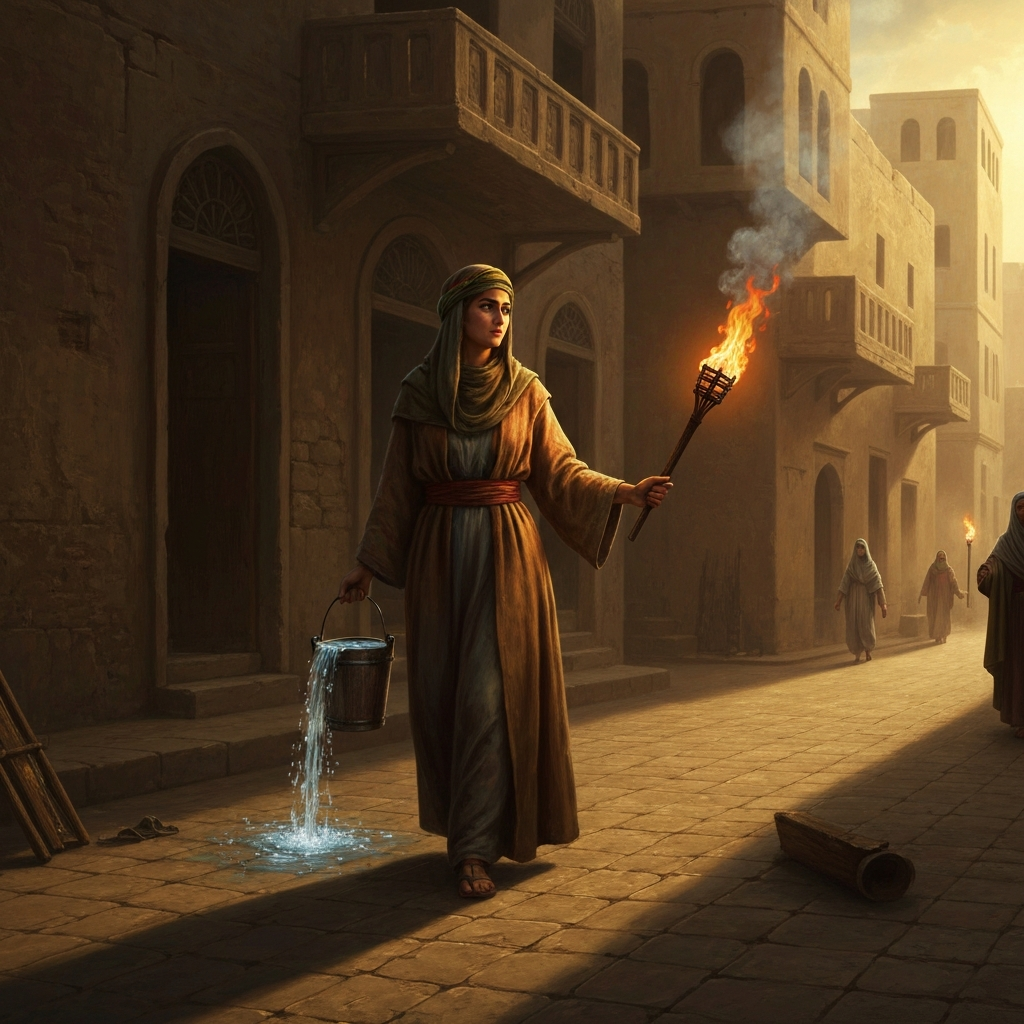
Ibn al-Fāriḍ's Great Ode to the Wine of Love
c. 1210–1235 CE — Cairo, Egypt, under Ayyubid rule · Cairo, Egypt — particularly the area near the Muqattam hills where Ibn al-Fāriḍ spent time in contemplative retreat
Contents
The Egyptian mystic Ibn al-Fāriḍ writes the Khamriyya — the Wine Ode — in which the wine was pressed before the grape existed, before Adam was created from clay, and the one who drinks it becomes the universe itself.
- When
- c. 1210–1235 CE — Cairo, Egypt, under Ayyubid rule
- Where
- Cairo, Egypt — particularly the area near the Muqattam hills where Ibn al-Fāriḍ spent time in contemplative retreat
In remembrance of the Beloved, we drank a wine — we were drunk before the vine was created.
The poem opens before time. Not before this particular cup of wine was poured, but before grapes existed. Before the vine existed. Before the earth in which the vine grows existed. Before the Adam who would press the grape existed. Ibn al-Fāriḍ is claiming that the intoxication he is describing is the intoxication from which creation flows — not a product of the world, but the precondition of the world’s emergence.
This is the Khamriyya, written in Cairo in the early thirteenth century by the man his tradition would call Sultan al-Ashiqin, the Sultan of Lovers. He is Egyptian by birth, the son of a legal functionary in Cairo, and he has been making pilgrimages to the solitude of the Muqattam hills since young adulthood, sitting in caves for months. The poems that came out of the caves entered the Arabic poetic tradition as nothing before them had.
The central lines are dense with paradox.
The moon gives light to it — but the moon is itself the wine’s light. Stars are kindled from it. The cup that holds it — if you breath on it, the whole world smells of it. If you touch it, hands reach for months toward what they felt. The one who drinks it sober has no mind left. The one who drinks it drunk is made sane by it.
Ibn al-Fāriḍ is describing the experience that Sufi practitioners call sukr — intoxication — which is a technical term for the state of divine absorption in which ordinary rational faculties are temporarily overwhelmed by the direct experience of divine presence. This is not metaphor in the sense of a false comparison. The wine is a true analogy: the state he is describing really does feel like intoxication, really does involve a loss of ordinary self-possession, really does transform the one who has it.
But the paradox of the poem is that this wine is not produced by anything in the created world. It is not the product of fermenting grapes. It is the wine that the divine love is, prior to creation, and creation is the world’s response to the invitation to drink it.
The poem’s central theological claim is the pre-existence of love.
Before the grape — love. Before the vine — love. Before the Adam of clay — love. The Quran says God breathed His spirit into Adam, and Adam became alive. Ibn al-Fāriḍ is asking: what is the spirit that was breathed? His answer: the wine. The divine love that animates creation is not something God decided to add after making the universe. It is what the universe is made of. The created world is the overflow of divine love looking for a vessel to hold itself.
This gives the Khamriyya its strange temporal quality. The poem keeps moving before the beginning: before the vine, before the grapes, before existence. And then it moves forward into the present of the reader, who reads the poem in Cairo or Damascus or Isfahan and discovers that they are drinking this same wine right now, that they have been drinking it since before they were born, that the thing they call their life is the wine’s ongoing effect on a vessel that didn’t know what it had been given.
Ibn al-Fāriḍ dies in Cairo in 1235 at around sixty years of age.
His tomb in Cairo becomes immediately a shrine. His students establish a presence there. The tomb is still visited. He is remembered as the greatest Arabic mystical poet — the peak of Arabic achievement in the form that the Persians would also perfect through Rumi and Hafez.
The poem that carries his name most completely — Khamriyya — is forty lines. Scholars have written thousands of pages of commentary on it. The commentary attempts to unfold the paradoxes, to explain what it means for wine to predate the grape, for intoxication to predate the drinker.
The poem resists explanation in the way that experience resists being described from outside.
Before the vine was created. Something was pressing the grapes that didn’t exist yet. Something was drunk before there was anyone to drink.
Ibn al-Fāriḍ knew what was happening in the cave on the Muqattam hills. He wrote it in the forty lines. The lines are still looking for someone to drink them.
Echoes Across Traditions
Entities
- Ibn al-Fāriḍ
- Adam
Sources
- Ibn al-Fāriḍ, *Diwan Ibn al-Farid*, ed. Nicholson (Cambridge, 1914)
- Th. Emil Homerin, *From Arab Poet to Muslim Saint: Ibn al-Farid, His Verse and His Shrine* (University of South Carolina Press, 1994)
- Th. Emil Homerin, trans., *The Wine of Love and Life: Ibn al-Farid's al-Khamriyya and al-Qa'iyya* (Chicago, 2005)
- Annemarie Schimmel, *As Through a Veil: Mystical Poetry in Islam* (Columbia, 1982)