Galahad: The Knight Who Was Not of This World
*Queste del Saint Graal*, c. 1215–1230 CE · Camelot, the road through the waste, the castle of Corbenic, the holy city of Sarras
Contents
Galahad is the only knight pure enough to achieve the Holy Grail — the son of Lancelot, conceived in a night of divine deception, raised without knowledge of his father. When he sits in the Siege Perilous — the seat that kills any unworthy knight — it holds him. He finds the Grail, is allowed to look within it, and immediately asks to die. He gets his wish.
- When
- *Queste del Saint Graal*, c. 1215–1230 CE
- Where
- Camelot, the road through the waste, the castle of Corbenic, the holy city of Sarras
There is a seat at the Round Table that no one sits in.
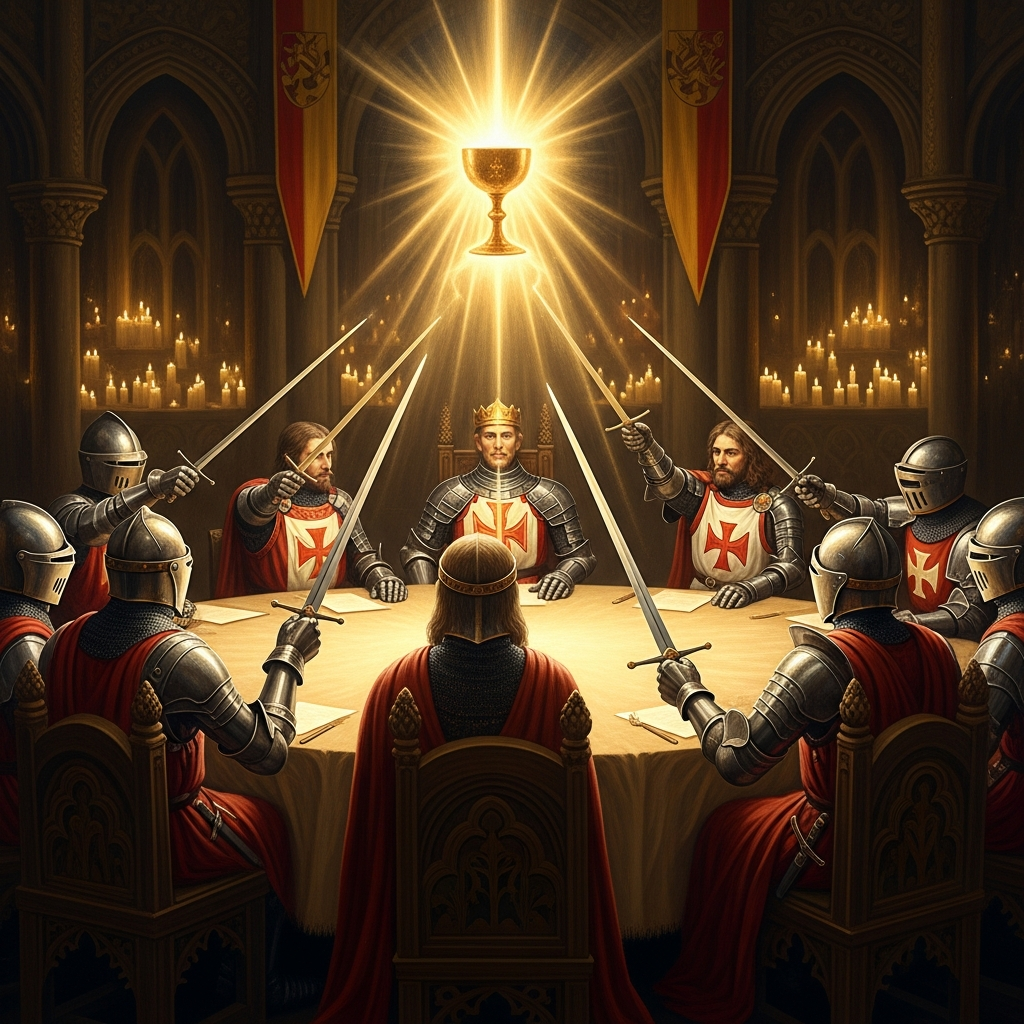
It has been empty since the Table was built. Merlin had it made with a particular vacancy in mind — the one seat that would hold the one knight for whom it was designed — and he named it the Siege Perilous, the Dangerous Seat, and he made the danger simple and absolute: any knight who sits in it before the right knight arrives will die. The seat has been empty for years. The knights of the Table have learned to walk past it without looking. Some of them pretend it is not there.
On the day Galahad comes to Camelot, the seat has writing on it.
The inscription reads: This is the seat of Galahad. The letters are freshly carved, as if carved that morning, though no one saw them cut. When the knights see them, they cover the seat with a cloth and stand well back, and they wait to see what will arrive to justify the name.
What arrives is a young man with no history.
He is brought by an old man in white — the sources are vague about who the old man is, though the Queste implies something angelic — and he is introduced without ceremony and seated, and the seat holds him. It does not crack. It does not ignite. It simply holds him, the way a seat holds anyone, and the ordinariness of the moment is somehow more striking than any miracle could be.
The knights stare at him.
They know who he must be — there has been a prophecy about this for years — but knowing does not prepare them for the fact of him. He is very young. He is very calm. He looks around the hall with an expression that is not pride and is not wonder and is not reverence: he looks at the Round Table the way someone looks at a place they have always known they would pass through.
Arthur, when he enters, puts his hands on the young man’s shoulders and says something the sources do not record. Then Arthur turns to his knights and says: Today the quest for the Holy Grail begins.
That night at dinner, the Grail passes through the hall in a blaze of light.
The next morning, every knight who can ride has ridden.
Lancelot does not know he has a son until Galahad is nearly grown.
The circumstance of Galahad’s conception is one of the myth’s deliberate cruelties. Pelles, the Fisher King, wants a child from the bloodline of Lancelot — the greatest knight — and the bloodline of the Grail keepers — his own line. He arranges it through Elaine, his daughter, through a night of deception in which Elaine is disguised as Guinevere, and Lancelot sleeps with her believing her to be the queen.
The child born from that night is Galahad.
The Queste does not dwell on the moral ugliness of this. It treats the deception as a necessary mechanism — the vessel that would hold the Grail required specific ingredients, and those ingredients required an arrangement that could not have been made honestly. This is theology by way of reproductive management, and the medieval authors were not unaware of how troubling it was. But the argument the Queste is making is that the divine economy operates on a longer horizon than human consent, that what was done in deception produced something that could not have been produced otherwise.
Lancelot, when he learns he has a son, grieves first — for the deception, for what it says about what he is — and then watches, as Galahad comes to Camelot, with an emotion that has no clean name. This is the knight he could not be. This is what his blood produces when it is removed from him and set apart from the love that defines and limits him. He does not resent his son. He loves him, in the particular way a father loves the person he might have been.
Galahad rides through the wasteland and performs the healings.
The narrative structure of the Queste is almost liturgical: knight arrives at location, knight encounters spiritual obstacle, knight passes through. Where other knights fail — fail because of pride, because of old sins, because of the ordinary residue of a warrior’s life — Galahad does not fail. He is not humble about his purity. He is not particularly humble about anything. He is simply adequate to each situation in the way that a key is adequate to a lock: not because it has strained to be the right shape, but because it was made to be exactly this shape.
He heals the Maimed King. He restores the wasteland. He arrives at Corbenic — the Grail castle — with Bors and Percival, and the ceremony that other knights have glimpsed through doorways they could not enter now opens for them fully.
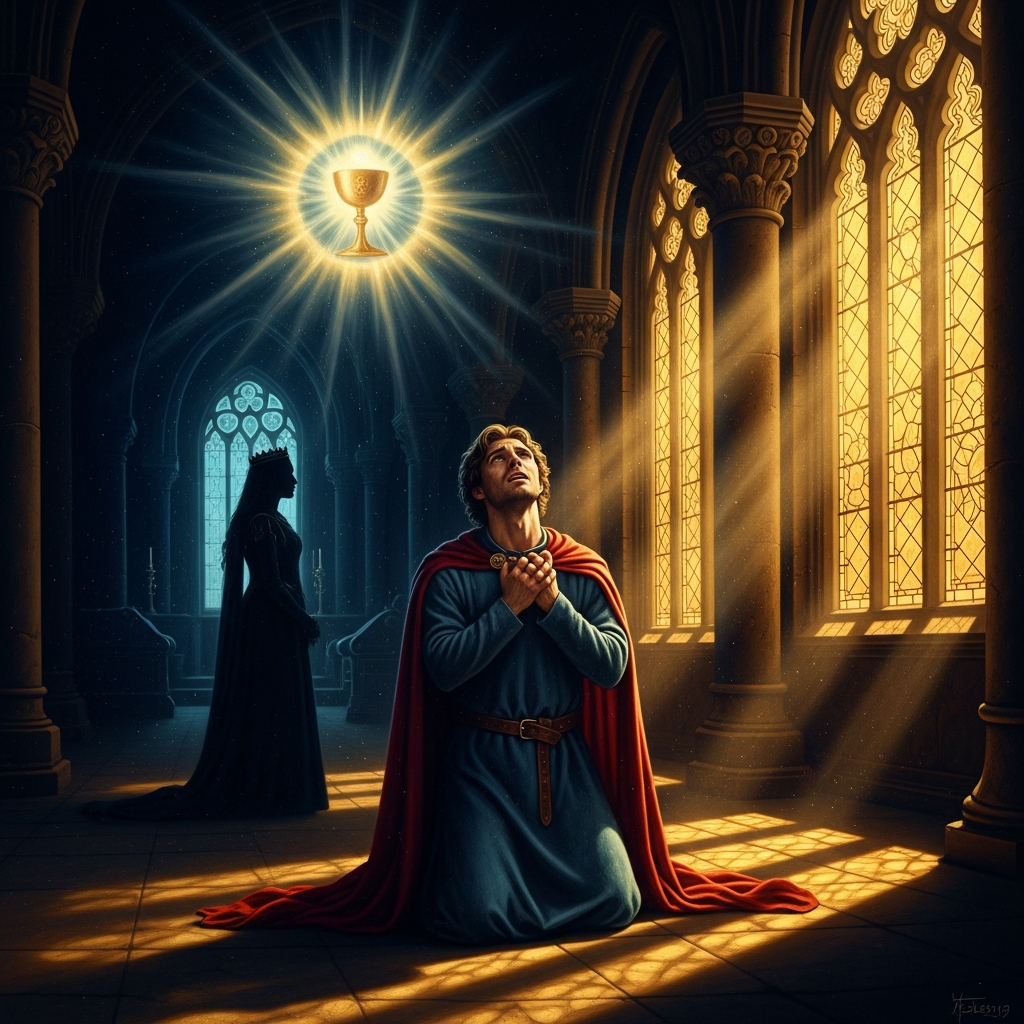
The Grail descends.
Galahad looks into it.
What he sees is not recorded. The Queste says only that he looks into the vessel and his face changes, and that he turns to those with him and says that he has seen what he came to see and that he has been granted a boon: to die at the moment of his own choosing.
He asks to die now.
The text does not treat this as despair. It treats it as the only reasonable conclusion to a life organized around a single object. Galahad has achieved the thing he was born to achieve. He has seen the inside of the thing that every knight in Britain has ridden toward. He has looked into the center of what the tradition calls grace, and having looked, he understands that there is nowhere else to go. This world is smaller than what he has just seen. He has no desire to ride back through it.
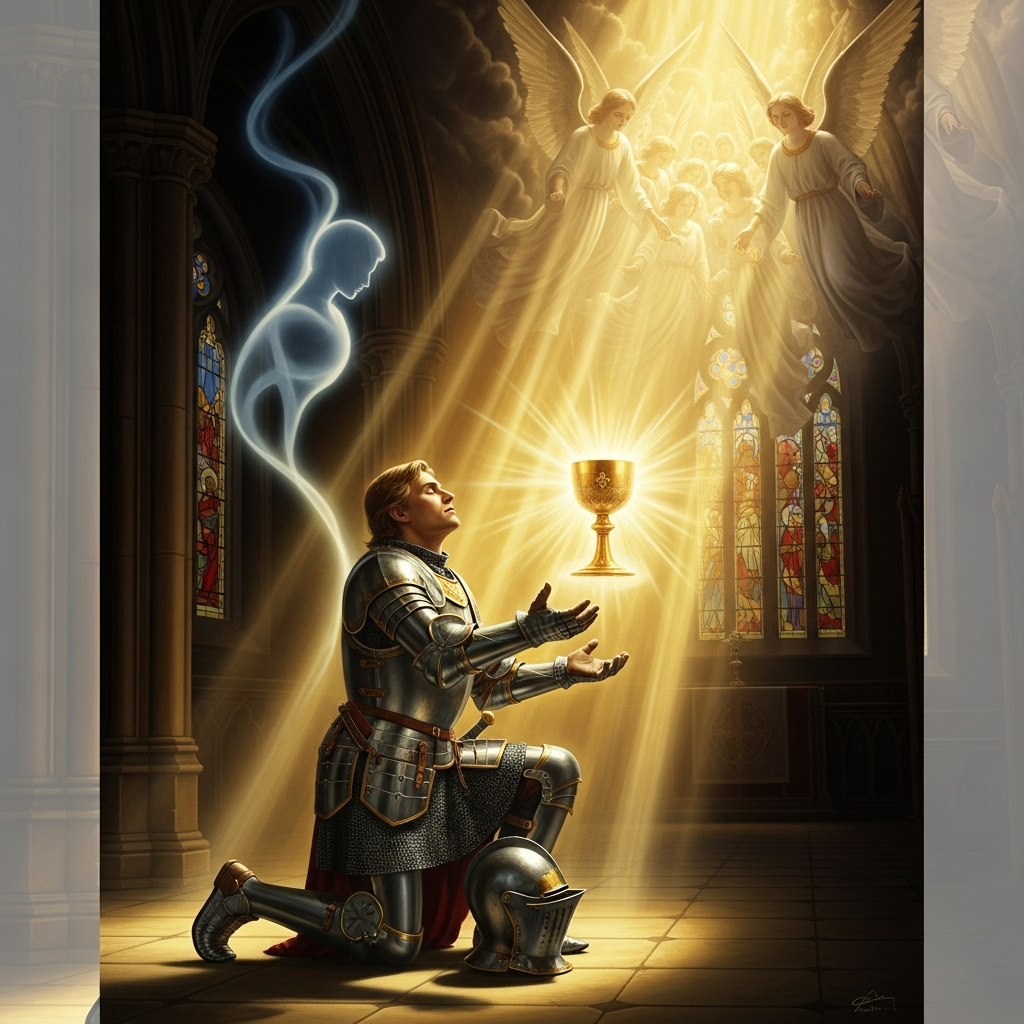
He prays. He receives the sacrament — administered, in a vision, by the figure who had been administering it since before the world — and then he dies kneeling.
His body is carried upward. Not buried. Carried.
Bors and Percival watch him go.
The Grail goes with him.
This is the detail the tradition insists on: after Galahad’s death, the Grail disappears from Britain. It has been achieved. Its period of availability is over. The kingdom that was organized partly around the quest for it will continue, but it will continue without the thing that gave the quest its meaning.
What is left, when Galahad rides away and the Grail follows him, is the Round Table as it was before the quest — but not as it was, because the quest has emptied it. The best knights are dead or scattered or changed in ways that cannot be reversed. Lancelot, when Bors brings him word, weeps — not only for his son but for the confirmation of what he has always known: that the door existed, that it was real, and that it was not for him.
He was the father of the one who walked through it.
That is something. In the tradition’s economy, that might be everything.
Echoes Across Traditions
Entities
- Galahad
- Lancelot
- the Holy Grail
- the Siege Perilous
- Bors
- Percival


Sources
- *La Queste del Saint Graal* (Vulgate Cycle), c. 1215–1230 CE
- Sir Thomas Malory, *Le Morte d'Arthur*, Books XIII–XVII, 1485 CE
- Pauline Matarasso, trans., *The Quest of the Holy Grail* (Penguin Classics, 1969)
- Richard Barber, *The Holy Grail: Imagination and Belief* (Harvard University Press, 2004)
- Roger Sherman Loomis, *The Grail: From Celtic Myth to Christian Symbol* (Columbia University Press, 1963)