Bedivere and the Sword He Could Not Throw
Malory, *Le Morte d'Arthur*, 1485 CE; developed from Welsh and French sources · The field of Camlann; the bank of the dark lake; the water's edge at the end of the world
Contents
Arthur, dying after Camlann, commands his last knight Bedivere to throw Excalibur into the lake. Bedivere walks to the water, raises the sword — and cannot. He hides it under a rock and returns. Arthur asks what he saw. 'Nothing but wind and water.' Arthur knows. He sends him back twice. Only on the third attempt does Bedivere throw the sword — and a hand rises from the water, catches it, and vanishes. Bedivere weeps. The barge comes.
- When
- Malory, *Le Morte d'Arthur*, 1485 CE; developed from Welsh and French sources
- Where
- The field of Camlann; the bank of the dark lake; the water's edge at the end of the world
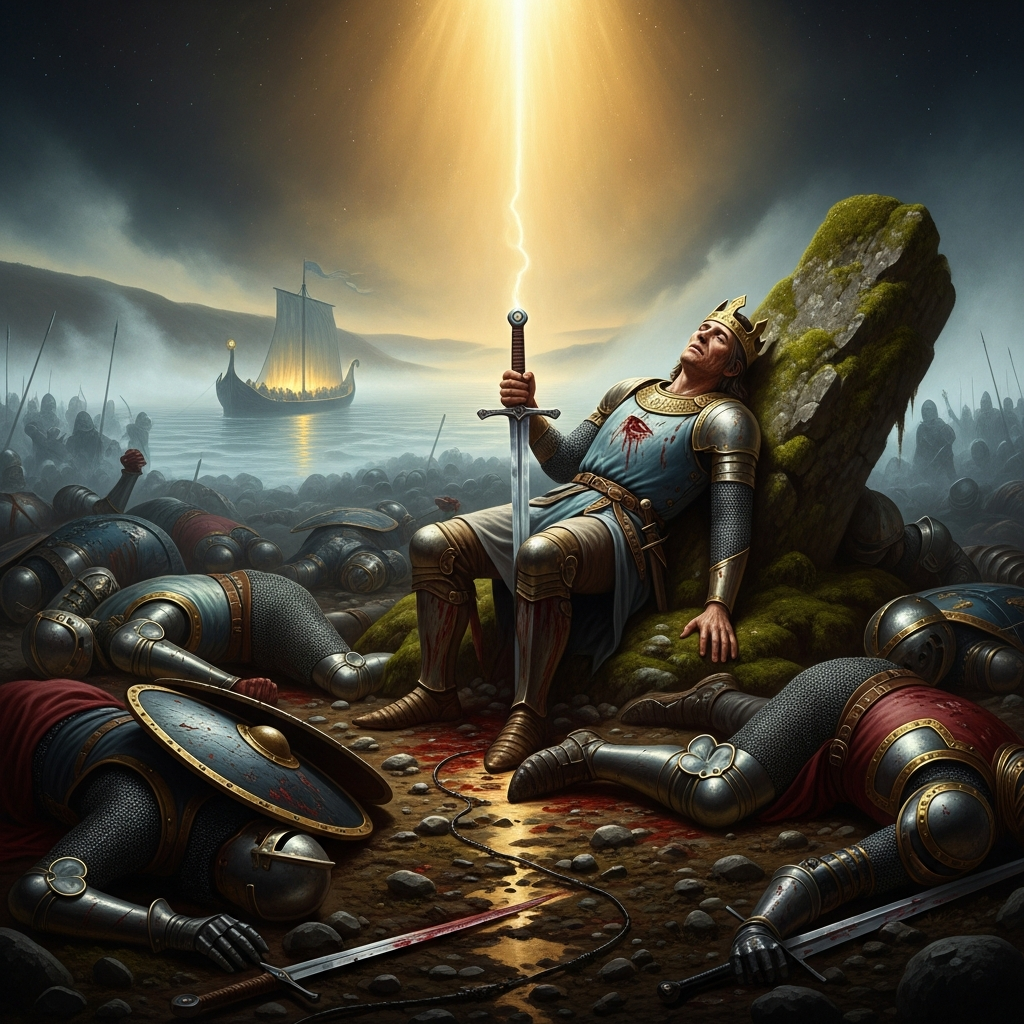
The field is empty now.
There were thousands here this morning — the noise of them, the mud they churned, the smoke of their cookfires still visible as a smear against the autumn sky. Now there is only Bedivere, and the king, and the sword.
Arthur is lying against the roots of an old tree at the field’s edge, his armor cut in three places, the head wound leaking through the cloth Bedivere packed against it. His face is the color of the sky before dawn. He is conscious, just. He has been conscious long enough to give Bedivere his instructions.
Take Excalibur to the lake. Throw it in. Come back and tell me what you see.
Bedivere takes the sword.
He carries it — in both hands, the way you carry something heavy and also sacred — toward the lake that lies at the field’s dark edge. He has been carrying this sword in one sense or another for thirty years, the sword and what the sword represented, the king who wielded it and what the king was trying to build. He is older than he looks. He is the last one.
He reaches the water.
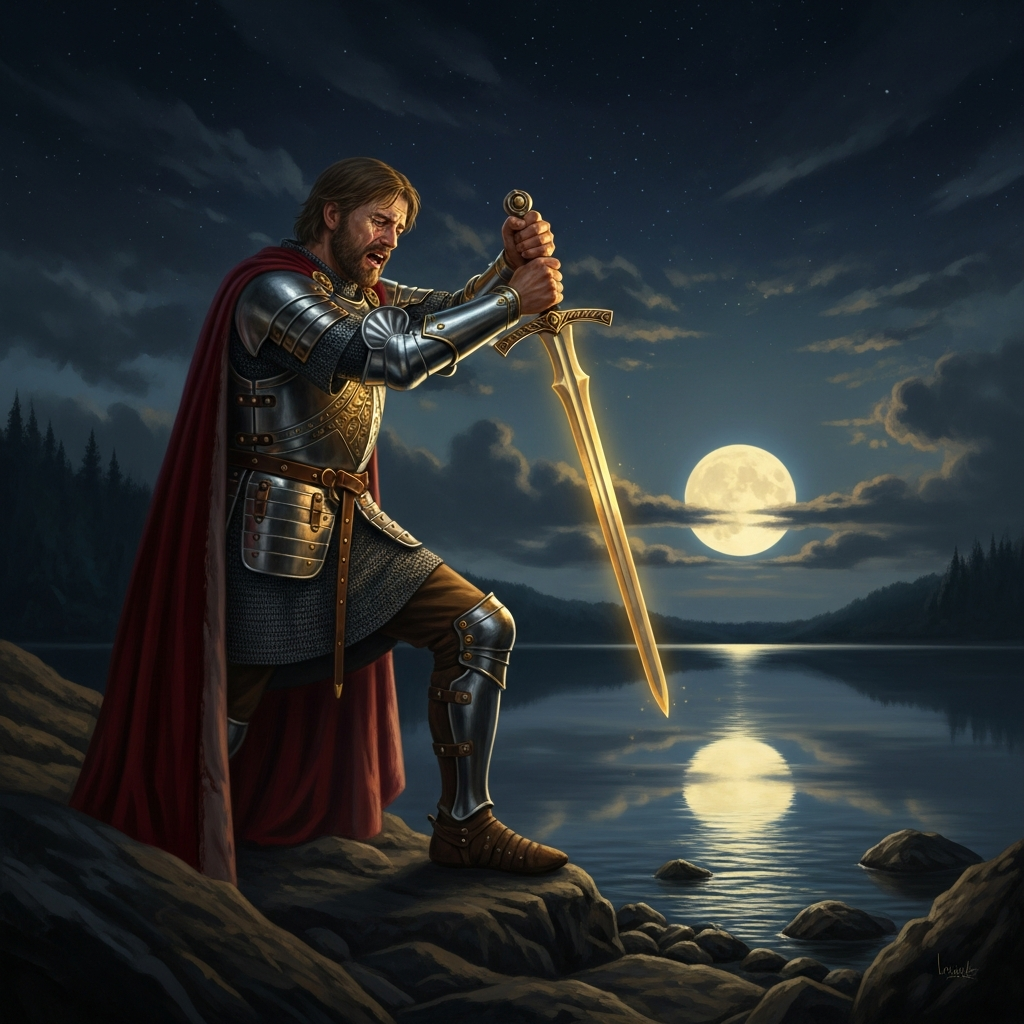
He holds Excalibur over the lake.
The sword catches the last light of the afternoon and reflects it in the way that Excalibur always reflects light — more than it should, more than the angle of the sun requires, with the additional quality of something that does not entirely belong to the natural order. The scabbard is long gone. The sword is just the sword now. It is enormous and beautiful and old.
He cannot throw it.
He tells himself it is the jewels. The pommel is set with jewels — the account is consistent on this — and precious stones are not thrown into lakes. They are kept, catalogued, passed to the royal treasury, used for something. There is a reasonable argument that the sword should be preserved. That it is too valuable to be lost. That the king, in extremis, may not be thinking clearly, and a knight who loves his king should not follow dying instructions without considering whether they make sense.
He hides the sword under a rock near the water’s edge.
He walks back across the empty field.
Arthur looks up. His eyes are still clear. He asks: What did you see?
Nothing but wind and water, my lord.
Arthur is silent. The silence is not long but it has weight.
You lie, he says. Go back.
The second time is harder than the first.
Bedivere knows now that Arthur will know. He knows that the king cannot be deceived in this, that whatever dying men have access to that the living don’t, Arthur has access to the truth about this sword in a way that bypasses the words. He walks back to the lake carrying the full knowledge that he should throw it and cannot.
He holds it over the water again.
The jewels catch the light again. The lake is dark and still, offering nothing. There is nothing in the lake’s surface that says throw it here, this is where it goes. There is nothing but the lake, which has always been here, which was here before Arthur and will be here after, which has no opinion about Excalibur and no expression of readiness to receive it.
He thinks: When will there be another sword like this? When will there be another kingdom? What I throw away now is gone from the world forever.
He hides it again.
He walks back.
Arthur asks: What did you see?
Nothing but waves and wind.
The king closes his eyes for a long moment.
You have betrayed me twice. You love the sword too much. I am nearly gone. Go back. Throw it. Do not fail me a third time.
He throws it on the third attempt, and he cannot explain exactly what changed.
He stands at the water’s edge with the sword for the third time. He holds it the same way. The lake is the same dark still surface. The light is failing now — there is less of it, and the cold is coming up from the water, the particular cold of a November lake at dusk.
He throws Excalibur.
Not with ceremony. Not having resolved the grief of it. He throws it the way you finally let go of the thing you have been holding — not because you want to, but because not letting go has become its own kind of cost, and the cost has finally exceeded what you can pay.
The sword turns through the air. It catches the last of the light. It begins to fall toward the water.
And the hand rises.
It rises from the lake wrapped in white cloth to the elbow, and it catches the sword by the hilt with a precision that suggests it knew exactly where Excalibur would be, and it holds the sword upright above the water’s surface, and it brandishes it three times — three times, Malory is specific about this — and then draws it down under the water, and the water closes, and the lake is still again.
Bedivere stands at the edge.
He weeps.
He does not try to explain to himself why he weeps. He has been a knight of the Round Table for thirty years and he knows the vocabulary of heroism and duty and loyalty and service and he could arrange those words into a sentence about what this moment represents. He does not. He stands at the edge of the lake and weeps the way people weep when something they spent their entire life on is over, and they know it, and the knowing has no bottom to it.
He walks back to Arthur.
He tells the king what he saw: an arm clothed in white, the sword taken, the lake closed.
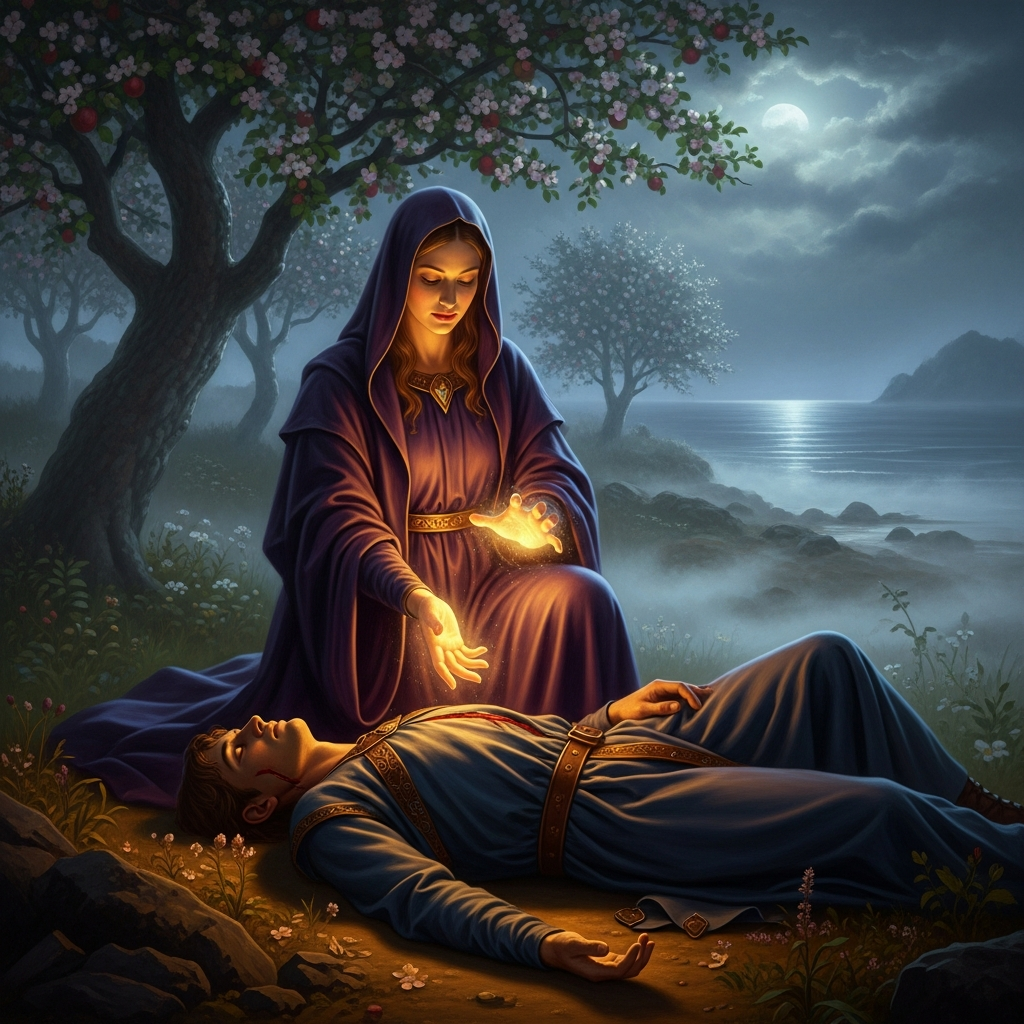
Arthur is satisfied. He asks Bedivere to carry him to the water’s edge, and Bedivere carries him — he is lighter than he should be, he is becoming something else already — and at the water’s edge the barge is there. Three women in black hoods, and one of them may be Morgan, and one of them may be the Lady of the Lake herself, and the faces are in shadow.
They take Arthur into the barge.
Arthur speaks, from the barge, to Bedivere on the bank. He says he is going to Avalon for the healing of his wound. He says he does not know if he will return. He says: Pray for my soul.
The barge moves.
Bedivere follows along the bank, running, crying out — My lord, what will become of me? — and the barge moves without answering him, moving faster than wind, and Bedivere runs until the water runs out of bank and he is standing at the edge of whatever the lake becomes where it goes, and the barge is a shape in the dark, and then not a shape.
He is alone on the bank.
He will be alone for a long time.
He is the one who stayed. He is the witness. He carries everything that happened in the frame of his one body, and he will walk it to a hermitage, and he will pray, and he will tell the story when they ask him, and he will tell it the same way every time: the sword, the lake, the hand, the barge, the king who may be sleeping.
The lake keeps its secret.
The hand does not rise again.
Echoes Across Traditions
Entities
- Bedivere
- Arthur
- Excalibur
- the Lady of the Lake
- the barge to Avalon


Sources
- Sir Thomas Malory, *Le Morte d'Arthur*, Book XXI, Chapters 5–7, 1485 CE
- Geoffrey of Monmouth, *Historia Regum Britanniae*, c. 1138 CE
- *Alliterative Morte Arthure*, anonymous, c. 1400 CE
- James Carley, ed., *Glastonbury Abbey and the Arthurian Tradition* (D.S. Brewer, 2001)
- Roberta L. Krueger, ed., *The Cambridge Companion to Medieval Romance* (Cambridge, 2000)