The Oath of the Round Table
Developed through the Vulgate Cycle and Malory, c. 1215–1485 CE · Camelot — the great hall, the round table at its center, the Pentecost feast at which the oath is renewed each year
Contents
The Round Table is not Arthur's invention — it is part of Guinevere's dowry, brought from her father Leodegrance. But the oath sworn at Pentecost each year is Arthur's: never to take up a cause for personal gain, never to be cruel, to protect the powerless, to refuse mercy to none who asks it. It is the most ambitious ethics charter in medieval literature. The tragedy of Camelot is that it almost worked.
- When
- Developed through the Vulgate Cycle and Malory, c. 1215–1485 CE
- Where
- Camelot — the great hall, the round table at its center, the Pentecost feast at which the oath is renewed each year
The Table comes before the oath.
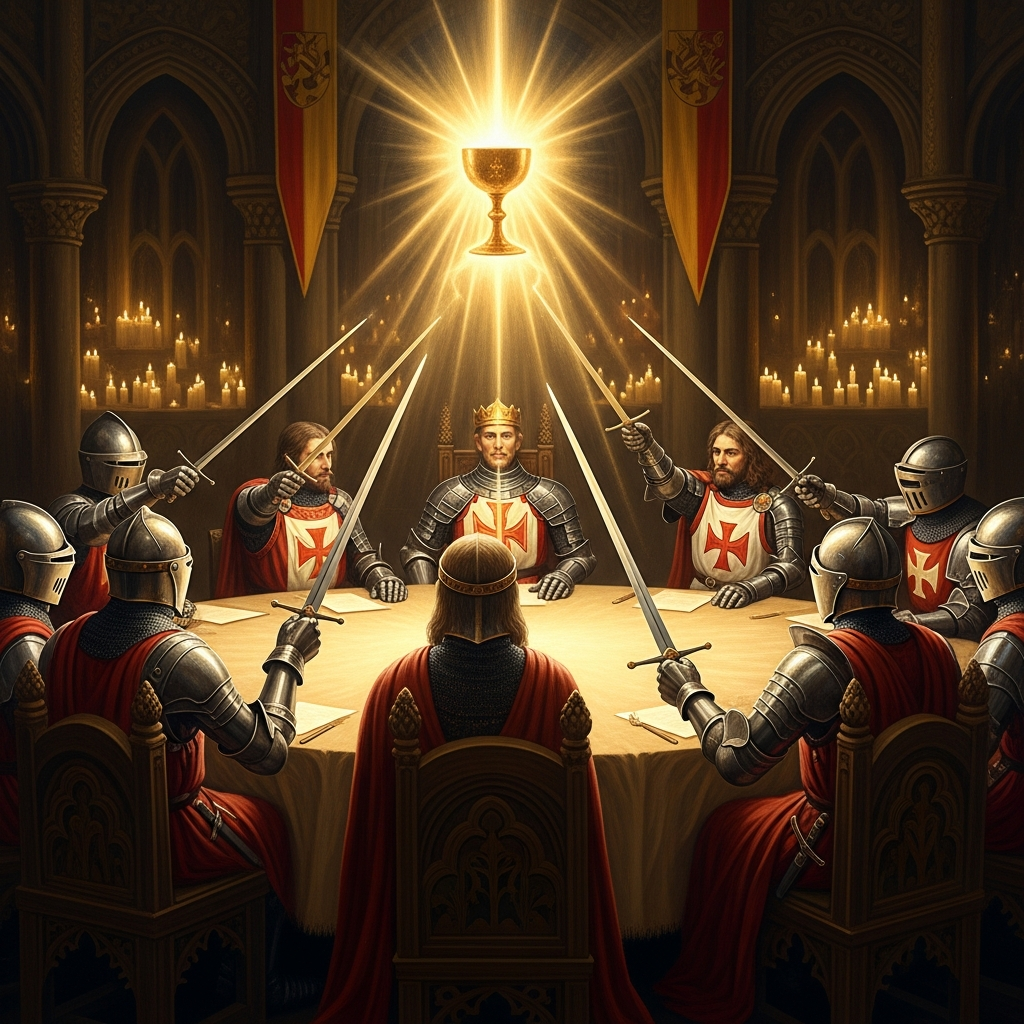
Leodegrance has kept it in his great hall since Uther Pendragon gave it to him years ago — a table built for a hundred and fifty knights, perfectly round, with no head and no foot, so that no man who sits at it can claim precedence over any other. It has been sitting in Leodegrance’s hall being round for most of a decade, taking up space, mostly used for storage at the edges. When Arthur marries Guinevere and Leodegrance sends it as dowry — he has no treasure adequate to the marriage, and the Table is the most significant thing he owns — Arthur receives it with more pleasure than he shows at any other wedding gift.
Merlin, when he sees the Table installed in the great hall at Camelot, says: Now you have the vessel. You need the men to fill it.
He means this practically: the Table seats a hundred and fifty, and Arthur does not yet have a hundred and fifty knights of the quality the seats require. He means it also in the other sense: a round table with no head is a furniture argument, a claim about equality made in wood. The argument needs to be made in flesh, in sworn language, in the repeated public act of men who mean what they say.
The Pentecost feast is where the oath is sworn each year.
Malory gives us the oath’s text.
Never to do outrage nor murder, and always to flee treason; also by no means to be cruel, but to give mercy unto him that asketh mercy, upon pain of forfeiture of their worship and lordship of King Arthur forevermore; and always to do ladies, damsels, and gentlewomen succour upon pain of death; also that no man take no battles in a wrongful quarrel for no law, ne for no world’s goods.
This is Malory’s version. The versions across the tradition vary in particulars. They agree in structure: the oath is negative first — what a knight will not do — and then positive: what a knight will do. It prohibits murder, treachery, cruelty, and battles fought for personal gain. It requires mercy to those who ask it, protection of women and the vulnerable, and the refusal to take up causes driven by greed.
Read in the context of the century that produced it, this is an extraordinary document.
The actual conduct of actual knights in the actual thirteenth century — the world of the Crusades, the Albigensian Crusade, the violence of feudal disorder in France and England — was not organized around mercy or the protection of the powerless. Knights fought for land, for money, for dynastic advantage, for revenge, for sport. The casualties of their fighting were disproportionately the people the oath claimed to protect: the peasants, the villagers, the women and children who could not defend themselves and were not defended.
The oath is not a description of how chivalry worked. It is a description of how chivalry should work, projected onto a mythical past, used as a standard against which the present could be measured and found wanting.
The seats fill slowly.
Merlin helps. Some knights are called to Camelot by reputation; some are rescued from unjust captivity and invited to take their place; some simply arrive, having heard of the Table and the oath, and present themselves for the testing that determines whether a seat is theirs. Malory names them: Lancelot and Gawain and Percival and Tristram and a hundred others, each with his own history, each carrying the specific configuration of virtue and flaw that the myth will eventually require.
The empty seat — the Siege Perilous — remains empty until Galahad.
The Table during its years of function is something the tradition wants you to understand as genuinely working. The knights do ride out and right wrongs and rescue the captive and defend the weak. The oath is not purely rhetorical — it is sworn with the intention of being performed, and performed with the seriousness that sworn language carries in a world where a man’s word is his primary social instrument.
The feast at Pentecost each year is both renewal and accounting. Knights return with their reports. The court hears what happened on the roads of Britain. The oath is sworn again, publicly, by every knight at the Table, in the hearing of the king and each other — the corporate memory of a community organized around a common standard.
It works for a long time.
The cracks are internal, and they are always internal.
The Table’s failure is not caused by an external enemy — not the Saxons, not the northern kings, not the Roman challenge that the early legends include. It is caused by the gap between what the oath requires and what the people who swore it are able to sustain.
Lancelot’s love for Guinevere is the largest crack. It is not the only one. There is the ordinary accumulation of resentment between knights who have fought side by side for decades and carry old wounds both physical and otherwise. There is Gawain’s specific inflexibility — his code of vendetta that runs alongside the Round Table code and eventually displaces it. There is Mordred, whose legitimacy question the Table cannot resolve. There is the Grail quest, which empties the Table of its best knights and returns them changed or not at all.
None of these is simply the Table’s fault. All of them are the Table’s failure.
The tragedy of Camelot, properly understood, is not that the attempt was made. It is that the attempt was so nearly successful.
Other traditions give their ideal kingdoms a divine warrant — the mandate of heaven, the grace of God, the cosmic law that makes the just order self-sustaining. The Arthurian tradition gives the Round Table only the oath — sworn by men, renewed by men, sustained by men, failing through men. There is no guarantee built in. There is only the Pentecost feast and the annually renewed words.
This is the tradition’s most honest confession and its most durable insight: the just order is not given from above. It is built, incrementally, in the choices of fallible people who have agreed to hold each other to a standard they understand they will not always meet.
The Table lasted longer than any individual knighthood at it.
The Table eventually could not last.
Between those two facts is everything the legend has to say about what human beings are capable of and what they cannot sustain, which is not nothing, which is not hopeful exactly, but which is something more honest than hopeful and possibly more useful.
The knights are in the hall.
The oath is being spoken.
The feast goes on until the fires die.
What is sworn here will outlast everyone who swore it.
What is built here will not last.
Both things are true, and the tradition holds them together with the precision of a structure that has thought carefully about what it is building and decided that the attempt justifies the cost.
Echoes Across Traditions
Entities


Sources
- Sir Thomas Malory, *Le Morte d'Arthur*, Book III, 1485 CE
- *Lancelot-Grail Cycle* (Vulgate Merlin), c. 1215–1235 CE
- Wace, *Roman de Brut*, c. 1155 CE
- Roger Sherman Loomis, ed., *Arthurian Literature in the Middle Ages* (Oxford, 1959)
- Felicity Riddy, ed., *Prestige, Authority and Power in Late Medieval Manuscripts and Texts* (Boydell, 2000)
- John Gillingham, *The Wars of the Roses* (Louisiana State University Press, 1981) — context for chivalric ideology