Morgan le Fay: The Queen of the Other World
Geoffrey of Monmouth, *Vita Merlini*, c. 1150 CE; developed through Malory, c. 1470 CE · Avalon — the island at the world's edge; the court of Camelot; the castle of Le Fay; the battlefield at Camlann
Contents
Morgan le Fay is Arthur's sister, trained by Merlin, ruler of Avalon — and in the earliest sources, his healer, not his enemy. She is the one who receives Arthur's body after Camlann and takes him to Avalon to recover. What got twisted in the later romances — from healer to villain — tracks the transformation of wise women into witches across medieval Europe.
- When
- Geoffrey of Monmouth, *Vita Merlini*, c. 1150 CE; developed through Malory, c. 1470 CE
- Where
- Avalon — the island at the world's edge; the court of Camelot; the castle of Le Fay; the battlefield at Camlann
In Geoffrey of Monmouth’s telling, written within a generation of the first full Arthurian chronicles, there is no doubt about what Morgan is.
She is a healer.
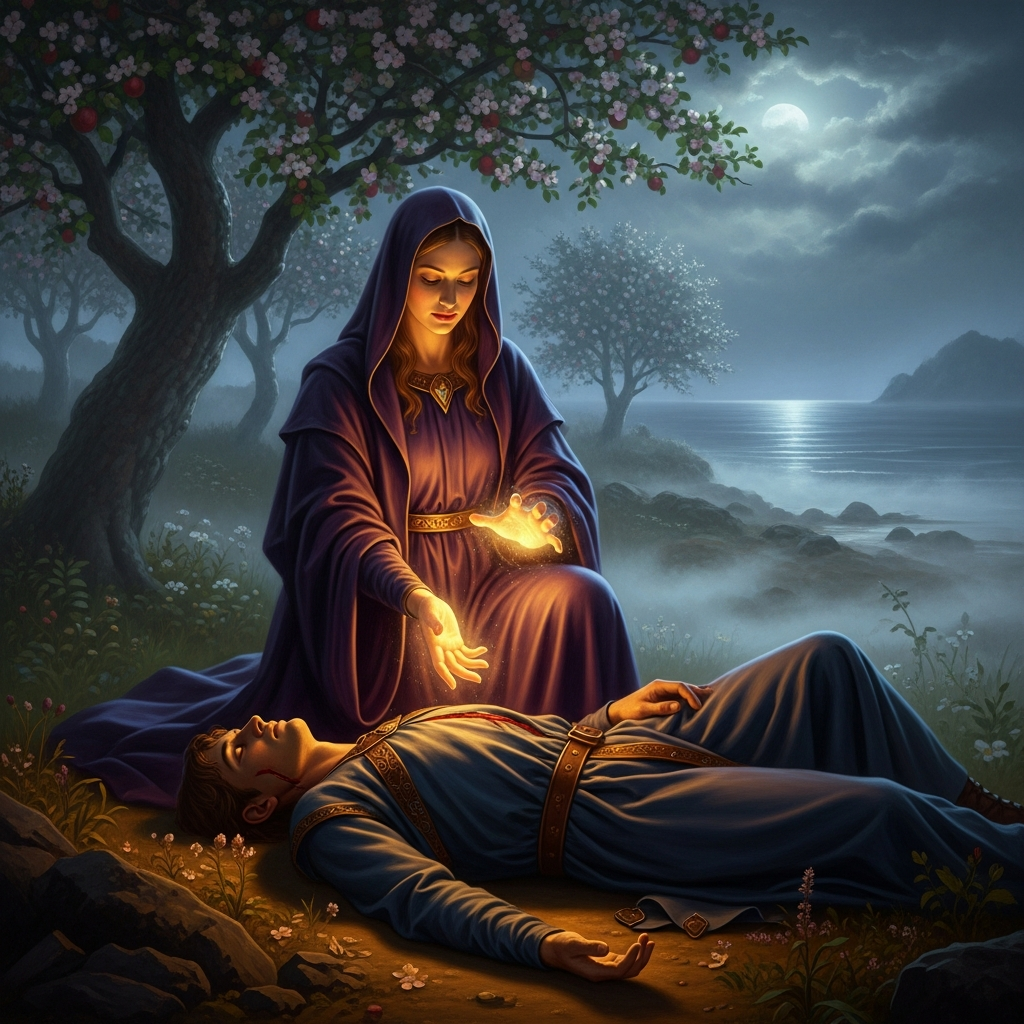
She lives on the island of Avalon — insula pomorum, the island of apples — which Geoffrey describes with care: a place of extraordinary fertility, where no one grows old faster than they should, where the grain raises itself without cultivation, where the trees hang heavy with fruit the year around. It is not a place of the dead. It is not a place of punishment or exile. It is the island at the edge of the world that is better than the world, and Morgan is its ruler, and she rules it as a woman who knows things the courts of men do not know.
She knows medicine in the deep sense — not herbalism alone but the art of attending to the body’s nature, the patient intelligence of someone who has spent a long time understanding the relationship between wound and recovery, between damaged tissue and the conditions that allow it to restore itself. She is, in Geoffrey’s framing, the most gifted healer in Britain. This is not incidental to her identity. It is her identity.
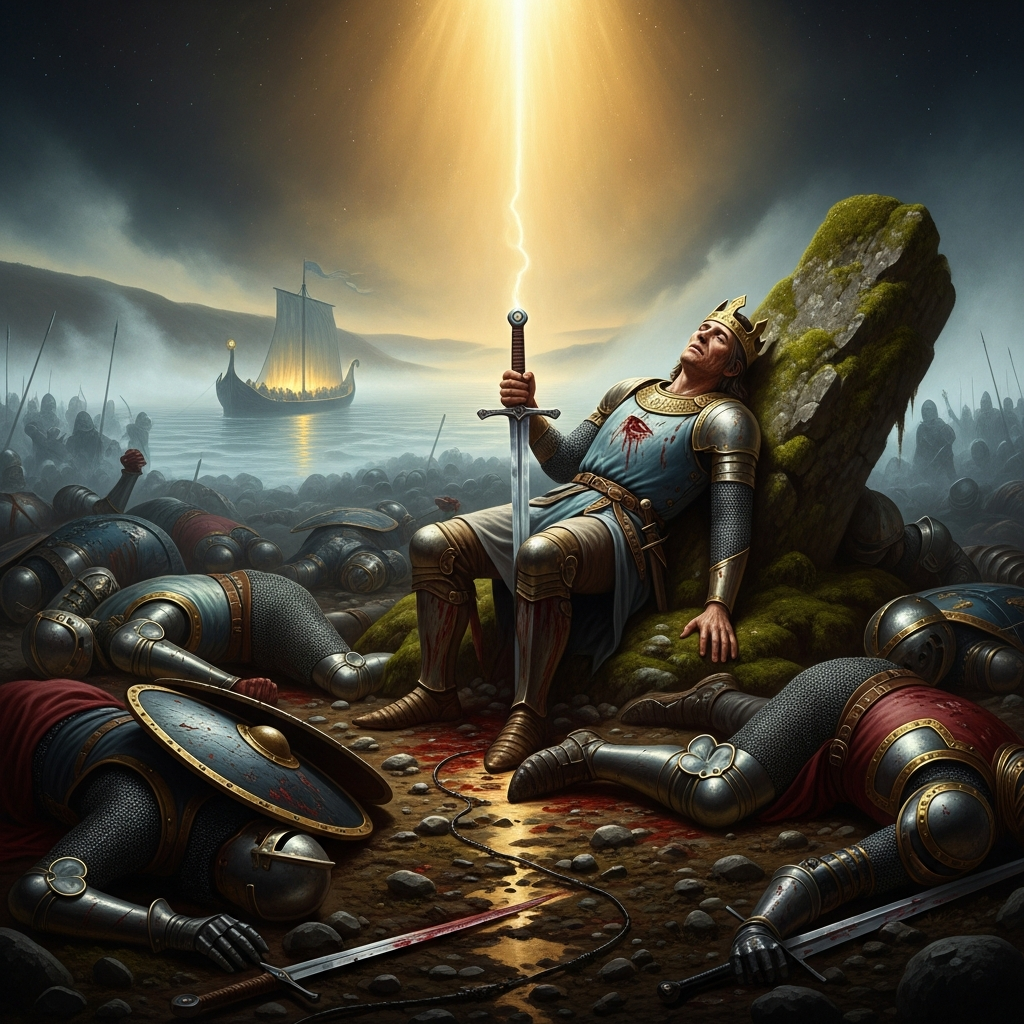
When Arthur is carried off the field at Camlann, his wounds are mortal by ordinary measure. Three wounds to the body, each of the kind that kills by the end of the day. Bedivere is there. The barge is there. And it is Morgan who meets the barge on the island’s shore.
She takes the king’s body in her arms, examines his wounds, and says only: If he had come sooner.
She does not say he is beyond help. She takes him inside, and the island closes, and Arthur sleeps.
The change in Morgan begins almost immediately in the textual tradition, and the mechanism of that change is legible in the manuscripts.
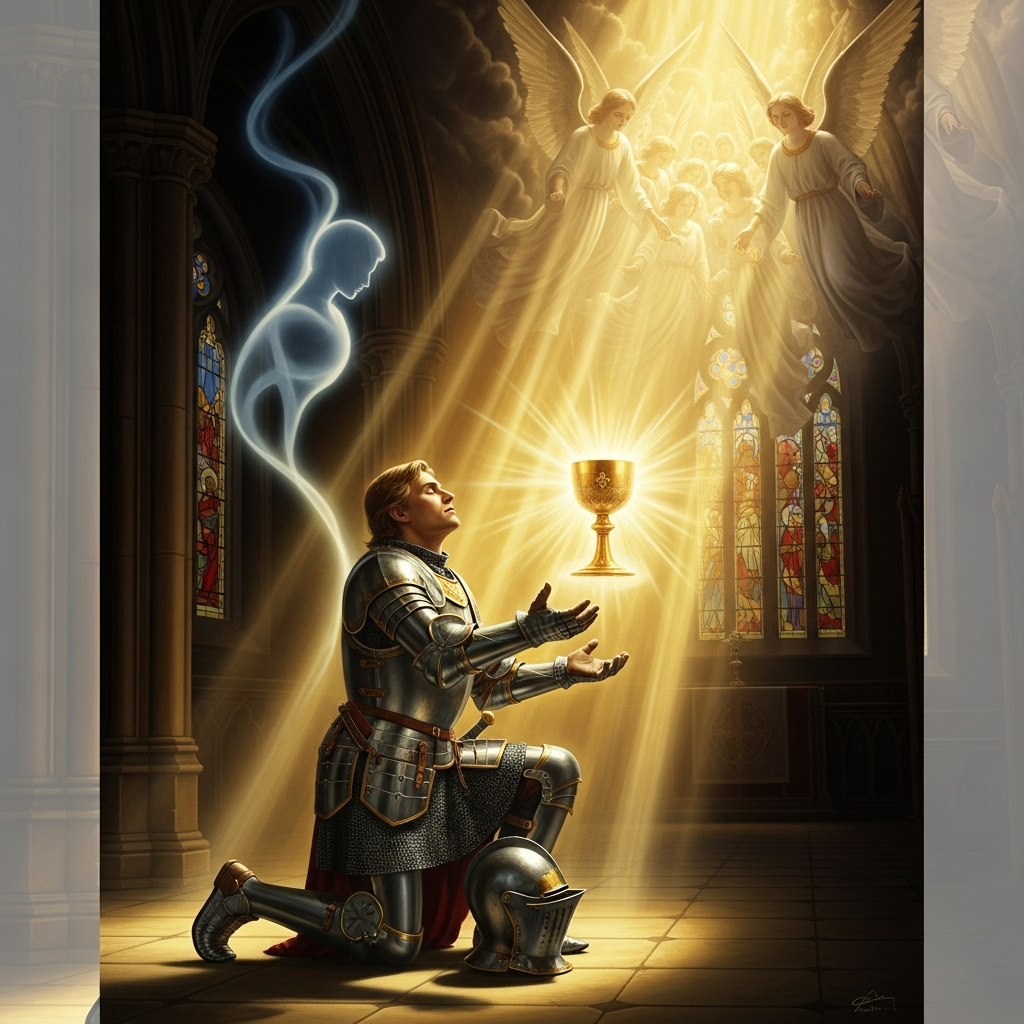
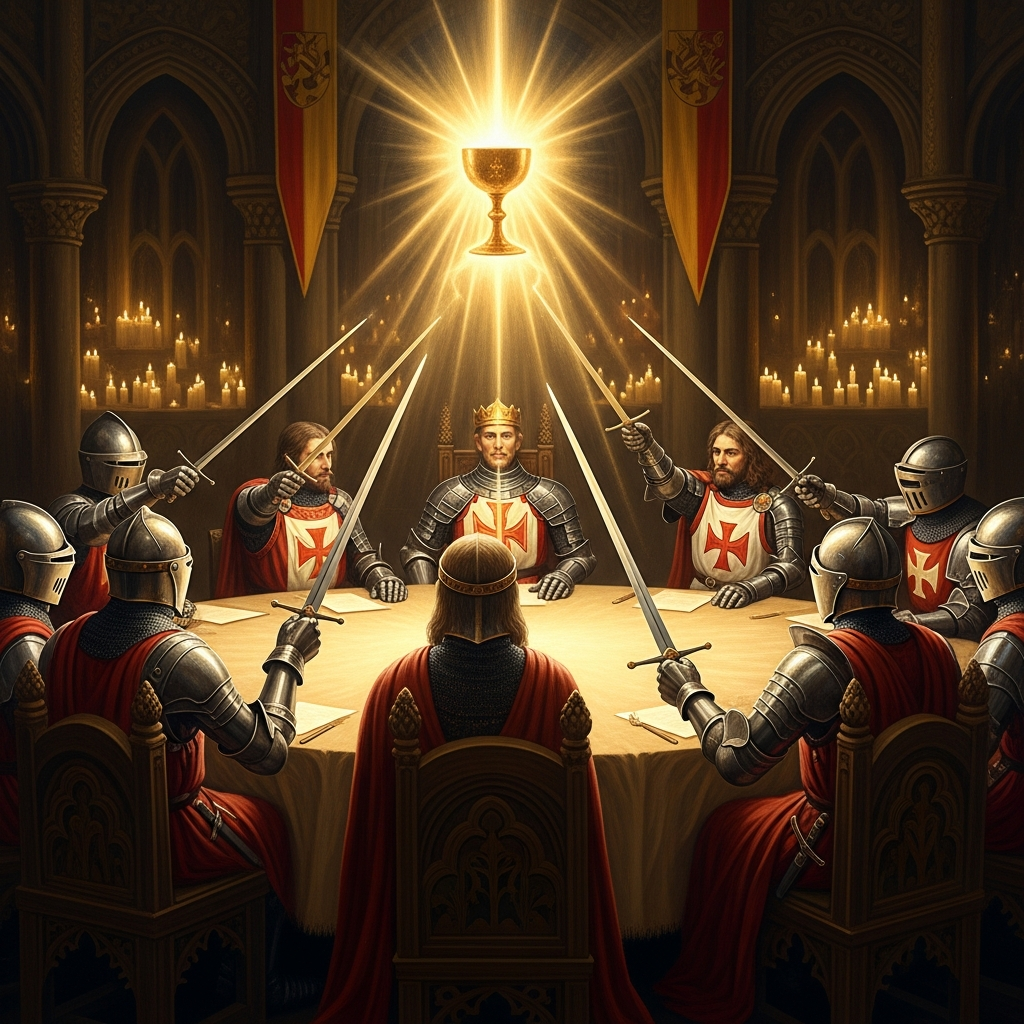
As the Arthurian legend passes from Geoffrey’s Latin chronicles into the French prose romances of the thirteenth century — the vast Vulgate and Post-Vulgate cycles, written mostly by anonymous Cistercian monks — the world of the legend is reorganized around the priorities of the clerical culture producing it. The Grail takes center stage. The spiritual taxonomy becomes more rigid: characters are saved or damned, holy or contaminated, on the right side of God’s economy or the wrong. The grey zones that Geoffrey inhabited — the island healer who is also the king’s sister, the woman who rules a space that belongs to neither life nor death — begin to collapse.
Morgan, in the prose cycles, is gradually repositioned. She is still magical, still Arthur’s sister, still associated with Avalon. But the magic she performs moves from healing to enchantment, from restoration to entrapment. She becomes the source of curses. She sends Excalibur’s magical scabbard to Arthur’s enemies. She creates rooms of illusion to torment knights. She schemes against Guinevere, against Lancelot, against Arthur himself — always from a position of grudge or envy or desire, never from the complex sovereignty of the woman who ruled the island of apples.
By Malory, writing in the fifteenth century, she is Arthur’s explicit enemy. The healing island is still there, at the end — she is still one of the queens who receives his body at Camlann — but it has the quality of a remnant, a survival from an older version of the story that the later tradition could not entirely displace.
What was threatening about her?
The question is worth sitting with, because the answer is not what the later tradition claims. It is not that she was evil. It is that she was autonomous.
Morgan’s characteristic in the early sources is that she operates outside of male institutional structures. She is not a queen because she is married to a king. She is not a healer because she trained in the Church’s tradition. She is not a seer because she serves a male prophet. She is these things on her own terms, in her own domain, by virtue of her own developed knowledge — and the knowledge she has is knowledge that heals rather than kills, that restores rather than destroys, that belongs to the body and its cycles rather than to the Word and its hierarchies.
This is the profile that the thirteenth century found difficult to accommodate.
The prose cycles are also the period when the Church was extending its legal control over medicine — requiring practitioners to have ecclesiastical licenses, prosecuting unlicensed healers, gradually prying the practice of medicine away from the women who had been its primary practitioners at the village level for centuries. The Malleus Maleficarum would not be written for another two hundred years, but the theology that would produce it was being assembled in exactly the period when Morgan is transformed from healer to witch in the literary tradition.
The parallelism is not coincidence. It is the same anxiety, working itself out in two registers simultaneously — the legal register and the literary one.
But the island is still there.
Every version of the legend, even Malory’s, ends with the barge and the queens and the island. The apparatus of Morgan’s original identity — the boat, the water, the island of apples, the women who know what the court does not know — cannot be written out of the story because it is structurally necessary. Without Avalon, Arthur simply dies on the battlefield. Without Morgan, there is no rex quondam, rex futurus, no once and future king, no possibility of return.
The tradition needs her to be the healer even when it is calling her the witch. The myth cannot function if the woman who knows what to do with the body is entirely removed from the narrative. So it keeps her — diminished, recontextualized, narratively framed as having malicious motives — but present, always at the end, always the one who receives him.
She is still on the island. She is still attending to the king’s wounds.
Whatever the romances called her, the barge still travels toward her shore.
Whatever the chronicles said she was, the land around her keeps its harvest, the apple trees keep their fruit, the island stays green.
She is the one the story returns to, in the end, when the men have finished their killing.
She always was.
Echoes Across Traditions
Entities
- Morgan le Fay
- Arthur
- Merlin
- Guinevere
- the isle of Avalon


Sources
- Geoffrey of Monmouth, *Vita Merlini*, c. 1150 CE
- Geoffrey of Monmouth, *Historia Regum Britanniae*, c. 1138 CE
- Sir Thomas Malory, *Le Morte d'Arthur*, 1485 CE
- Lucy Allen Paton, *Studies in the Fairy Mythology of Arthurian Romance* (1903)
- Jeanne-Marie Boivin, *L'Irlande au Moyen Âge: Giraud de Barri et la Topographia Hibernica* (1993)
- Carolyne Larrington, *King Arthur's Enchantresses: Morgan and Her Sisters in Arthurian Tradition* (I.B. Tauris, 2006)