The Night Uther Became Arthur's Father
Geoffrey of Monmouth, *Historia Regum Britanniae*, c. 1138 CE · The castle of Tintagel on the Cornish coast; the battlefield where Gorlois dies; the roads between them
Contents
Uther Pendragon is at war with Gorlois of Cornwall and in love with Gorlois's wife, Igraine. Merlin offers to disguise Uther as Gorlois so he can spend a night with Igraine at Tintagel. The price: the child that is conceived. Igraine does not know the man beside her is not her husband. Gorlois dies in battle that same night. Arthur is conceived in a deception that Merlin has designed from the beginning.
- When
- Geoffrey of Monmouth, *Historia Regum Britanniae*, c. 1138 CE
- Where
- The castle of Tintagel on the Cornish coast; the battlefield where Gorlois dies; the roads between them
Merlin has known about Arthur for longer than Uther has been king.
This is the implication the tradition embeds in everything Merlin does in the early part of the legend, the thing that makes all his bargaining and arranging feel less like opportunism and more like construction: he is building something, and the thing he is building requires specific materials that are not yet in existence, and acquiring those materials requires him to act in the present on knowledge that belongs to the future.
He needs a child from Uther’s bloodline.
He needs the child to be conceived at a particular moment, in a particular way, with particular lineages in combination. He has seen what this child will become. He has not seen whether it will actually happen — the seer’s curse is that foresight is not certainty — but he has seen enough to know that everything he does from here forward has to be organized around the creation of this one person.
He has also known, for some time, that Uther Pendragon is in love with Igraine of Cornwall.
Igraine is Gorlois’s wife.
She is described in Geoffrey and in Malory with the same set of qualities: beautiful, faithful, wise, not the kind of woman who could be seduced by flattery or gifts. She came to Uther’s court as Gorlois’s wife and she left it as Gorlois’s wife, after noticing that the king was watching her with an intensity that was not appropriate to the occasion and that nothing short of leaving would defuse.
Gorlois leaves Uther’s court without formal permission, taking Igraine to Cornwall, and the insult to the king gives Uther the justification he needs to pursue what he wants. He invades Cornwall. He makes war on Gorlois, which is expensive and lethal and also, on some level, beside the point: he does not want Cornwall, he wants Igraine.
Merlin appears.
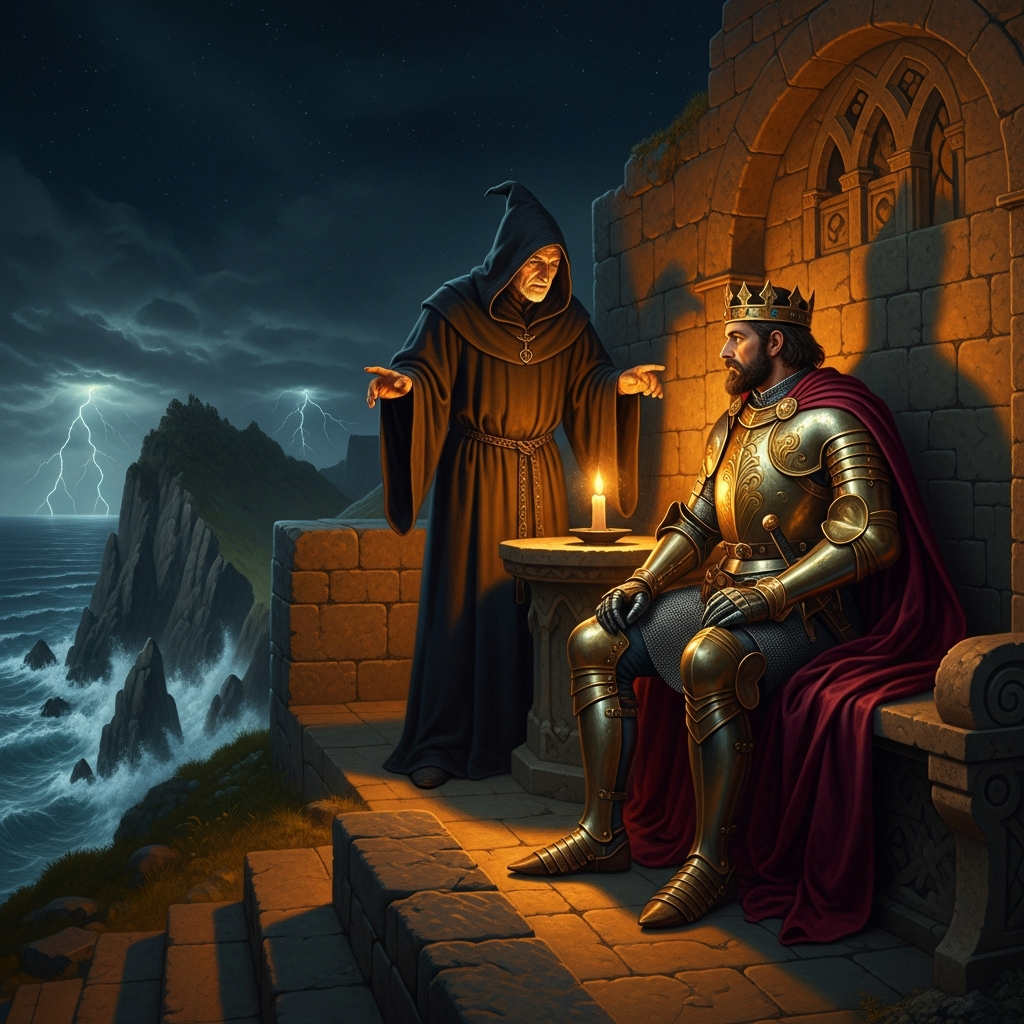
Merlin’s offer is precise: he will use his arts to disguise Uther as Gorlois so that Uther can enter Tintagel — the cliff-castle that guards Igraine, that is essentially impregnable as long as Igraine stays inside it — and spend a night with her. The condition of the agreement is stated without softening: the child that is conceived belongs to Merlin. He will come for it at birth. It will not remain with Uther.
Uther agrees.
He agrees with the speed of a man who has thought about the price and decided that whatever it is, it is less than what he wants.
What Igraine knows, and when she knows it, is the moral center of the story, and the tradition handles it with a discomfort that reveals its own unease.
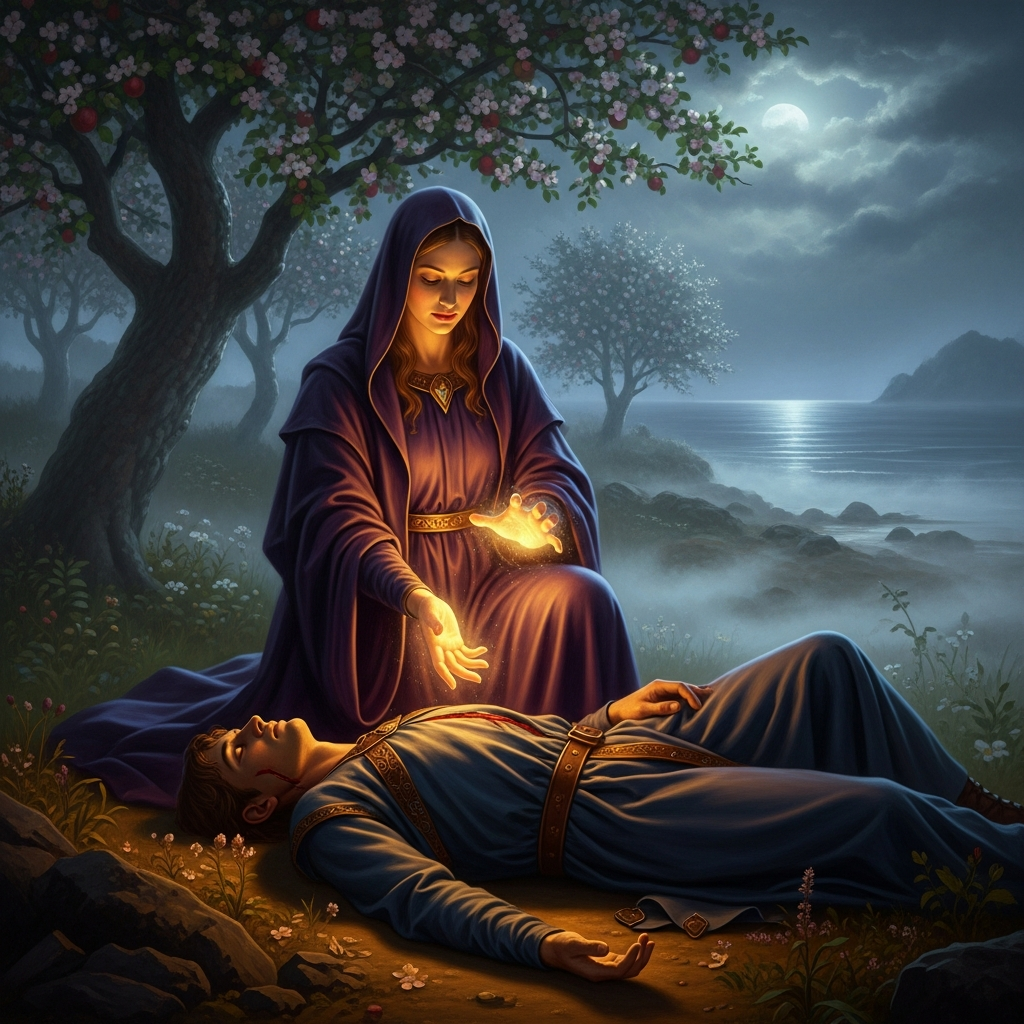
She does not know. She is in Tintagel with her women and her guards, her husband’s army outside Tintagel with Gorlois defending the position, and a man who looks and sounds and moves like her husband comes through the gate. He comes to her chamber. He lies with her. She has no reason to think he is not who he appears to be. She behaves accordingly.
In the morning he is gone.
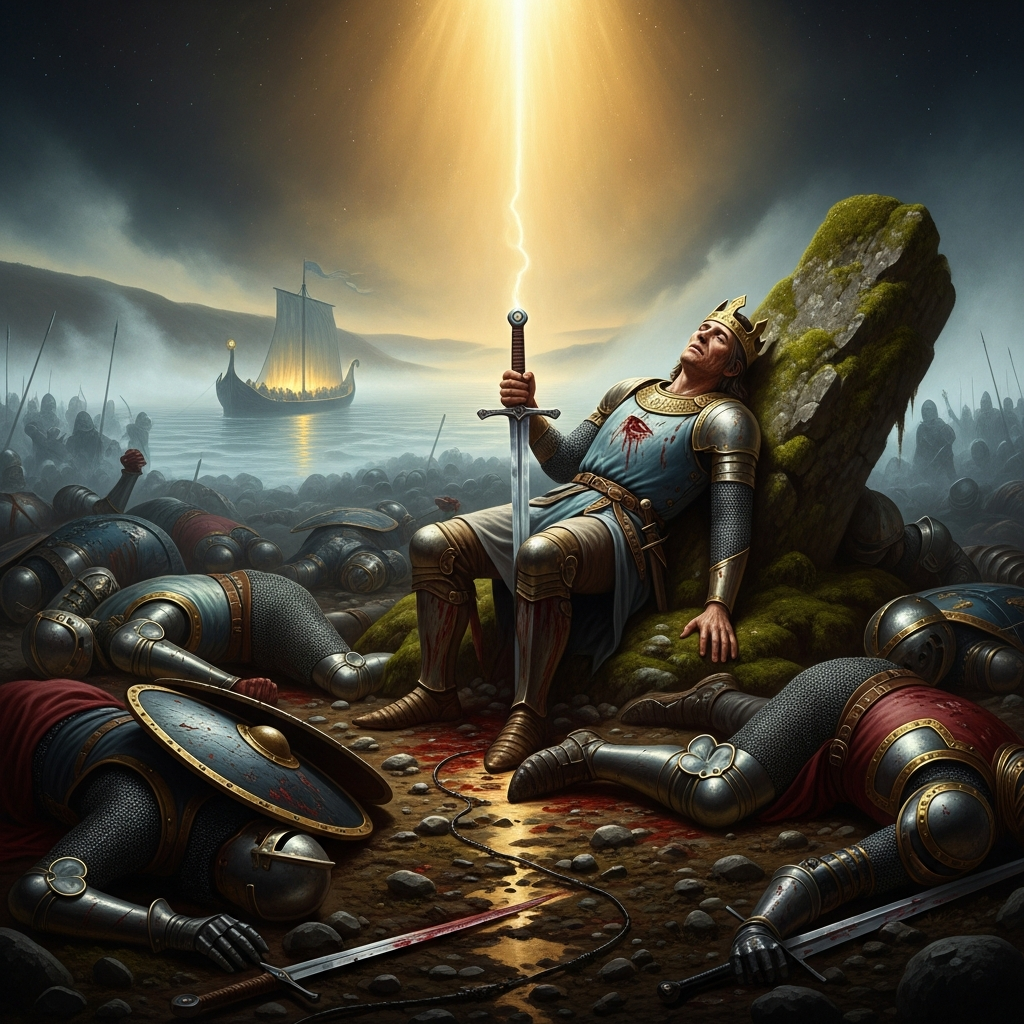
Later that same day — that same morning, in some accounts — word comes from the front that Gorlois has been killed in a sortie against Uther’s forces. Igraine receives this news having just spent the night with the man her husband’s death has freed her to marry.
The timing is impossible, and she knows it.
Malory records her recognition: she understands, when Uther comes to her shortly afterward and claims her hand, that the man who came to her the night before was not Gorlois. She does not know how. She knows that something was done to her through a deception she was not given the means to detect. She marries Uther. She bears the child. She never speaks of what she understood to Uther, and he never speaks of it to her, and between them the founding secret of the kingdom is sealed in the mutual silence of two people who have agreed, tacitly, that certain things are better not examined.
The child is taken.
Merlin collects him at birth — Malory has Uther hand the infant to a man at the postern gate, without Igraine’s knowledge, in the dead of night — and the child is carried to Sir Ector, who will raise him without knowing who he is, whose son he is raising alongside his own son Kay, feeding him and housing him and teaching him the things a knight needs to know.
Arthur grows up not knowing who he is.
This is necessary, in the tradition’s logic. The sword in the stone requires a candidate with no knowledge of his own claim, because the selection must not be contaminated by ambition. The boy who draws the sword out of the stone does it first by accident, second by design but without premeditation, third in front of witnesses who cannot deny what they have seen. He is legitimate because he does not know he should be.
But legitimacy built on deception is still built on deception.
Merlin’s vision for Britain required an origin he could not obtain honestly.
This is the tradition’s most uncomfortable proposition. The kingdom that would define the medieval imagination of what a kingdom should be — just, merciful, organized around the protection of the powerless, governed by the most ambitious ethics charter in medieval literature — begins the night a king raped a noblewoman through a fraud she could not have detected.
The later legend develops an ethos from this foundation that is explicitly opposed to what was done to build it. The Round Table oath prohibits cruelty to women. It prohibits taking by force what should be given freely. It prohibits the abuse of power for personal desire. Every point of the oath is a correction of the founding night.
This is either the tradition’s blindness or its self-awareness, and the scholars have argued for both.
What is clear is that Merlin designed the deception knowing what the child would become and knowing what the child would stand for, and that the standing-for and the designed-from are in direct contradiction — and that the tradition preserved both without resolving the tension, generation after generation, as if it understood that the tension was the point.
The king who would not have been born if the rules were followed becomes the king whose entire project is to make the rules hold.
Merlin takes the child into the dark.
The kingdom is already being built.
Echoes Across Traditions
Entities
- Uther Pendragon
- Merlin
- Igraine
- Gorlois
- Arthur (conceived)

Sources
- Geoffrey of Monmouth, *Historia Regum Britanniae*, Book VIII, c. 1138 CE
- Sir Thomas Malory, *Le Morte d'Arthur*, Book I, Chapters 1–2, 1485 CE
- Wace, *Roman de Brut*, c. 1155 CE
- Layamon, *Brut*, c. 1190–1215 CE
- Norris J. Lacy, ed., *The New Arthurian Encyclopedia* (Garland, 1996)
- John T. Koch, ed., *Celtic Culture: A Historical Encyclopedia* (ABC-CLIO, 2006)