Lancelot and the Kingdom He Could Not Serve
Lancelot first appears in Chrétien de Troyes, c. 1177 CE; developed through the Vulgate Cycle c. 1215–1235 CE · The roads of Britain, the castle of Corbenic, the chapel at the river's edge, the court of Camelot
Contents
Lancelot is the greatest knight in the world and cannot achieve the Grail because of one thing: his love for Guinevere, the queen. He comes within sight of the Grail and is blinded. He wakes on the riverbank outside the chapel, told by a voice that he has spent twenty-four years in sin. He rides away. The Grail quest breaks the Round Table — and Lancelot's love is the first crack.
- When
- Lancelot first appears in Chrétien de Troyes, c. 1177 CE; developed through the Vulgate Cycle c. 1215–1235 CE
- Where
- The roads of Britain, the castle of Corbenic, the chapel at the river's edge, the court of Camelot
The candle flame in the Grail chapel burns without a wick.
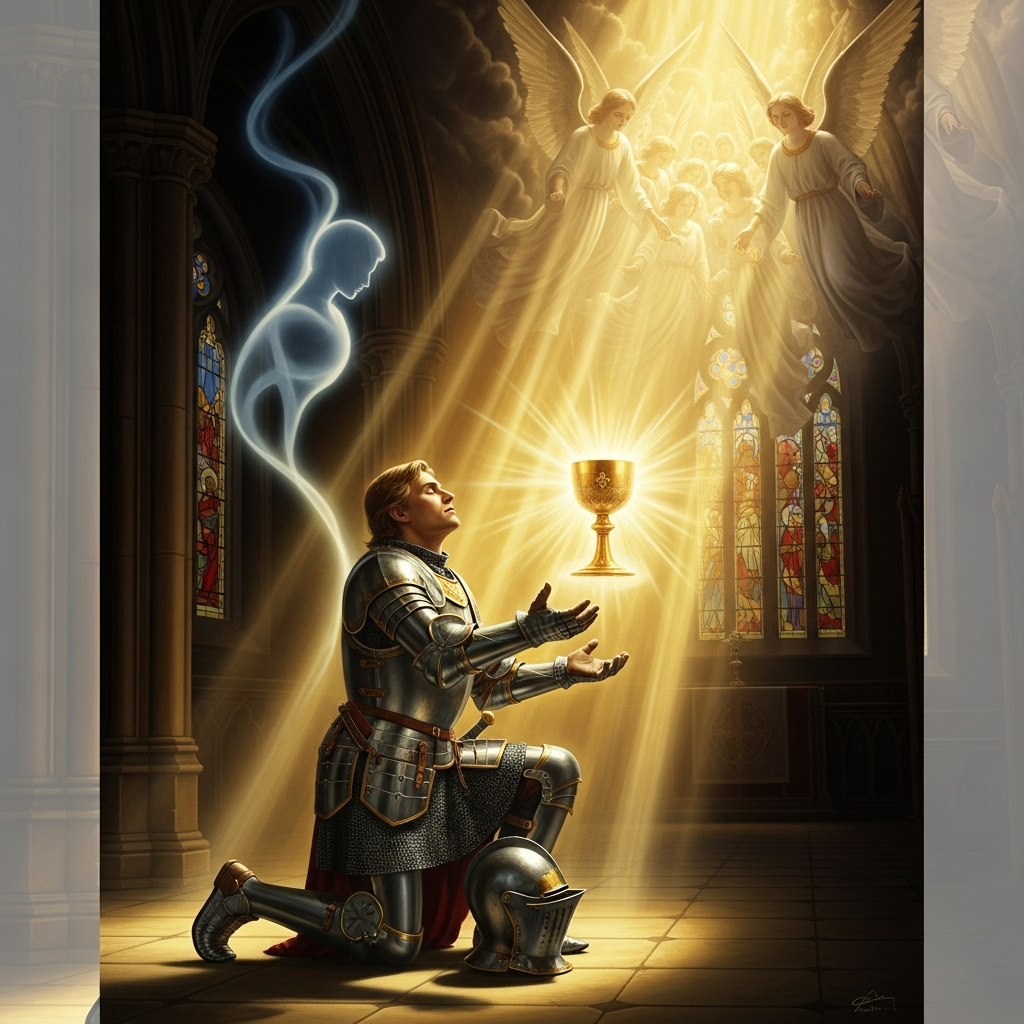
Lancelot has been riding for weeks. He has passed through the wasteland that surrounds Corbenic — the parched fields, the unmoving river, the villages that seem to have been waiting for something without knowing what — and now he is outside a chapel door that stands slightly ajar, and through the gap he can see the Grail on the altar, and the light it gives off is not quite light.
He dismounts. He walks to the door. He puts his hand on the wood.
He cannot enter.
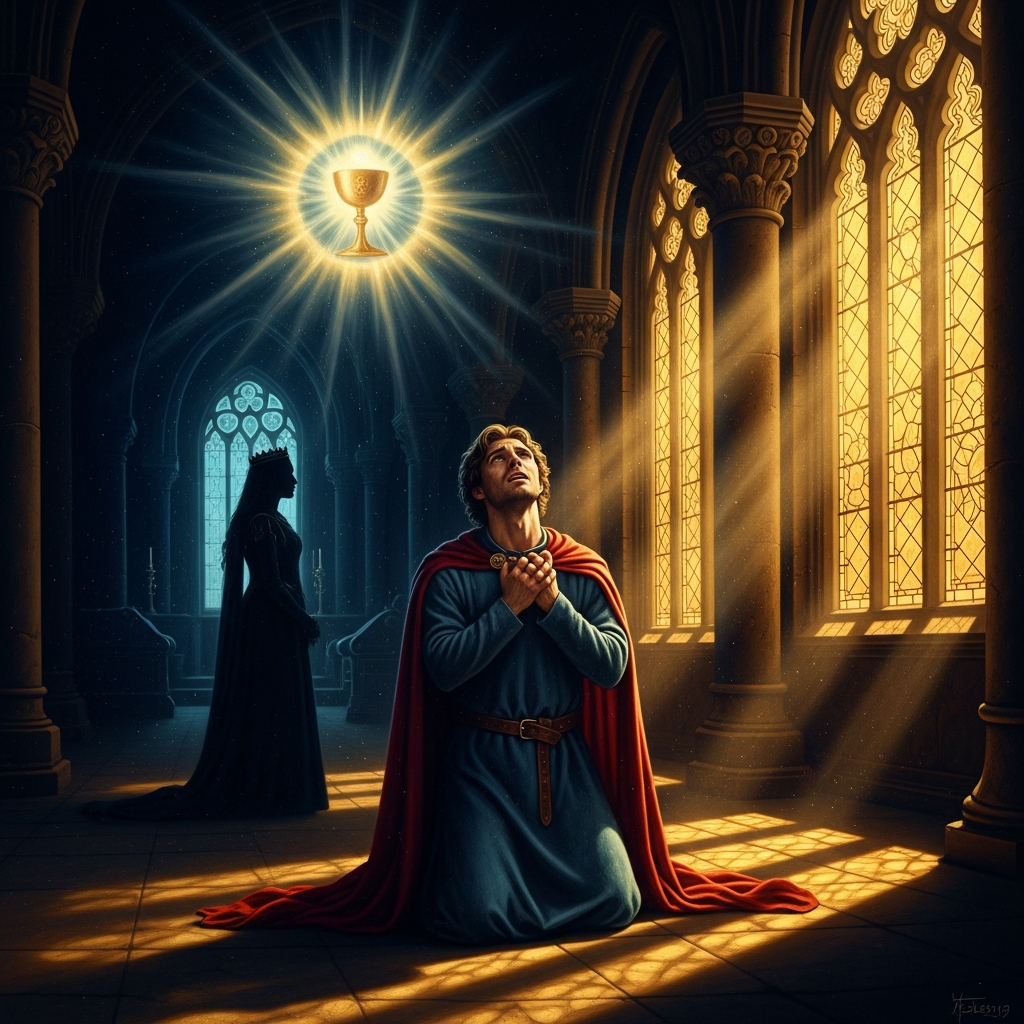
This is not a metaphor. His body will not cross the threshold. He stands with his hand on the doorframe, and some force that the Queste does not name and does not need to name holds him at the entrance of the one place he has ridden toward for a year, and he kneels down in the grass outside and prays — sincerely, desperately, with the full knowledge that he is not what the prayer requires him to be.
And then the door opens. And the light from the Grail comes out.
And Lancelot, who has survived a hundred battles without flinching, falls unconscious in the grass as if struck by something larger than an army.
He wakes at sunrise on the riverbank.
A voice has spoken to him in the dark, and he has not heard it as words so much as a weight placed on the chest. Twenty-four years in sin. The sentence is exact. Twenty-four years since the night he first came to Guinevere — and however the Queste frames the sin, however the later romances soften or condemn it, the mathematics are brutal. He has spent his entire knighthood, the whole arc of his legend, in a condition that makes the Grail impossible.
He lies on the riverbank and looks at the sky, and the sky is ordinary, and the extraordinary thing is that he is not surprised.
He has known, for a long time. Not consciously — he has not sat across from Guinevere in the hall and thought: this will cost me the Grail. He is not built for that kind of self-accounting. But somewhere below the surface of his heroism, in the place where a man knows what he is regardless of what he performs, he has known that the love and the quest exist in the same body and cannot both succeed.
He gets up. He retrieves his horse. He rides.
Lancelot is the most difficult figure in Arthurian legend because the tradition cannot decide what to do with him.
He is, by every martial measure, the best. He fights better than Gawain, better than Tristram, better than any knight alive. He rescues Guinevere from dangers that no other knight reaches in time. He loves Arthur with a loyalty that is, except for the one irreconcilable exception, absolute. He performs miracles of mercy — freeing prisoners, defending the weak, showing compassion to enemies in ways the other knights do not. He is, in the Vulgate, described as the closest approximation to what a knight can be.
And yet the Grail is not for him.
The Queste is explicit about the reason, and relentless about it, and if anything too relentless — the hermits and holy men who explain it to Lancelot throughout his quest read like a theological committee with one point to make. The point is this: grace and achievement are not the same. You can be the best knight who ever lived and still not be capable of what the Grail requires, because the Grail does not require greatness. It requires a particular kind of emptiness — a self that has been cleared of divided loyalty — and Lancelot’s self is full of Guinevere, as it has been for a quarter century, as it will be when he dies.
He does reach the Grail once more, by a different road.
He arrives at Corbenic during the night of its greatest mystery — the door open, the angels attending, the Grail central on the altar — and he enters the chapel because nobody stops him this time, and he walks forward, and the light hits him, and he is blinded and paralyzed for twenty-four days. Twenty-four days: one for each year.
When he recovers, he describes what he saw before the light took him.
He says he saw the most beautiful thing he had ever seen. He cannot say more. The language does not exist for what he saw. He is left, for the rest of his life, with the knowledge that he came closer than almost any other knight — that he walked into the chapel, that he saw the face of the mystery — and that the mystery sealed itself against him at the last moment with a kindness that was worse than rejection.
The love and the failure are the same thing.
This is the argument the Queste is actually making, and it is an argument that has troubled readers for eight centuries precisely because it is so uncomfortable to accept. Lancelot’s love for Guinevere is not presented as small or ugly or merely lustful. It is the love that makes him who he is. It is the engine of every rescue, every tournament, every impossible feat that fills the middle books of the legend with their extraordinary momentum. Without Guinevere, Lancelot would be a competent knight. With Guinevere, he is a legend.
And the legend cannot achieve the Grail.
He returns to Camelot carrying this. He does not leave Guinevere. The Vulgate does not require him to, and Malory does not require him to, and the later romances do not require him to, and this is not a failure of moral imagination on the part of the authors — it is honesty. The man who could leave Guinevere in order to be worthy of the Grail would not be Lancelot. He would be someone else. The only Lancelot who exists is the one who cannot leave her, and that Lancelot spends his whole life within sight of a door he cannot enter.
He knows what is on the other side.
He has seen the light.
He chooses to remain outside.
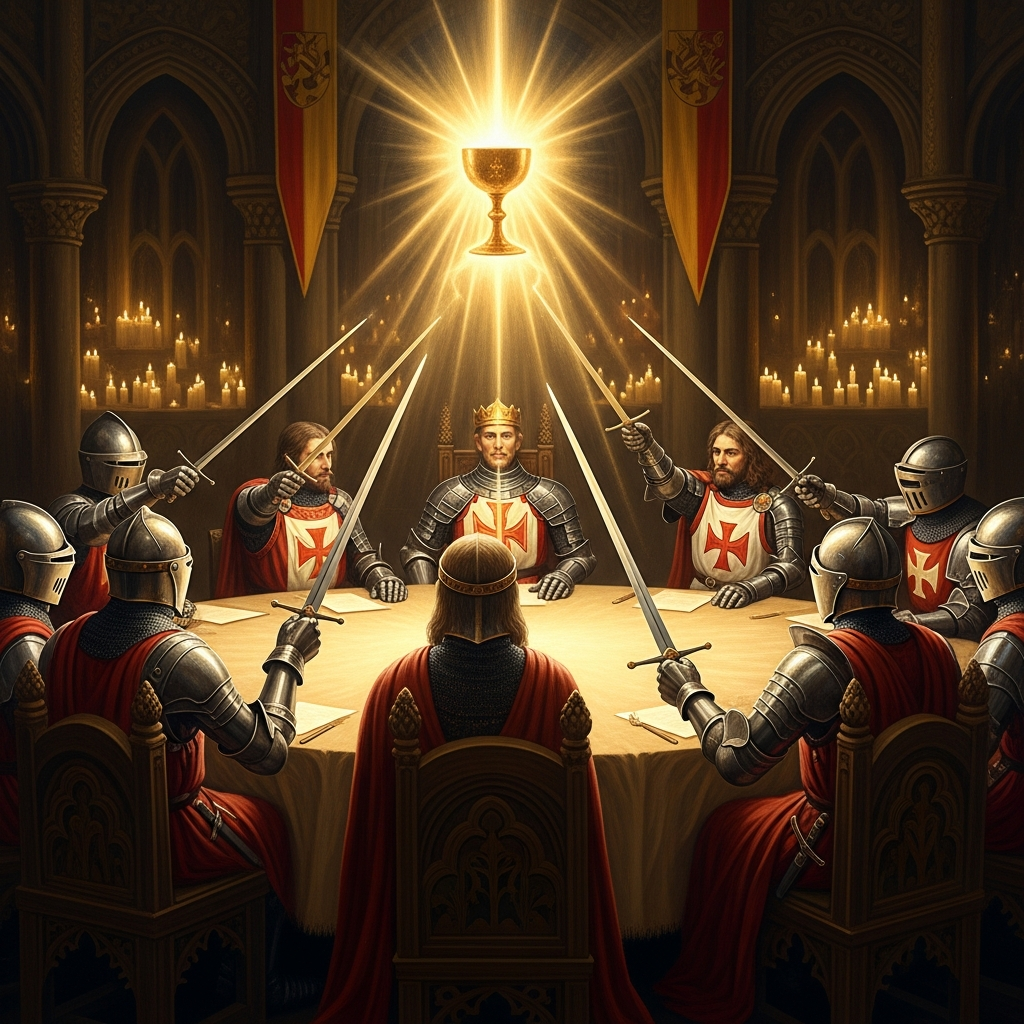
The Round Table, when it breaks, breaks first here — not at the betrayal, not at the siege, not at Camlann, but here, in the grass outside a chapel in the wasteland, where the greatest knight in the world falls unconscious under the weight of his own love and wakes to a sky that is very ordinary, and rises, and rides away.
Echoes Across Traditions
Entities
- Lancelot du Lac
- Guinevere
- Arthur
- the Holy Grail


Sources
- Chrétien de Troyes, *Lancelot, the Knight of the Cart* (*Le Chevalier de la Charrette*), c. 1177–1181 CE
- *La Queste del Saint Graal* (Vulgate Cycle), c. 1215–1230 CE
- Sir Thomas Malory, *Le Morte d'Arthur*, Books XI–XVII, 1485 CE
- Pauline Matarasso, trans., *The Quest of the Holy Grail* (Penguin Classics, 1969)
- Norris Lacy and Geoffrey Ashe, *The Arthurian Handbook* (Garland, 1997)
- C.S. Lewis, *The Allegory of Love*, Chapter 2 (Oxford, 1936)