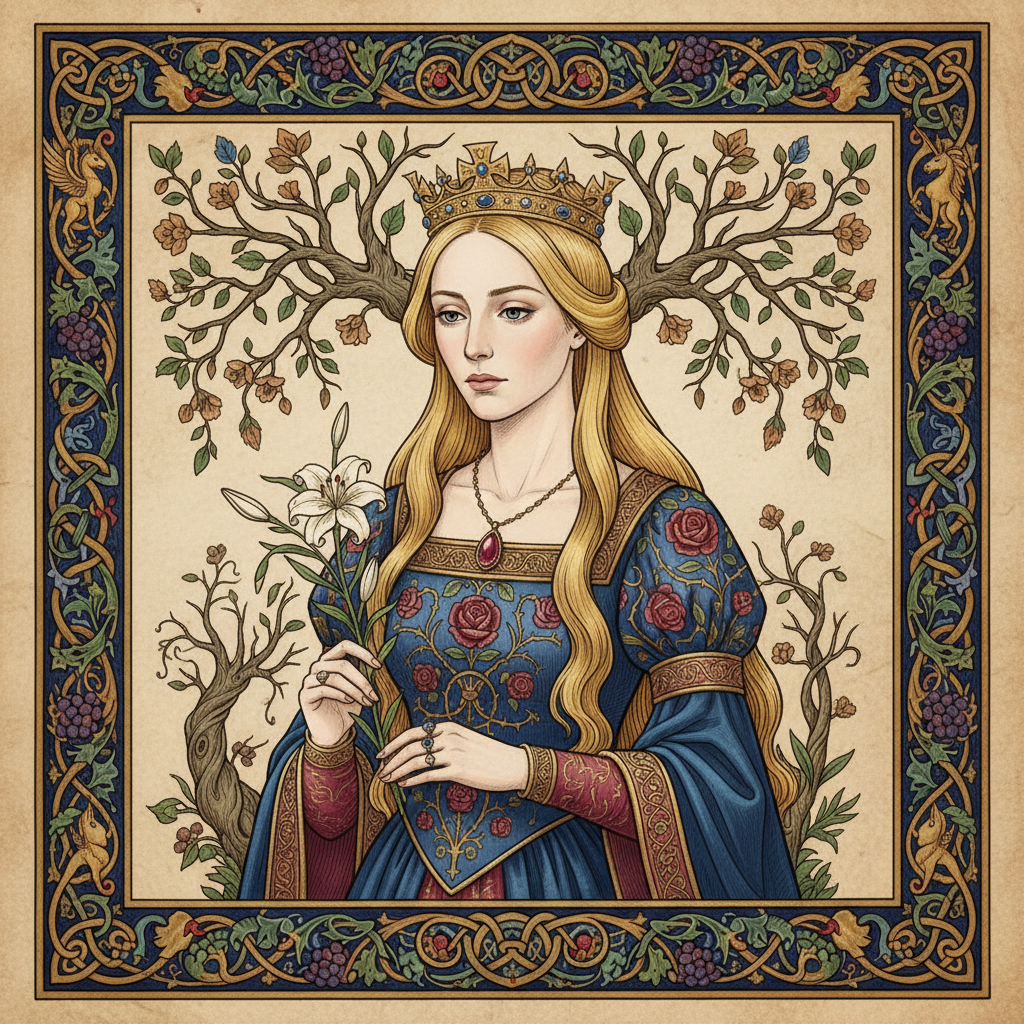
Combat Profile
Lancelot's Ruin
Guinevere amplifies the power of her beloved at the cost of destabilizing Camelot's foundations, dealing damage proportional to an ally's strength while weakening all defenses.
Courtly Radiance
Guinevere's presence grants nearby allies charisma and persuasion, but her inner conflict with duty creates vulnerability to accusations and betrayal.
Her desire for Lancelot overrides her duty to Arthur and to the kingdom
Lore: Guinevere is Arthur’s queen and the most beautiful woman in Britain. In the earliest Welsh traditions she is a more ambiguous figure — in one triad, Arthur has three wives all named Gwenhwyfar — but in the French and English traditions she becomes defined by her affair with Lancelot. She is not a passive figure: she is politically astute, commands loyalty, and in some versions rules capably during Arthur’s absences. But the tradition makes her the hinge on which Camelot breaks. Her desire is not trivial or petty — she genuinely loves Lancelot, and the tragedy is that this love, which in another context might be noble, is catastrophic in this one. In Malory’s ending, she takes the veil and lives out her days in genuine repentance, refusing even to see Lancelot when he comes to find her.
Parallel: Guinevere occupies the Eve position — the woman whose desire brings the Fall (Genesis 3). But the Malorian tradition also gives her the Mary Magdalene arc: the sinner who repents and devotes herself to God (Luke 7:36-50). She is not simply condemned; she is the proof that repentance is possible even after catastrophic sin. The dual reading — Eve and Magdalene in one figure — is distinctly medieval Christian.
1 min read
Mordred (who uses her affair as the weapon to destroy Camelot); public exposure (her sin's power depends on secrecy)
Chretien de Troyes; Vulgate Cycle; Malory, *Le Morte d'Arthur*; *Mabinogion* (as Gwenhwyfar)