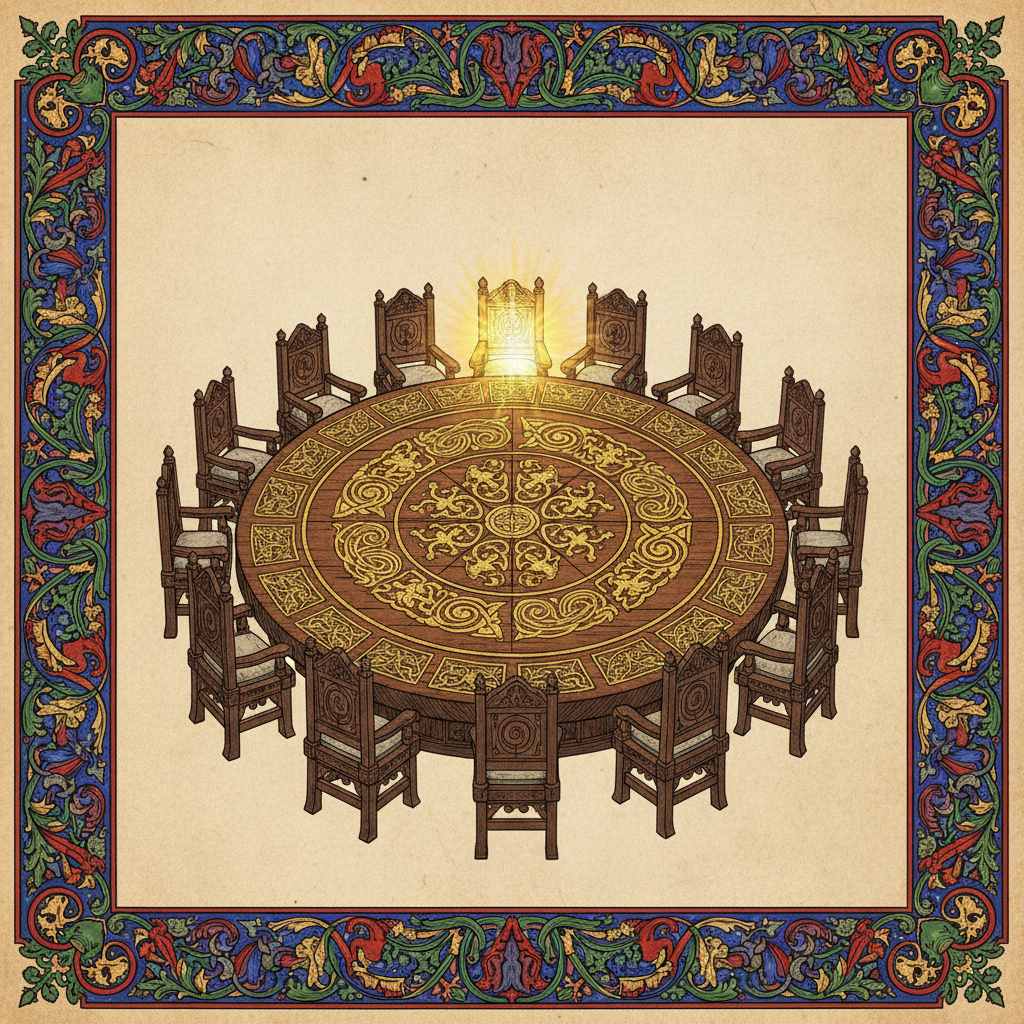
Combat Profile
Perfect Circle
grants all seated knights equal voice and unbreakable bonds of fellowship, making betrayal spiritually impossible
Harmonious Accord
radiates an aura of unity and brotherhood that inspires noble virtue and dissolves petty conflict among the worthy
The human sin of those who sit at it. The Table is perfect; the knights are not
Lore: The Round Table is Merlin’s invention and Arthur’s defining achievement as a political and spiritual leader. A circular table has no head — every seat is equal. In a feudal world defined by rigid hierarchy, this was a radical statement: the best knights of Christendom, regardless of birth or rank, seated as equals, unified by a shared commitment to justice, mercy, and the defense of the weak. At its height, 150 knights sit at the Table. The Siege Perilous (the “Dangerous Seat”) remains empty — it is reserved for the knight who will achieve the Grail, and anyone else who sits in it dies. When Galahad arrives and sits in it unharmed, the quest begins — and the fellowship ends. The knights scatter. Most die. Those who survive return to a broken court, and the Lancelot-Guinevere crisis finishes what the Grail Quest started. The Round Table is never reassembled. The ideal of equality and fellowship was real, and it was not enough to save itself from the sins of its members.
Parallel: The Round Table is the early Church as described in Acts 2:44-45 (“All the believers were together and had everything in common”) — the ideal community that fragments. It is the twenty-four elders seated around God’s throne (Revelation 4:4) — equals in the presence of the divine. The Siege Perilous is the seat reserved for Christ at God’s right hand (Hebrews 1:3) — the empty place that only the chosen one can fill. The Table’s destruction parallels the Fall (Genesis 3) and every subsequent shattering of unity: Babel, the divided kingdoms of Israel and Judah, the Great Schism of 1054. The shape itself is theological: the circle, having no beginning and no end, is a symbol of eternity and of God.
1 min read
Adultery (Lancelot/Guinevere), treachery (Mordred), and the Grail Quest itself (which scatters the fellowship beyond recovery)
Wace, *Roman de Brut* (~1155, first mention of the Round Table); Vulgate Cycle; Malory