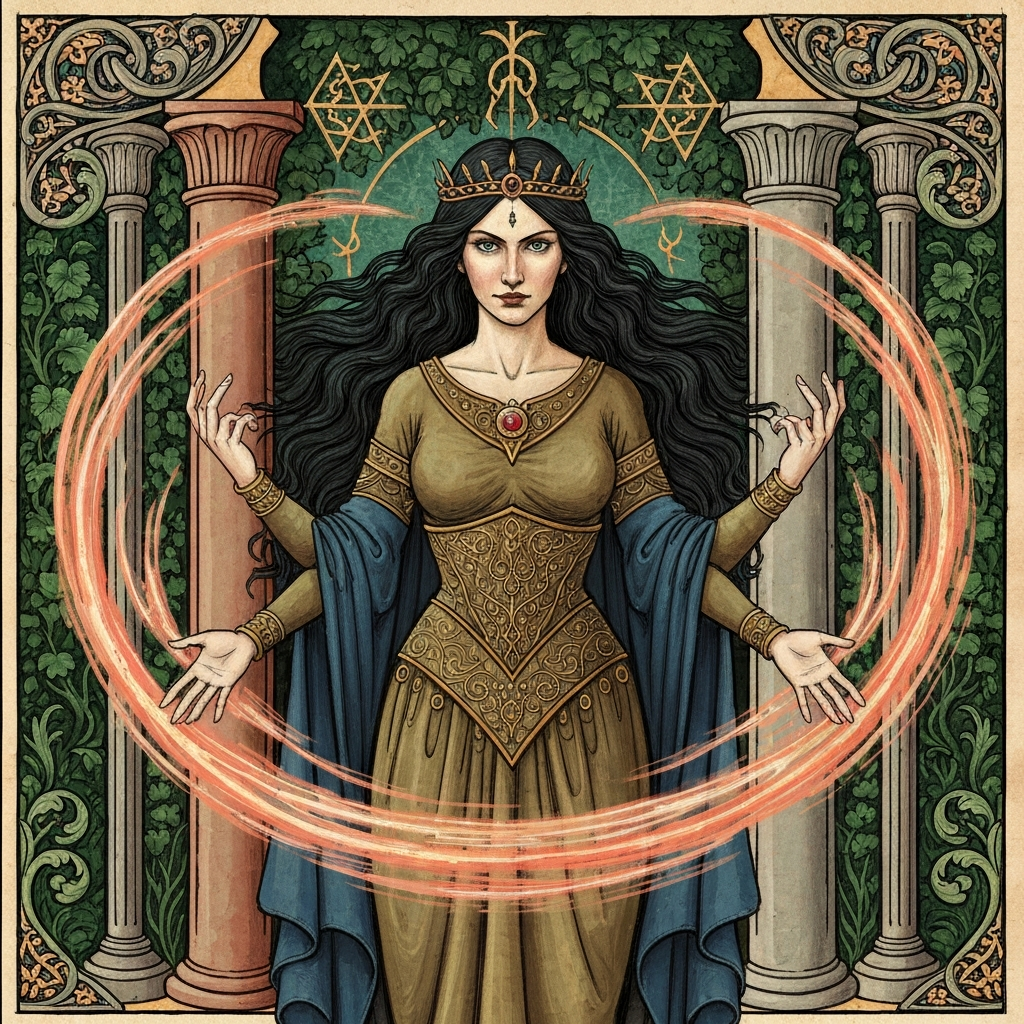
Combat Profile
Avalon's Veil
Morgan shifts between realms, becoming immune to harm while healing allies and cursing enemies simultaneously across the boundary between worlds.
Fey Sovereignty
Morgan's connection to Avalon grants her dominion over transformation magic and allows her to perceive and manipulate the hidden threads connecting Christian and Pagan realms.
Her enmity toward Arthur and Guinevere (in some versions) drives her to petty schemes; her magic, while powerful, is rarely sufficient to overcome the Christianized order
Lore: Morgan le Fay (Morgan the Fairy) is Arthur’s half-sister, daughter of Igraine and Gorlois of Cornwall. She is the most contradictory figure in the tradition: villain and healer, enemy and savior, pagan remnant and Christian penitent depending on which text you read. In Geoffrey of Monmouth’s Vita Merlini, she is the benevolent ruler of Avalon, a healer of extraordinary skill. In the Vulgate Cycle and Malory, she becomes a jealous antagonist who plots against Arthur and Guinevere, steals Excalibur’s scabbard, and attempts to expose the Lancelot-Guinevere affair (though in this she is telling the truth). In Sir Gawain and the Green Knight, she is the mastermind behind the Green Knight’s challenge to Camelot, testing the court’s virtue. Yet in every version that includes Arthur’s departure to Avalon, Morgan is there on the barge, ready to heal the king she spent years opposing. She represents the old Celtic magic — the pre-Christian Otherworld of fae, shapeshifters, and enchantresses — that Christianity could never fully absorb or fully reject.
Parallel: Morgan occupies the same space as Lilith in Jewish tradition — the independent, powerful feminine that the dominant religious framework cannot easily categorize as simply good or evil. She also echoes the wisdom/witchcraft boundary in Scripture: the Witch of Endor (1 Samuel 28) serves Saul even as she defies God’s law. The fact that she heals Arthur at the end suggests the medieval Christian intuition that even powers outside the Church’s framework might serve God’s purposes.
1 min read
The Grail (Christian sanctity neutralizes her sorcery); Merlin (who surpasses her)
Geoffrey of Monmouth (*Vita Merlini*, ~1150); Malory, *Le Morte d'Arthur*; *Sir Gawain and the Green Knight*; Vulgate Cycle