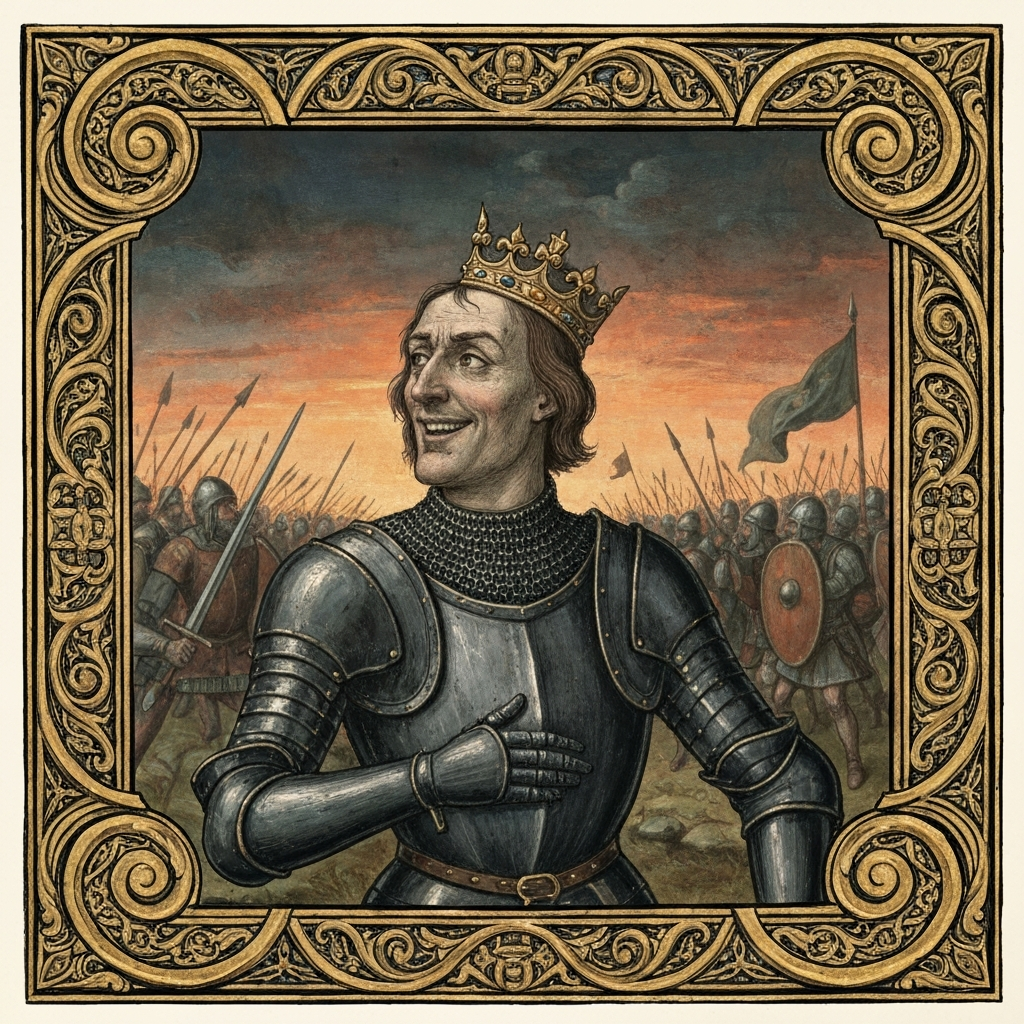
Combat Profile
Kingsbane
Mordred's blade strike targets the very foundation of his opponent's authority, reducing their defenses by half for three turns.
Inherent Corruption
All allies gain +15% damage when fighting alongside Mordred, but suffer cumulative curse stacking that triggers at battle's end.
He is not the equal of Arthur or Lancelot in combat; he wins through politics, not prowess. His claim to the throne depends on Arthur's absence
Lore: Mordred is Arthur’s doom. In the earliest sources (Geoffrey of Monmouth), he is simply Arthur’s nephew who betrays him. In the later tradition (the Vulgate Cycle, Malory), the story darkens: Mordred is Arthur’s illegitimate son, conceived unknowingly with his half-sister Morgause. Arthur, upon learning of the incestuous birth and a prophecy that a child born on May Day will destroy him, orders all noble children born that day set adrift in a boat (echoing Herod’s Massacre of the Innocents — Matthew 2:16). Mordred survives. He grows up at court, bitter and sharp, waiting. When Arthur pursues Lancelot to France, Mordred strikes — seizing the throne, claiming the queen, forcing Arthur’s return. At Camlann, in the final battle, Arthur drives his spear through Mordred, and Mordred, impaled, pushes himself up the shaft and strikes Arthur with his sword. They destroy each other.
Parallel: Mordred is the Judas of the Round Table — the betrayer from within the inner circle (Matthew 26:14-16). He is also Absalom, the son who rebels against his father the king (2 Samuel 15-18). In the theological structure of the Arthurian cycle, he functions as the Antichrist (2 Thessalonians 2:3) — the figure who arises when the true king departs, claiming authority he does not possess, and whose defeat requires the king’s return. The incest origin adds another layer: Mordred is the fruit of Arthur’s own sin come back to destroy him, the living proof that sin begets consequences.
1 min read
Arthur (kills him at Camlann, even as Mordred delivers the mortal wound)
Geoffrey of Monmouth; Vulgate Cycle; Malory, *Le Morte d'Arthur*; the Annales Cambriae (~970, earliest mention of Camlann)