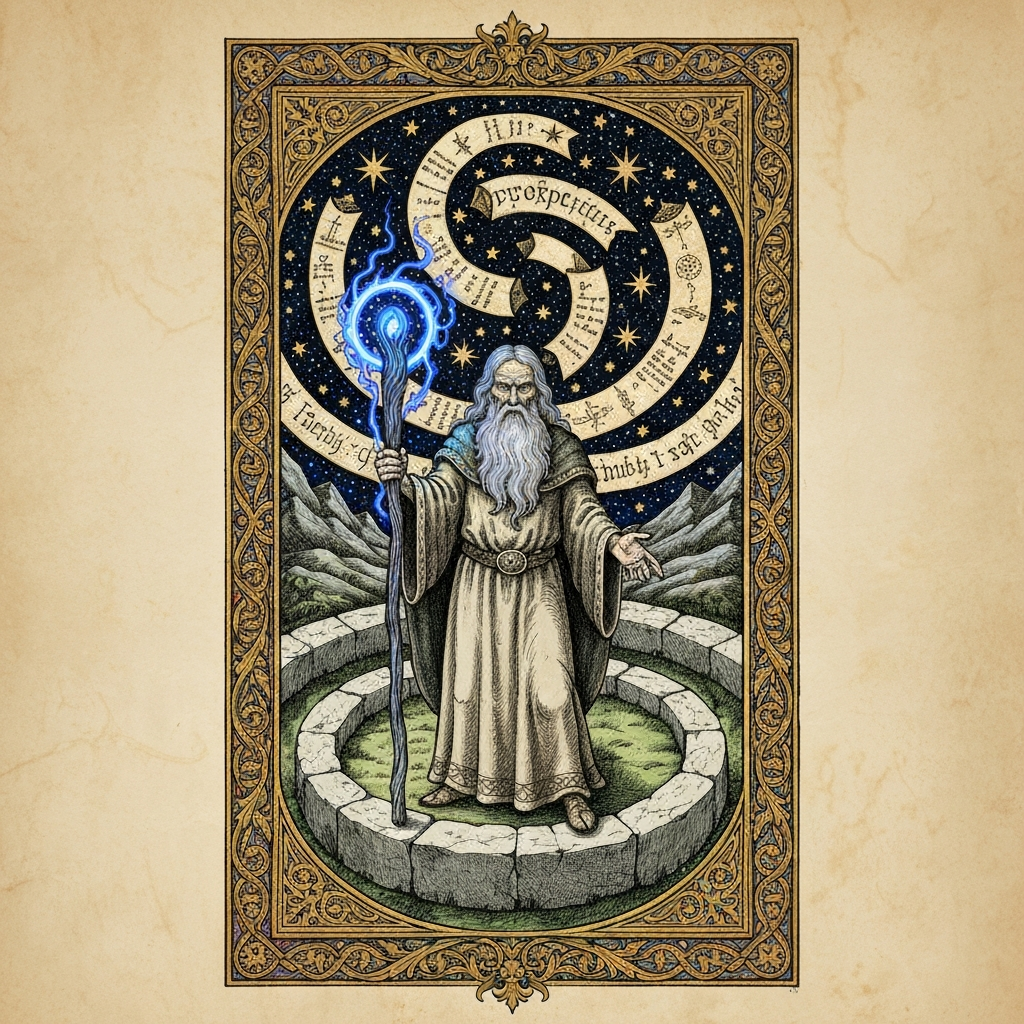
Combat Profile
Architect of Fate
Merlin reshapes destiny itself, engineering pivotal moments that alter the course of kingdoms and bloodlines.
Omniscient Sight
Merlin perceives past, present, and possible futures simultaneously, granting perfect clarity in all matters of consequence.
His desire for Nimue/Viviane, which she uses to learn his secrets and imprison him. The prophet who sees the future cannot escape his own fate
“Merlin knew well that he should be put in the earth alive, but he could not act against it.” — Vulgate Suite du Merlin
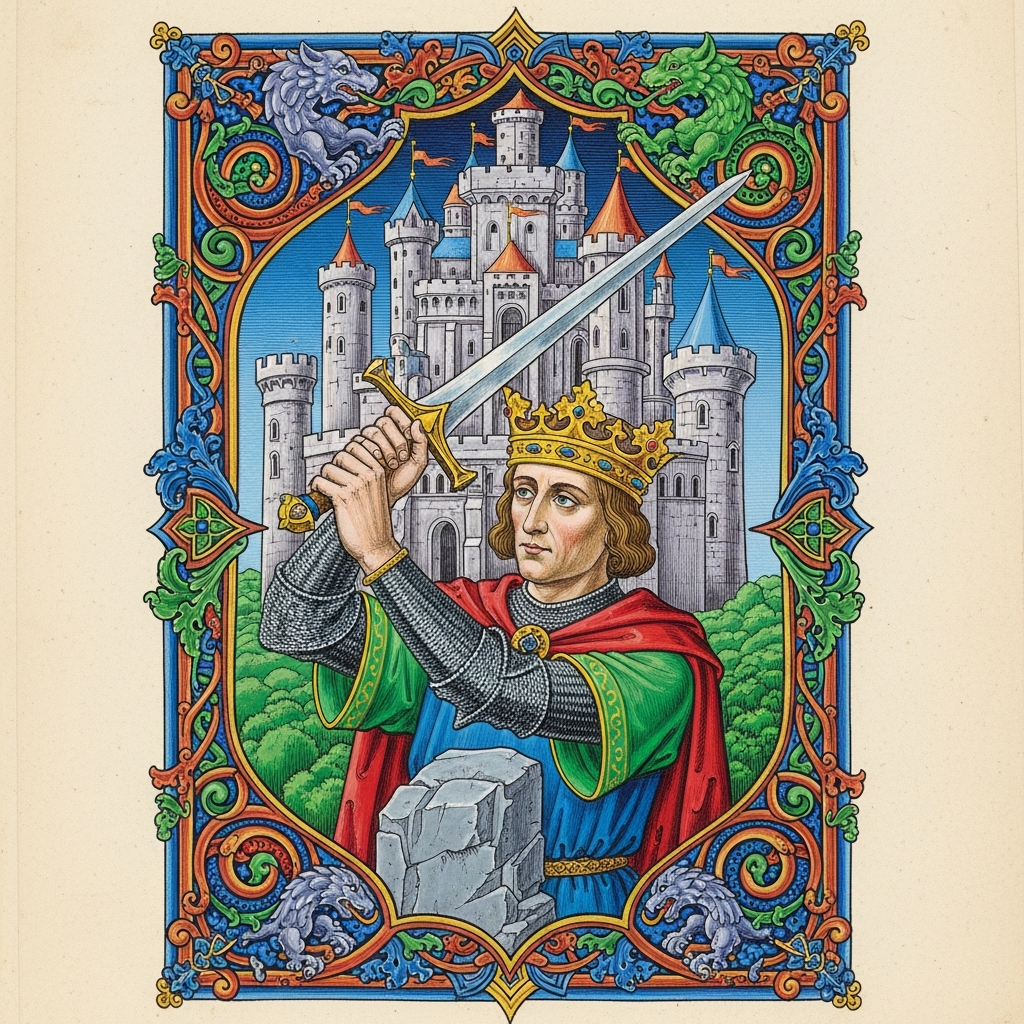
Lore: Merlin (Myrddin in Welsh) is the architect of the Arthurian world. In Geoffrey of Monmouth, he is the son of a demon (an incubus) and a human woman — a Nephilim-like hybrid whose diabolical inheritance gives him his power but whose mother’s virtue (she was a nun in some versions) baptizes that power into service of God. He is the mind behind everything: he engineers Arthur’s conception, arranges the Sword in the Stone as the test of kingship, advises Arthur through the early wars, and establishes the Round Table. He can see the future with perfect clarity — he knows how Camelot will fall, he knows the Grail Quest will scatter the fellowship, he knows Mordred will betray Arthur. He knows, and he builds the kingdom anyway. His own end is the tradition’s cruellest irony: the man who can see everything coming is undone by his desire for Nimue (or Viviane), a young enchantress who learns his secrets and uses them to imprison him forever — in a cave, a tree, a tower of glass, depending on the source. He is alive but trapped, seeing but unable to act, the ultimate image of wisdom without freedom.
Parallel: Merlin is the Nephilim of Christian mythology — the demon/human hybrid (Genesis 6:4; 1 Enoch 6-16) whose mixed nature produces extraordinary power. He is also the prophet who cannot escape his own prophecy, paralleling Samson (Judges 16) — the man of supernatural gifts brought low by a woman who extracts his secrets. His imprisonment echoes the binding of the Watchers in 1 Enoch 10:4-6 and the chaining of Satan in Revelation 20:1-3 — powerful beings contained, still conscious, awaiting a release that may or may not come.
1 min read
Nimue/Viviane (imprisons him using his own magic); love (the one force his intellect cannot outmaneuver)
Geoffrey of Monmouth, *Historia Regum Britanniae* (~1136) and *Vita Merlini* (~1150); Vulgate Cycle; Malory; Robert de Boron, *Merlin* (~1200)