Nimue and the Trap of Merlin's Own Teaching
Lancelot-Grail Cycle (Vulgate), c. 1215–1235 CE; developed in Malory, 1485 CE · The forests of Britain; the lake shore; the sealed space that is neither a tree nor a cave but something for which there is no good word
Contents
Merlin falls in love with Nimue (the Lady of the Lake) and teaches her all his arts. She uses everything he teaches her to seal him inside an oak tree, or a cave, or a tower of air — depending on the telling. He sees it coming. He cannot prevent it. He has foresight but not free will. The greatest magician in British legend is imprisoned by his own pupil using his own magic.
- When
- Lancelot-Grail Cycle (Vulgate), c. 1215–1235 CE; developed in Malory, 1485 CE
- Where
- The forests of Britain; the lake shore; the sealed space that is neither a tree nor a cave but something for which there is no good word
Merlin knows.
This is the first fact of the story, and the most important. He knows from the beginning that Nimue will seal him away. He knows when he first sees her, or he knows shortly after, or he has always known because the future is present to him the way the past is present to other men — available, visible, organized, not subject to alteration by the fact of knowing.
He teaches her anyway.
This is not the detail that a story about foolish love would contain. In a story about foolish love, the wise man is blinded by his desire and cannot see clearly. Merlin sees clearly. He can see the sealed space, the moment when the door closes, the silence that follows. He sees Nimue’s face when she completes the work. He sees it, and he continues to teach her, sitting with her in the forest or by the lake’s edge or in the high room where he keeps his instruments, showing her the precise operations of his art with the patience of a master who believes the student is worth the teaching.
He believes she is worth it.
He is not wrong.
Nimue comes to Arthur’s court and she comes specifically to be near Merlin.
The Vulgate is careful about her motivations. She does not want what men who scheme at courts want. She wants knowledge — the deep knowledge of how the world’s hidden machinery operates, which Merlin has spent a long life acquiring from sources he has never fully named. She wants it the way a student wants the one thing she has always been moving toward, and she is willing to spend years acquiring it, and she is willing to use whatever proximity achieves that acquisition.
She uses Merlin’s love.
She does not love him, or she does not love him in the way he loves her — the Vulgate is explicit that she finds him tedious in his pursuit, that the love is an inconvenience she manages rather than a feeling she shares. She manages it with precision. She does not encourage him past the point of usefulness. She permits exactly the degree of hope that keeps him teaching. She is, in the clinical sense, ruthless — and the tradition does not entirely condemn her for it, which is its own form of honesty.
She learns everything he can teach her.
This takes years. She is with him through most of the early reign — through the wars, the consolidation, the building of the Round Table’s first generation. Merlin is at Arthur’s court and she is near Merlin and the court goes about its business around them, unaware that the sequence of lessons in the forest is the mechanism by which it will lose its prophet.
The sealing happens on a journey.
Malory places it in the forest of Broceliande, or in a forest that serves that function — a place of old trees, deep shade, the kind of forest that is everywhere in the Arthurian tradition and is understood to be the threshold between the known world and something older than it. They are walking together, and she is asking questions, and he is answering them, because answering is what he does and because the knowing and the answering have become indistinguishable from the knowing and the sealing.
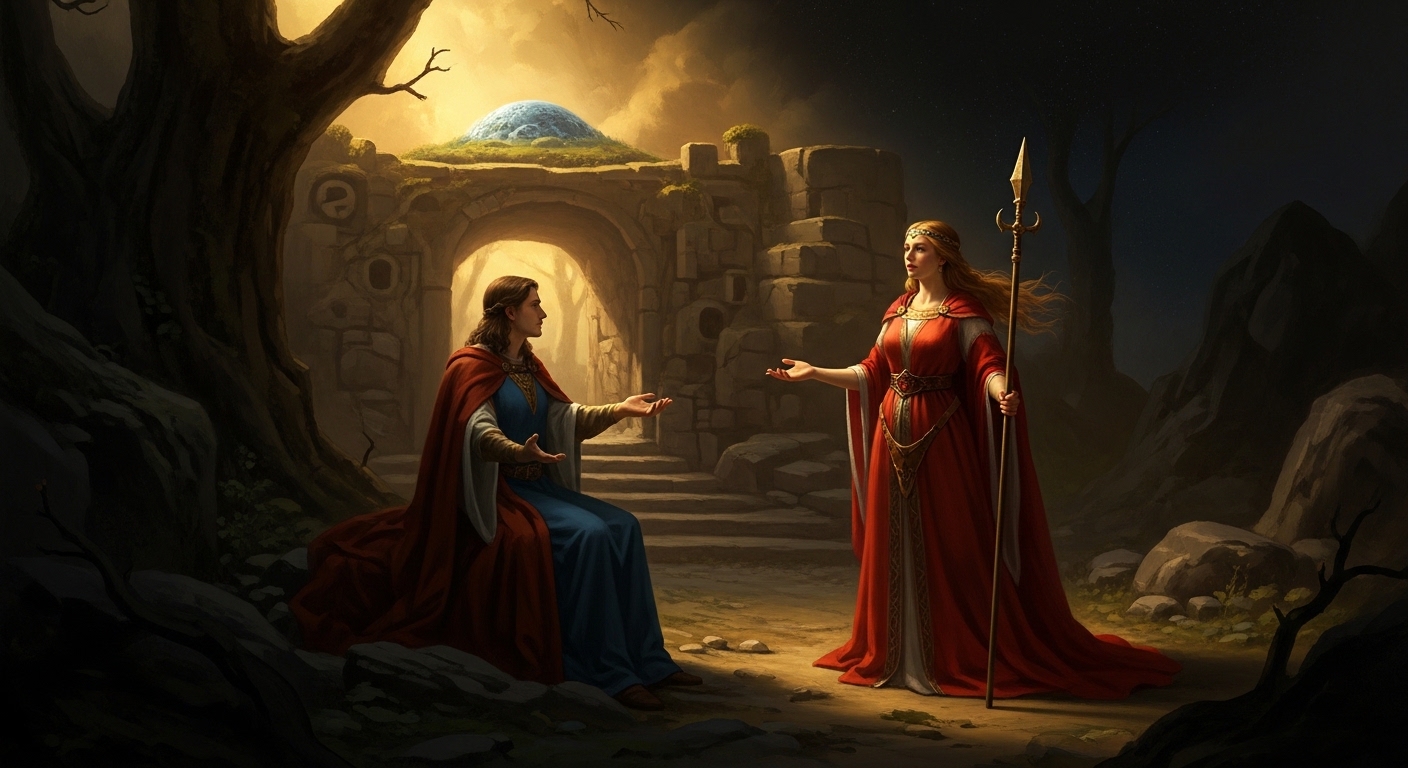
She asks him about a cave beneath a flat rock — or a hollow in an oak, or a tower that exists in the space between two spells — and he shows her.
She shows him the interior. He steps inside to demonstrate something — the point varies by telling — and she completes the working before he turns around.
In the Vulgate, she walks around the sleeping place seven times, chanting the words he taught her. In Malory, she covers the rock with the charm he explained to her. In the Welsh tradition, the place is the oak, and she seals it with the seal he described. The details vary because the essential act is the same in every version: she uses the teaching as the instrument of the teaching’s end, and he cannot prevent it, and the air closes around him.
He speaks to her before the end.
In some versions he tells her what she has done. Not accusingly — the tone in the Vulgate is something closer to recognition, the quality of a man who has reached a moment he has always known was coming and finds it neither better nor worse than he expected. He says: You have done what you have done. She says: Yes. He says nothing more.
In other versions he says: You will remember this differently than it happened. She does not answer.
The tradition cannot agree on what he says because it cannot agree on what the correct attitude toward a foreseen disaster is — whether acceptance, or grief, or a kind of terrible equanimity, or something else for which it does not have a word.
What the tradition does agree on is that he does not beg.
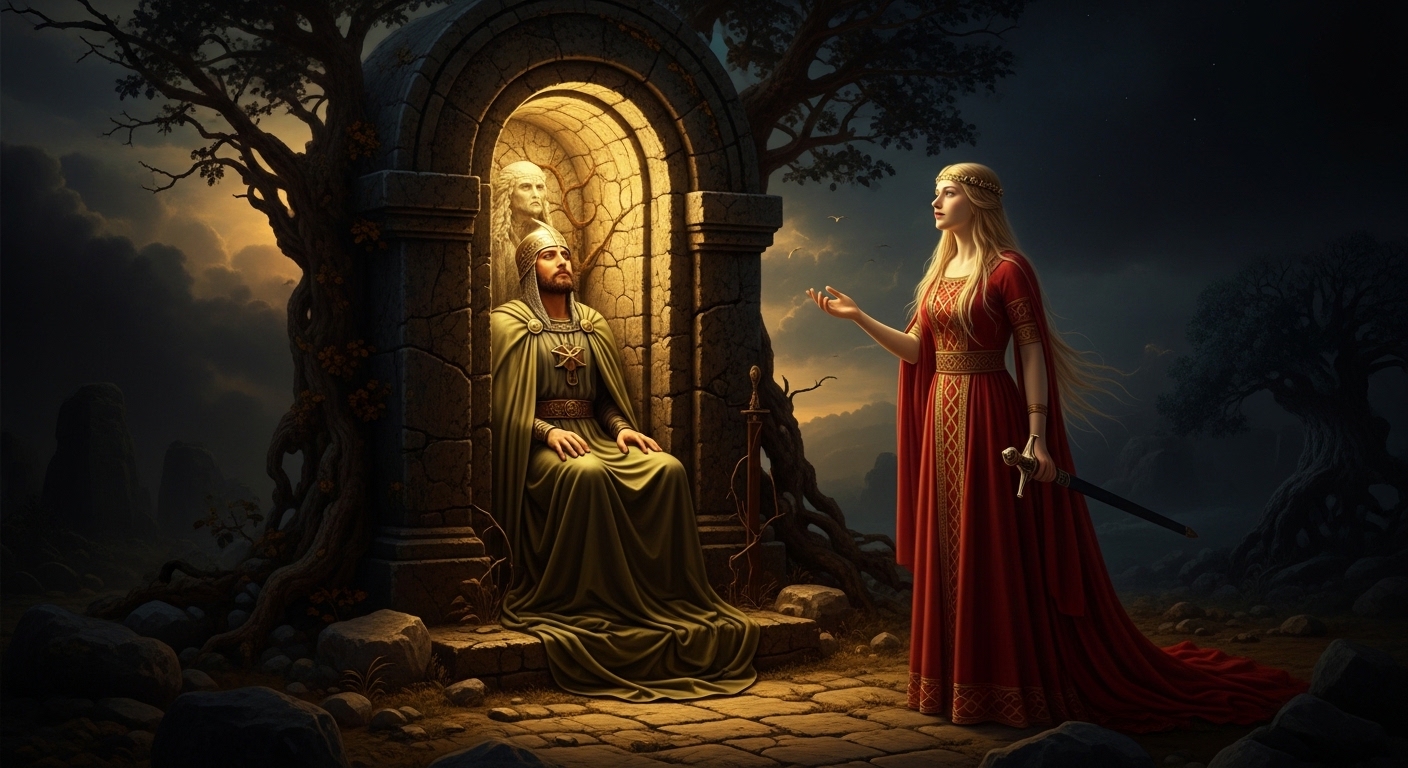
He is sealed inside. He continues to exist inside the sealed space — dreaming, or aware, or speaking to those who come close enough to hear a voice from the stone or the oak or the air. The tradition records that he spoke, occasionally, for a long time. Advice about the kingdom, warnings about what was coming, the kind of counsel he had been providing from outside the sealed place now provided from within it.
The sealed prophet. The seer who saw his own sealing and could not prevent it.
Arthur does not know why Merlin is gone.
He knows Merlin is gone — one day the presence that had been at his shoulder since before his birth is simply absent, and the court adjusts to the absence the way courts adjust to things, which is to say not well and without naming what has been lost. Nimue takes Merlin’s place, loosely. She is still there, still at court, still the Lady of the Lake with her particular quality of knowledge. She advises Arthur. She is loyal, in her way.
But she is not Merlin.
Merlin, inside the sealed space, knows what is happening above him. He knows about Lancelot and Guinevere. He knows about Mordred, whose significance he understood before Mordred was born. He knows about Camlann.
He cannot say anything that reaches them.
Or he can say things, from inside the sealed space, that the wind carries, that the trees carry, that occasionally arrive as a half-heard voice in the right place at the right moment — but they cannot hear him clearly enough to act on what he is saying, and the knowing and the seeing are not the same as the speaking and the changing.
He sees the whole thing.
He cannot stop it.
He never could have stopped it.
The oak stands in the forest. The forest is old. The voice in the oak says things that the passing knights sometimes pause to hear and cannot quite make out.
The kingdom goes toward what it was always going toward.
Merlin watches.
Scenes

Echoes Across Traditions
Entities
- Merlin
- Nimue (Viviane / the Lady of the Lake)
- Arthur
- Morgan le Fay

Sources
- *Lancelot-Grail Cycle* (Vulgate Merlin), c. 1215–1235 CE
- *Suite du Merlin* (Post-Vulgate), c. 1230–1240 CE
- Sir Thomas Malory, *Le Morte d'Arthur*, Book IV, 1485 CE
- Norris J. Lacy, trans., *Lancelot-Grail: The Old French Arthurian Vulgate and Post-Vulgate in Translation* (Garland, 1993)
- Michael J. Curley, *Geoffrey of Monmouth* (Twayne, 1994)
- A.O.H. Jarman, *The Legend of Merlin* (University of Wales Press, 1960)