Lalibela's Dream: A Jerusalem in Stone
King Lalibela reigned c. 1181–1221 CE; churches built c. 12th–13th century · Lalibela (Roha), the Lasta highlands of northern Ethiopia
Contents
King Lalibela of Ethiopia, after being poisoned by his brother and carried to heaven in a vision, is commanded by God to build a new Jerusalem in the mountains of Africa — churches carved not built, cut downward into the living rock by human hands and, according to tradition, finished overnight by angels.
- When
- King Lalibela reigned c. 1181–1221 CE; churches built c. 12th–13th century
- Where
- Lalibela (Roha), the Lasta highlands of northern Ethiopia
Before he was a king, Lalibela was a child who slept surrounded by bees.
His mother found him as an infant in a swarm of them — not stung, not frightened, utterly calm, the bees covering him from head to foot in a living gold. She interpreted this as a sign, as mothers in such stories always do, and she named him accordingly: Lalibela means, in the Agaw language, the bees recognize his sovereignty. His older brother, who was already in line for the throne, heard the interpretation and became afraid.
When Lalibela was a young man, his brother had him poisoned.
The poison did not kill him. Instead, it carried him somewhere.
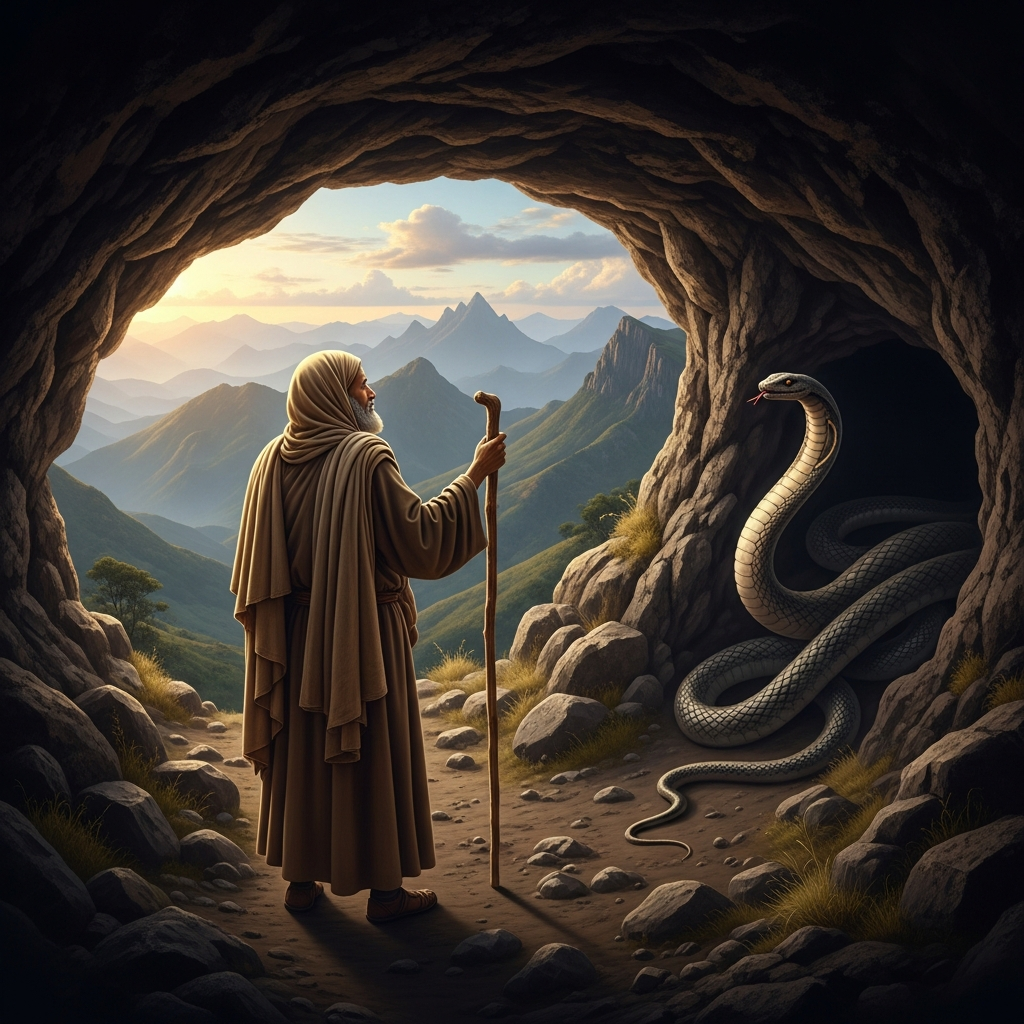
The Gadla Lalibela — his hagiography, compiled a century or two after his death — describes what happened in the three days Lalibela lay between life and death: he was taken up. Not metaphorically. He was carried bodily through the air, the way the prophets were carried, through three levels of heaven, and in the third heaven God spoke to him directly.
God said: I want you to build churches. Not any churches — churches unlike any that have ever been built. Not buildings that rise from the earth but buildings that go into it. In the red rock of the highlands, you will find churches already waiting. Cut away what surrounds them. Find what is already there.
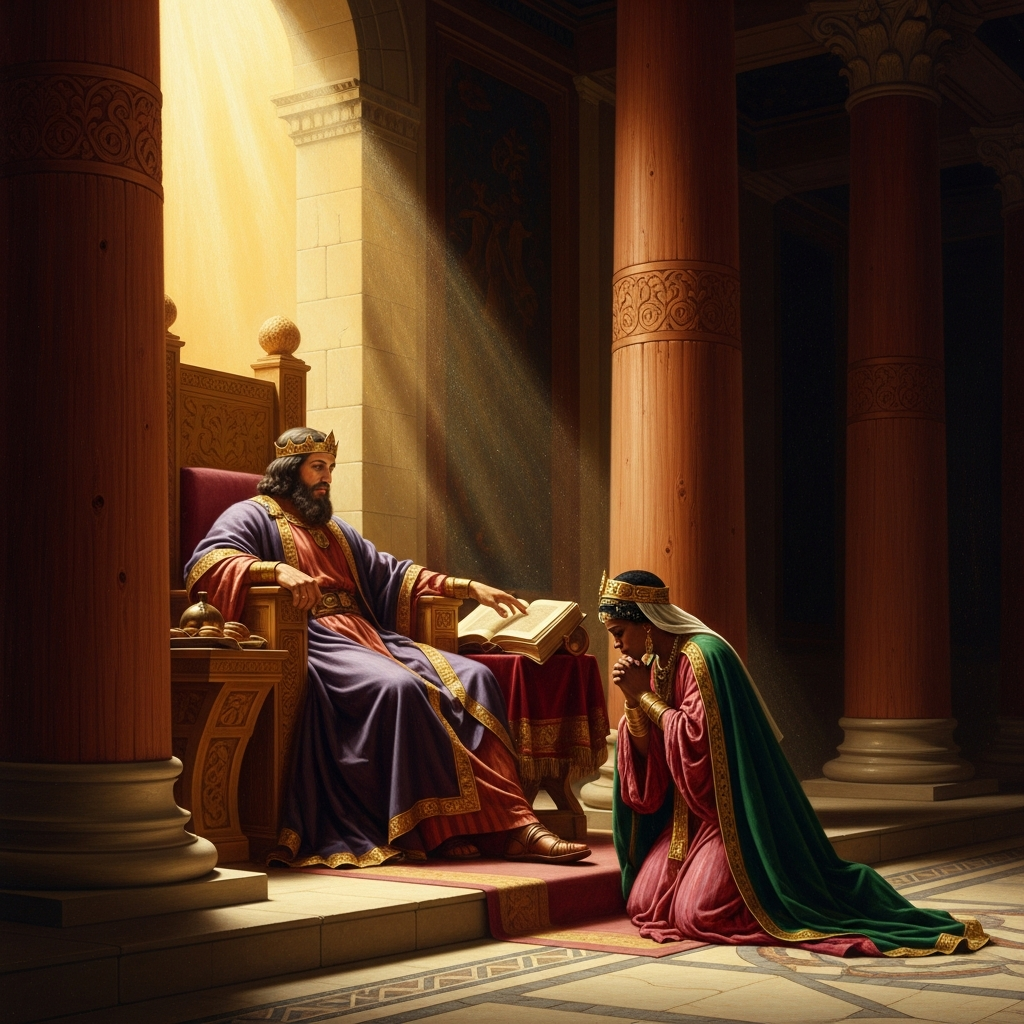
Lalibela was shown the plan in detail, the way Solomon was shown the plan of the Temple. He was shown eleven churches, their placement in relation to one another, the underground passages connecting them, the topography of the site redesigned to mirror Jerusalem. He was shown the River Jordan, the Hill of Calvary, the tomb of the resurrection — all relocated to a plateau in the Lasta mountains of northern Ethiopia.
He woke up and the poison was gone.
He was crowned after his brother died without an heir, and he ruled for forty years, and almost all of those years were given to the churches.
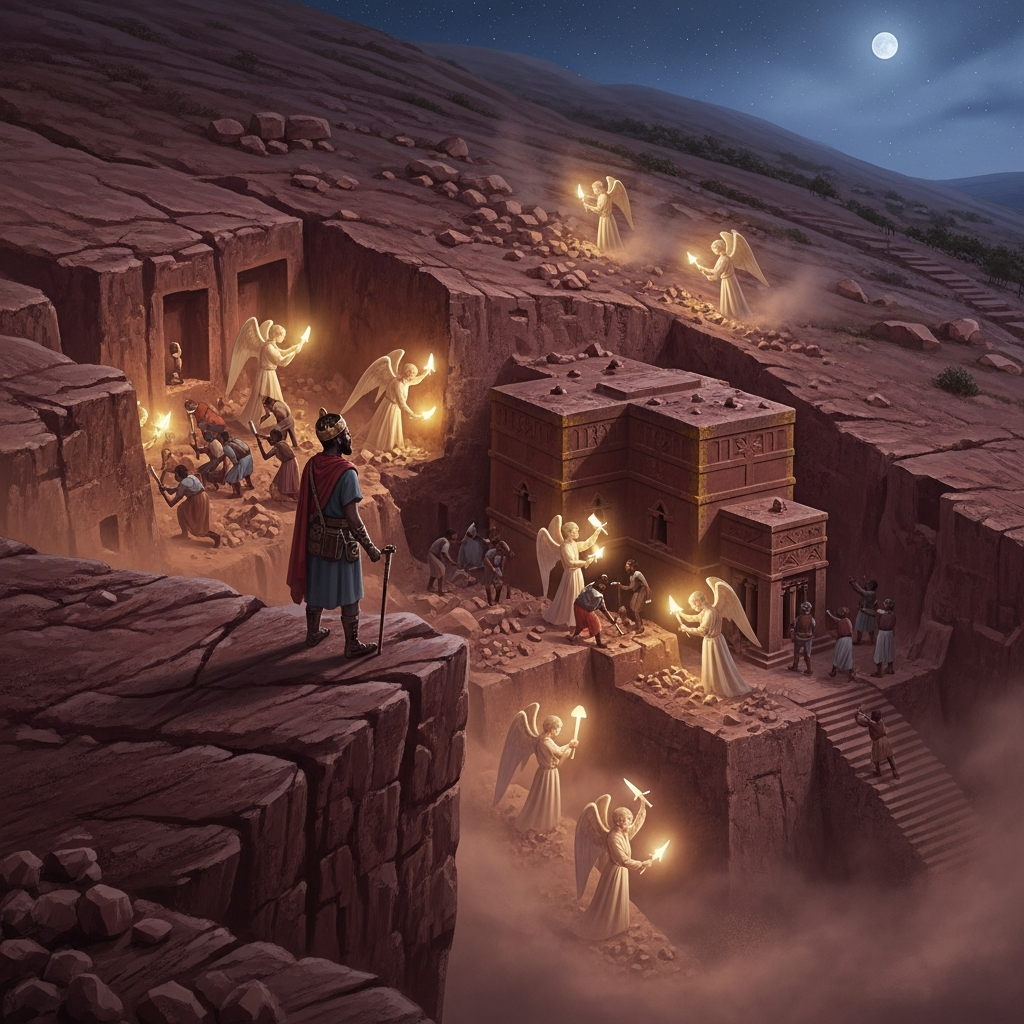
The work was entirely manual. Ethiopian craftsmen with iron chisels and wooden mallets descended into trenches cut from the top of the plateau, working in the narrow spaces they were creating, removing the red tuff in chips and blocks. The work required three-dimensional planning of extraordinary precision: to carve a freestanding church from inside a rock trench, you must visualize the negative space before you excavate it, and the error is permanent — there is no way to replace stone you have wrongly removed.
The craftsmen were followed each night, the tradition holds, by angels who completed in the hours of darkness what the humans could not finish in a day. This is not ornamentation. The priests of Lalibela treat it as factual. Some historians have suggested the angelic labor explains why no contemporaneous account of the construction process survives — the building was not fully observed because some of it could not be observed.
Queen Maskal Kibra, Lalibela’s wife, built and managed several of the churches herself. She is buried in one of them. The tradition credits her specifically with the church of Bete Abba Libanos, which is carved into a cliff face and is perhaps the most technically improbable of the eleven — three walls are stone, the fourth is the cliff itself, and the interior columns are joined to the ceiling at angles that should not stand.
The churches are organized around a sacred geography Lalibela mapped from memory of his vision.
The northern group of churches clusters around the church of Bete Medhane Alem — House of the Savior of the World — which is the largest rock-hewn church on earth: thirty-three meters long, twenty-four meters wide, carved entirely from the living rock, its roof supported by twenty-eight interior pillars in the style of a Greek basilica. Everything about its scale is impossible until you are standing inside it, and then it is simply enormous, and the light falls through the narrow windows at an angle that changes completely as the day moves, so that morning prayer and evening prayer happen in effectively different rooms.
A river runs between the northern and southern groups of churches. It is called the River Jordan.
The southern group contains Bete Giyorgis — the Church of Saint George — which is the most photographed of the eleven and the most severe: a perfect cube of red rock, lowered thirty meters into a trench cut from the plateau, its exterior surfaces carved with interlocking crosses, the whole thing accessible only by a single staircase cut through the rock wall of the trench. Lalibela is said to have built it last, after Saint George appeared to him on horseback and complained that none of the churches were yet dedicated to him. The king built this one in apology.
Saint George rides a white horse in Ethiopian iconography. The Church of Saint George, from above, looks like a cross.
When Lalibela died, around 1221 CE, the eleven churches were complete.
He was buried in the church of Bete Golgotha, which contains a replica of Christ’s tomb and where, on certain days, only men are permitted to enter. His tomb is still there, behind a curtain, and priests pray over it every day.
The city that grew up around his churches was renamed Lalibela after his canonization. Before him, it was called Roha. After him, it became what he had been told to make it: a Jerusalem that Ethiopians did not have to cross deserts and seas to reach, a place where the Holy Land was right there in the mountains, cut into the rock, permanent as the rock itself, older-seeming than anything built.
Pilgrimages began while he was still alive. They have not stopped.
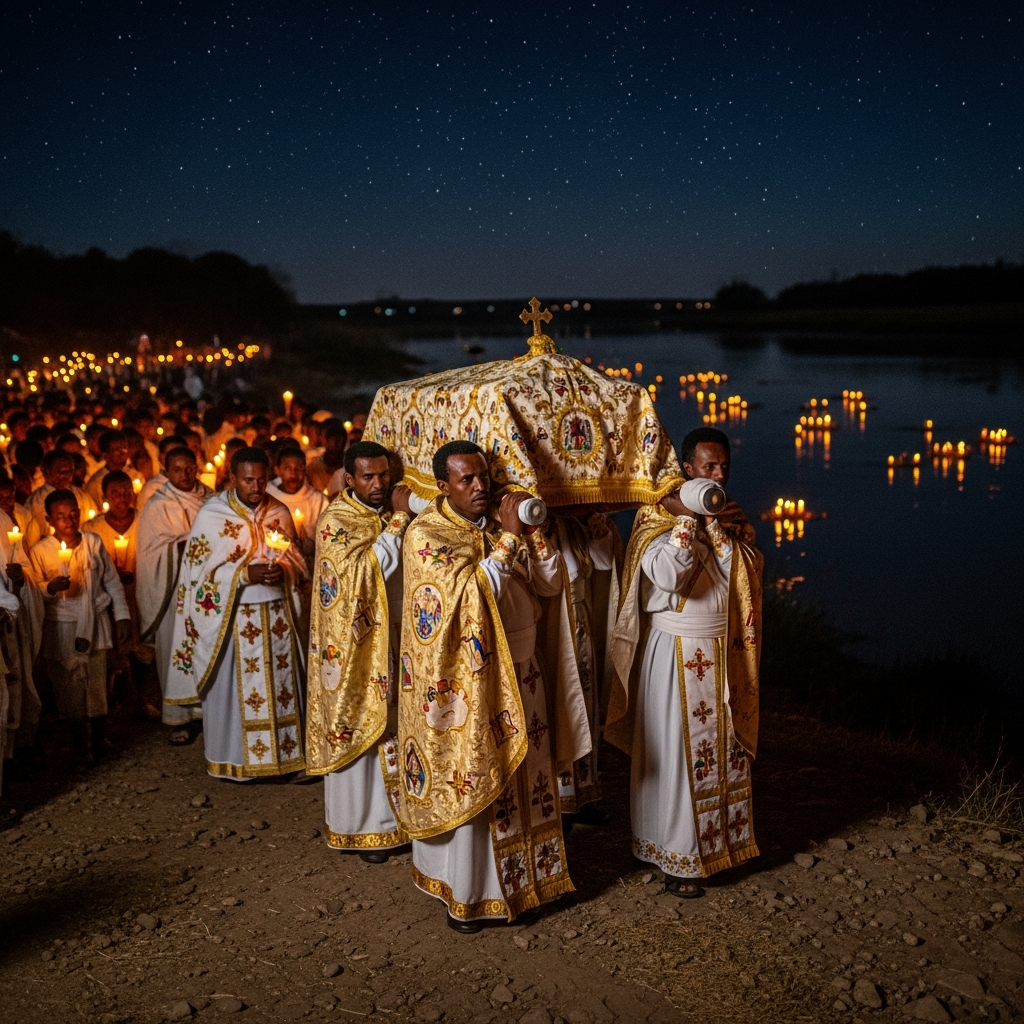
On Ethiopian Christmas, the white-robed pilgrims fill the trenches so completely that from the rim above, looking down, you cannot see the churches — only people, packed into the negative spaces of the rock, singing in the space that was not built but found.
Echoes Across Traditions
Entities
- King Lalibela
- angels
- God
- Queen Maskal Kibra
Sources
- Gadla Lalibela (Life of Lalibela), 14th–15th century hagiography
- David Phillipson, *Ancient Ethiopia: Aksum, Its Antecedents and Successors* (1998)
- Ivy Doress, 'The Rock-Hewn Churches of Lalibela,' *African Arts* Vol. 2 No. 4 (1969)
- Roger Schneider, *The Rock Hewn Churches of Ethiopia* (1959)
- UNESCO World Heritage Committee, *Lalibela Church Complex* inscription (1978)