The River That Remembers Jordan
Annual celebration on 19 Terr (January 19); tradition established with Ethiopian Christianity from 4th century CE · Gondar; Lalibela; every Ethiopian town with a body of water; the Jordan River in memory
Contents
Every January at Timkat, Ethiopian priests carry the Tabot — a replica of the Ark of the Covenant — to a body of water in a candlelit procession, re-enacting the baptism of Christ in the Jordan. At dawn, the water is blessed, and the faithful leap in. For one night, every river in Ethiopia is the Jordan.
- When
- Annual celebration on 19 Terr (January 19); tradition established with Ethiopian Christianity from 4th century CE
- Where
- Gondar; Lalibela; every Ethiopian town with a body of water; the Jordan River in memory
The procession begins the evening before.
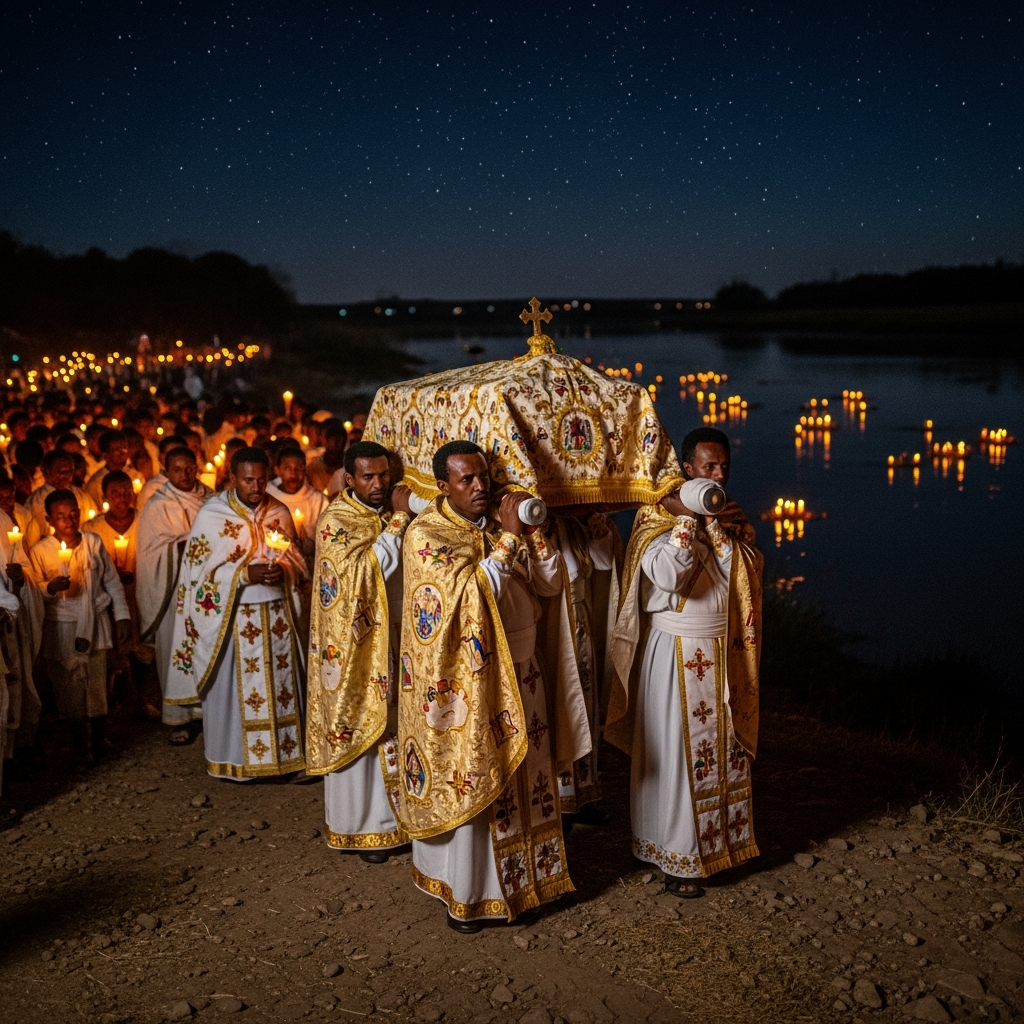
At dusk on the 18th of Terr — the Ethiopian month that falls in January — the priest of each church emerges from the Holy of Holies carrying the Tabot, wrapped in embroidered cloth so that no one can see it directly. The Tabot is the church’s tablet: a flat piece of wood or stone, inscribed with the name of the saint to whom the church is dedicated, kept in the innermost room in the manner of the original tablets in the original Ark, never unwrapped in public, touched only by the priest whose responsibility it is.
He carries it on his head.
The congregation falls in behind him. The deacons carry the processional crosses — the tall, ornate crosses of Ethiopian Christianity, each one different, each one the visual signature of its church, held up above the crowd on long poles. Debteras — the singing class, neither priests nor monks but liturgical specialists who have spent years memorizing the full repertoire of Ethiopian chant — begin the mahlet, the processional hymn. The drums begin.
The drums of Ethiopian church music are unlike other drums. They are kettledrums, the kebero, played with flat-palmed strokes that produce a bass resonance capable of being felt in the chest at distance. When multiple churches’ processions converge on the same water — as they do in Gondar and Lalibela, where the feast is celebrated with particular intensity — the drum patterns from different churches overlap and interfere with each other, producing a texture that is not cacophony but layered, the way several prayers said aloud in the same room produce something different than silence.
The destination is water.
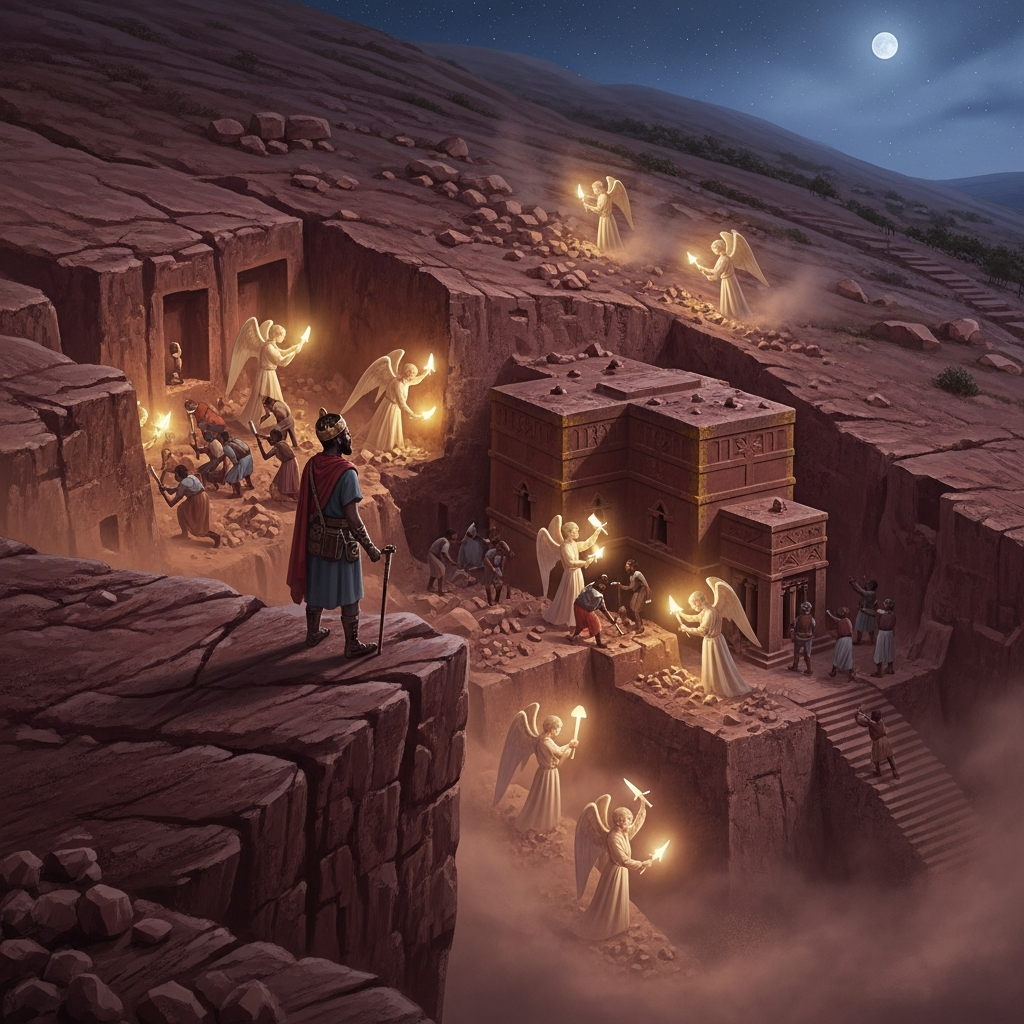
Any water that can be found: a river, a lake, a reservoir, a pool. In Gondar, the processions converge on the great open baptismal pool built in the Fasilides Baths compound in the seventeenth century, an expansive stone-walled rectangle in the grounds of the imperial palace complex, designed specifically for Timkat. In Lalibela, the river called the Jordan — renamed for this purpose, as Lalibela renamed all his rivers — receives the processions from the eleven churches. In smaller towns, a stream will do, or a pond.
The Tabot is installed at the water’s edge in a tent or canopy. Torches and candles are lit. The crowd fills the space around the water — not just the congregation but everyone in town, and travelers who have come from distances that in other circumstances would not be worth the journey. They stand through the night. The singing does not stop. The debteras take turns.
At some point in the long hours before dawn, a child falls asleep against a grandmother’s leg. A very old priest sits on a camp stool. A group of young men circle the water one more time, shouting responses to the chant. The night has a quality of gathered attention — everyone present is oriented toward the same thing, the water, the Tabot near the water, the event that is about to happen.
The blessing comes at dawn.
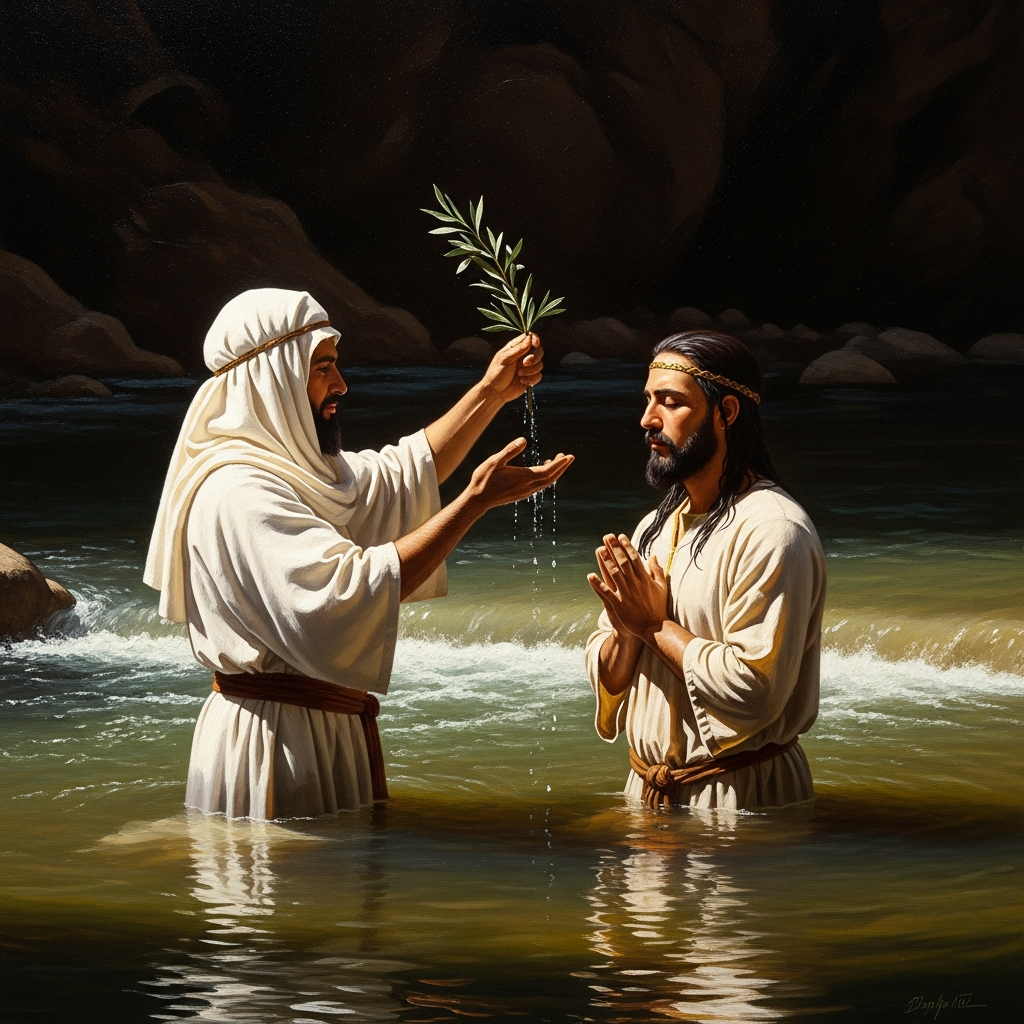
The senior priest stands at the water’s edge and blesses it with holy water that he carries — water blesses water, the new holiness recognizing and activating the holiness already present. He recites the service of Epiphany, the church’s account of the Jordan moment: John the Baptist in the river, Christ coming to him, the reluctance of John (I need to be baptized by you, and yet you come to me), the entry into the water, the sky opening, the dove descending, the voice.
This is my Son, the Beloved, with whom I am well pleased.
This is the moment the ceremony is aimed at. Not a commemoration of the moment — not a memorial, not a reenactment in the theatrical sense — but a re-presence of the moment. The Alexandrian theology that Ethiopian Christianity inherited holds that the liturgy does not represent the sacred event but participates in it across time: when the priest blesses the water at Timkat, the water being blessed is, in the full theological sense, the Jordan.
The moment the blessing is complete, people jump in.
Not everyone. The very old and the very young stand at the edge. But a significant portion of the crowd — the young men first, then everyone else, in whatever clothes they are wearing — enters the water. Not a reverent wading but a plunge: the full-body immersion that is the gesture of baptism, the gesture that says I am dying to my old life and coming up as something new.
The water in Gondar in January is cold. This is not incidental. The coldness is part of the experience — it wakes the body into full presence, it makes the renewal corporeal rather than merely symbolic, it ensures that no one who goes in will be uncertain whether it happened.
On the Fasilides pool in Gondar, the young men compete to be the first in, running across the edge and leaping as far out into the pool as they can. The splash of the first body hits the still surface and the pool comes alive all at once, white robes everywhere, water flying in the early light.
The procession back takes most of the second day.
The Tabot is carried home in triumph, ahead of the singing crowd. The atmosphere is different from the solemnity of the departure: this is festival now, not vigil. Food has been prepared at home. The children who fell asleep the night before are awake and dancing in the street. The drums take on a different rhythm — faster, more percussive, the beat that signals arrival rather than anticipation.
Each church’s Tabot returns to its Holy of Holies. The wrappings are removed, the sanctuary is sealed, the curtain falls back into place. The tablet returns to its darkness.
But the Jordan remains in the water.
It is always there, waiting for the next 18th of Terr, for the next procession of torches through the dark, for the next priest who will stand at the edge and say the words that open the sky. Every body of water in Ethiopia is a candidate. Every river has the capacity. It only requires the procession to find it, the drums to wake it, the blessing to make the connection real.
The river remembers. It always has.
Echoes Across Traditions
Entities
- the Tabot
- the priests
- the congregation
- Christ being baptized
- John the Baptist

Sources
- Donald Levine, *Wax and Gold: Tradition and Innovation in Ethiopian Culture* (1965)
- Taddesse Tamrat, *Church and State in Ethiopia 1270–1527* (1972)
- Ephraim Isaac, 'Social Structure of the Ethiopian Church,' *Ethiopia Observer* Vol. 14 (1971)
- Matthew 3:13–17; Mark 1:9–11; Luke 3:21–22 (Hebrew Bible / New Testament)
- UNESCO Intangible Cultural Heritage of Humanity inscription: Timkat (2019)