The Mandaeans: Keepers of the Living Water
Mandaean origins c. 1st–2nd century CE (Jordan Valley / Mesopotamia); texts compiled c. 3rd–7th century CE · The Jordan River valley; the Tigris and Euphrates marshes; the diaspora after 2003
Contents
The Mandaeans are the last surviving Gnostics — a religion that predates Christianity, recognizes John the Baptist (not Jesus) as their prophet, and practices ritual immersion in flowing water (the masbuta) as their central sacrament. They believe the soul is a spark of divine light trapped in matter, and that each immersion loosens the bonds. For two thousand years in the marshes of Iraq and Iran, they have baptized in rivers. Most of their ancient homeland is now gone. About 60,000 Mandaeans remain.
- When
- Mandaean origins c. 1st–2nd century CE (Jordan Valley / Mesopotamia); texts compiled c. 3rd–7th century CE
- Where
- The Jordan River valley; the Tigris and Euphrates marshes; the diaspora after 2003
The river must be moving.
This is the first requirement, and it is not negotiable. The water must flow — must come from somewhere and go somewhere, must carry within it the quality Mandaeans call yardna, the living property of a river that has not been stopped. A cistern will not do. A pool will not do. A ritual bath of the kind found in Jewish practice is explicitly rejected. If you want to perform the masbuta — the baptism that is the center of Mandaean religious life, the act that the community has performed continuously for two thousand years — you must stand in a river.
This seems, at first, like a practical requirement. It is not. It is a theological statement.
The Mandaeans believe that the material world was not made by the highest God.
The highest God — Hayyi Rabbi, the Great Life — is pure light, and pure light cannot make a world of matter without intermediaries. The intermediaries were called uthra, beings of light who were themselves created from the first emanation. But somewhere below the hierarchy of light, a being named Ptahil — a lesser creator, confused and ambitious — took it upon himself to fashion the visible world. He did not know, when he made it, that he lacked the authority. He did not know, when he placed living souls inside bodies of clay, that he was committing an act that would require an infinite remedy.
The soul in the body is the light trapped in the jar.
Every Mandaean soul — nishmata — is a spark of the original divine light that has descended through the planetary spheres, accumulating layer after layer of material weight, and arrived in the world of matter confused, heavy, and separated from its source. The entire structure of Mandaean religion is designed to address this one problem: how does the spark find its way back?
The answer is: through the river.
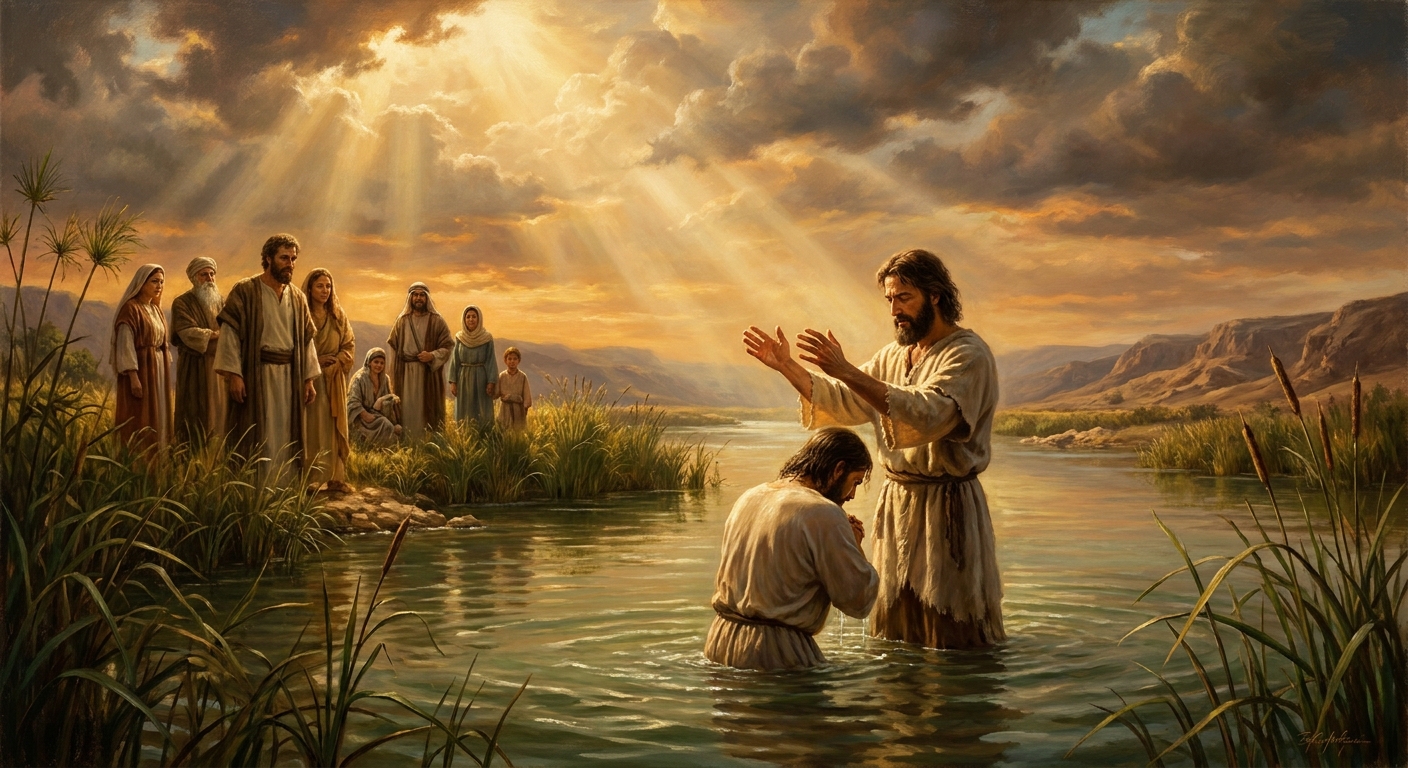
John the Baptist is called Yahya Yuhana in Mandaean texts.
He is not a forerunner. He is the prophet — the last in a line of light-messengers that includes Adam, Seth, Noah, and Shem, but he is the culminating figure, the one who established the ritual practices that define the community. In the Mandaean account, Jesus was a false prophet who corrupted the original teaching. The Mandaeans were in the Jordan Valley before Christianity, and they remember this. They do not convert. They have not converted in two thousand years.
Yahya baptizes in the Jordan not because the water cleanses physical impurity but because the water connects the soul to the World of Light. The yardna — the living quality of the river — is itself a manifestation of Manda d’Hiia, the Knowledge of Life, the divine intelligence that descends to meet the ascending soul at the moment of immersion.
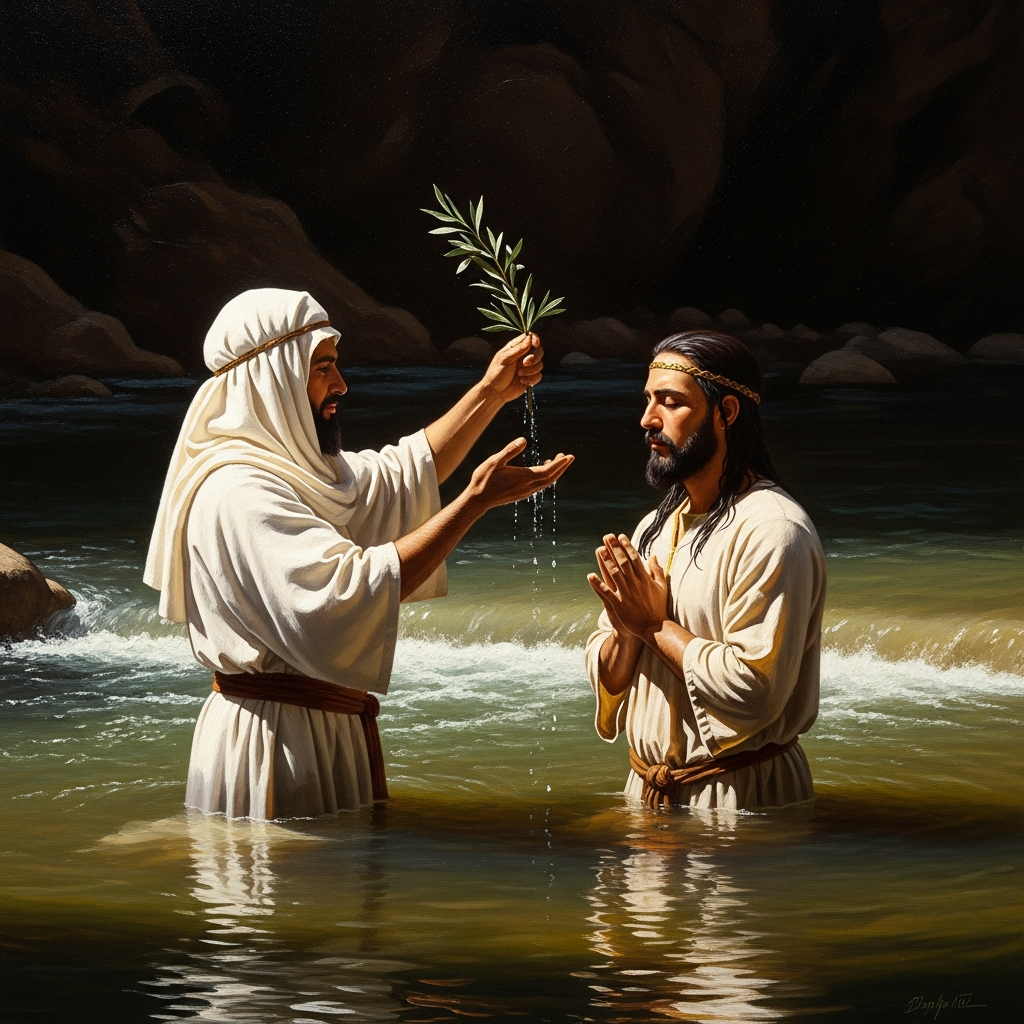
The priest who performs the baptism is called tarmida, which means disciple or student. He is always a man; he is always ordained through a direct chain going back to the original community. The chain must be unbroken. If it breaks, the community cannot perform the masbuta, and the path closes.
The ritual requires the body to be entirely submerged three times.
Before entry into the river, the candidate is sealed on the forehead with sesame oil by the priest. They wear white — the rasta, the garment of the World of Light. They are led into the current. The priest holds them while the water moves around both their bodies. The candidate is plunged under once, twice, three times, and each time is raised back into the air.
At the moment of immersion, the priest pronounces the kushta — a clasped handshake between the living, the formula for truth and spiritual connection. The handshake is given under the water, in the river, with the current moving around the clasped hands. It is a handshake between the candidate and the tradition going back to Yahya; a handshake between the soul in matter and the World of Light above it; a handshake between the dead and the living, since the rite also benefits the recently deceased.
The water does not merely wash. The water conveys mana — the Mandaean term for the divine portion in a soul. The immersion loosens, slightly, the attachment of the nishmata to the body that confines it.
Every baptism is, in a small way, practice for dying.
Abathur sits at the scales.
In Mandaean eschatology, the soul after death must pass through purgatorial realms and eventually reach Abathur — the weigher of souls, an angelic figure who examines the balance of deeds and measures the soul’s readiness for ascent. The scales are not theatrical. They are metabolic: the soul carries the weight of its material attachments, and Abathur reads this weight directly. Mandaeans who have performed many baptisms in life carry less accumulated material density. The river has been loosening the bonds, incrementally, for decades.
The path upward through the light-worlds is called the masiqta — the ascent. It is also the name of the death-mass performed for the deceased. The same ritual structure serves the living and the dead, because Mandaean religion understands death and baptism as the same movement made at different scales.
For two thousand years, the community baptized in the Tigris and the Euphrates.
They lived in the marshes of southern Iraq and the rivers of Khuzestan in Iran — among the reeds, in villages that sat directly on the flowing water, in the geographies that matched the requirements of their ritual. They were silversmiths. They were honest. They were protected, sometimes barely, by Islamic jurisprudence that recognized them as People of the Book. They survived the Mongols. They survived the Ottomans. They survived the British Mandate and the Ba’ath years and the various nationalisms of the twentieth century.
They did not survive 2003.
The Iraq War destroyed their communities directly and indirectly: violence targeted explicitly at non-Muslim minorities, the collapse of civil order, the displacement of five million Iraqis, and the specific persecution of Mandaeans by militias who did not recognize them as people of any book at all. The community in Iraq collapsed from approximately 60,000 to fewer than 5,000 in five years. The rest fled to Australia, Sweden, the United States, the United Kingdom.
In Sydney, in Michigan, in Gothenburg, they found rivers. Or they built tanks of flowing water. The ritual requirement — the yardna, the living water — had to be maintained in a diaspora. Priests ordained in Iraq perform baptisms in the Huron River, the Thames, the Yarra. The chain of ordination is being held together by families who cannot go back.
The river must be moving.
The light must find its way back.
Those two requirements — one practical, one cosmic — are the same requirement, stated at different scales. The Mandaeans have understood this for two thousand years. They are still in the water, holding the chain, waiting for the spark to recognize itself.
Echoes Across Traditions
Entities
- Manda d'Hiia (Knowledge of Life)
- John the Baptist (Yahya)
- The masbuta (living water baptism)
- Abathur (the weigher of souls)
- Ptahil (the lesser creator)
Sources
- Ginza Rba (*The Great Treasure*), the Mandaean holy book, c. 3rd–7th century CE
- Book of the Zodiac (*Asfar Malwashe*), Mandaean liturgical text
- Edmondo Lupieri, *The Mandaeans: The Last Gnostics* (2002)
- Jorunn Jacobsen Buckley, *The Mandaeans: Ancient Texts and Modern People* (2002)
- Sinasi Gunduz, *The Knowledge of Life: The Origins and Early History of the Mandaeans* (1994)