Yamato Takeru: The Prince Who Became a White Bird
Legendary period — Kojiki Book II, c. 1st-2nd century CE traditional dating · Throughout central and eastern Japan — from Yamato to Ise to Edo to Owari to Ōmi
Contents
The most powerful warrior in Japan's founding mythology kills his brother, defeats the eastern tribes, slays a monster with a divine sword — and dies alone on a mountain, his soul departing as a white swan flying north.
- When
- Legendary period — Kojiki Book II, c. 1st-2nd century CE traditional dating
- Where
- Throughout central and eastern Japan — from Yamato to Ise to Edo to Owari to Ōmi
He kills his brother with his bare hands.
The Emperor Keikō sends his two sons to summon a rebellious nobleman. Only Yamato Takeru’s brother returns, and he says: the man refused to come. Keikō says to Yamato Takeru: why has your brother not obeyed me? Go teach him obedience.
He means: speak to him. He means: persuade him.
Yamato Takeru goes to the place where his brother is eating and takes him and twists him and breaks him.
When the Emperor asks where the older son is, Yamato Takeru takes a hand and fingers from his sleeve, wrapped in a mat, and presents them.
The Emperor is afraid of his younger son now.
He sends him away on missions.
First to Kyushu, to kill the two brothers Kumaso Takeru who are the great warriors of the south — who have the same name, Takeru, meaning brave. Yamato Takeru goes to their feast disguised as a woman — he is young enough, the Kojiki notes, to pass as a woman, which he will never be able to do again — and at the height of the celebration kills one brother while he is drunk and the other as he runs. The dying Kumaso gives him the name Yamato Takeru: you are braver than we are. Take the name.
He comes home. The Emperor sends him east, to subdue the eastern territories.
Before he goes east, he visits Ise Shrine and his aunt Yamato-hime, a priestess. He tells her: The Emperor does not think I will return. He sends me out to be killed. He weeps. His aunt gives him the sacred sword Kusanagi and a fire-striking flint wrapped in a bag.
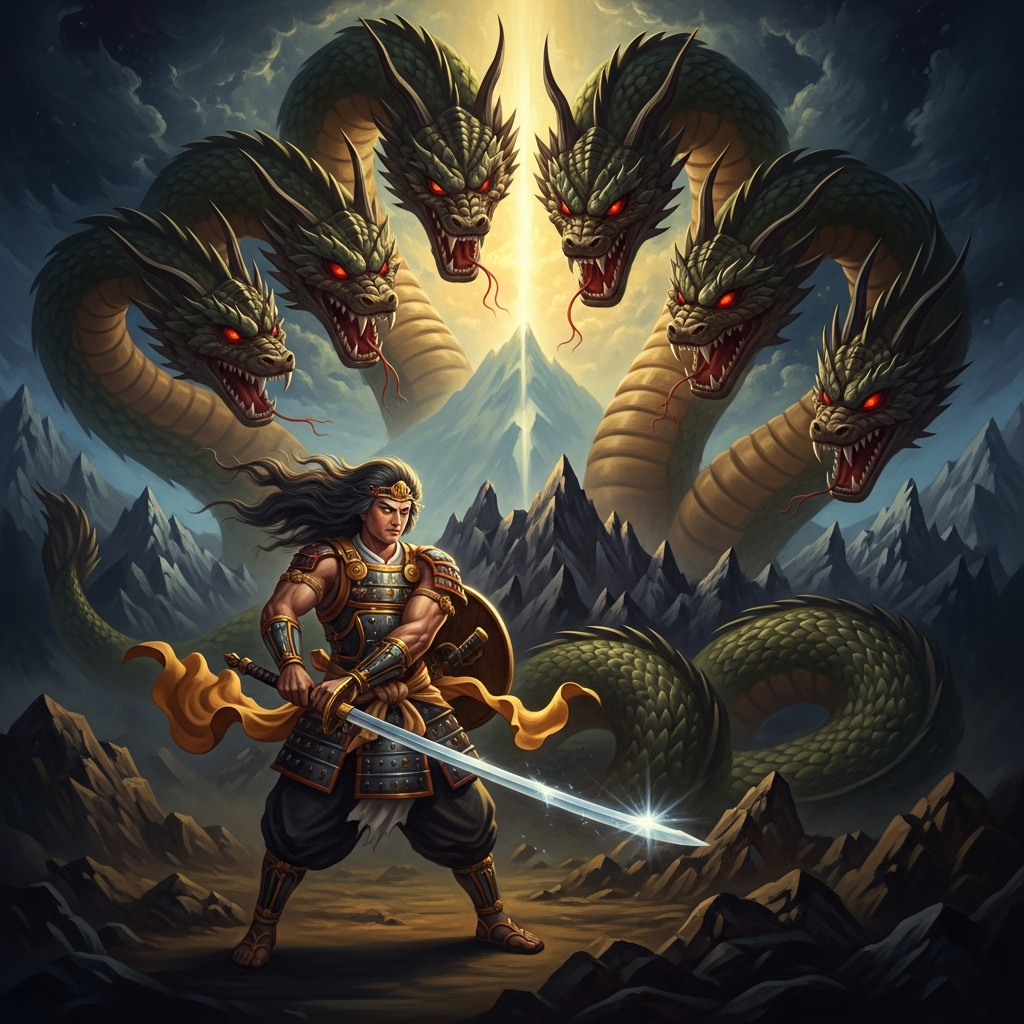
The eastern campaign is long. He crosses mountains and faces enemies and kills them and subdues them and pacifies them. In one battle, his enemies set fire to the plain around him. He takes Kusanagi and cuts the surrounding grass — Kusanagi means Grass-Cutter — and strikes his flint and sets a counterfire, and his enemies, trapped between their own fire and his, are destroyed.
He marries Miyazuhime and has children. He is at the height of his power.
Then he goes to Mount Ibuki in Ōmi Province to subdue the local divine spirit without taking his sword — leaving Kusanagi with Miyazuhime. On the mountain he meets a white boar. He says: This is the mountain god’s messenger. I will kill it on my way back.
The white boar is the mountain god.
He descends from the mountain ill. The divine spirit has entered him as sickness. He travels toward home, growing weaker, stopping at springs to drink, composing poems about the places of Japan he will not see again. He reaches the field of Nobono and he falls.
He dies on the plain, far from Yamato.
His soul leaves as a white bird.
The white swan flies north, over the sea, toward the open sky. The people of the region run after it — across mountains, across the sea — and they build shrines at each place the bird lands. The white bird does not land in a way that ends. It moves north and is seen at the places the Kojiki names and then is gone.
Yamato Takeru, the warrior whose father was afraid of him, is now a bird over the sea. His wives come to where he died and weep. His poems are the first of his kind in the tradition — the poems of someone who knows he is dying and names the places of Japan as he leaves them.
The sword Kusanagi is still at Atsuta Shrine in Nagoya.
The white bird is still somewhere north.
Echoes Across Traditions
Entities
- Yamato Takeru
- Emperor Keikō
- Miyazuhime
- the fire-spirit of Ibuki Mountain
- the white swan
Sources
- Kojiki (Record of Ancient Matters), compiled 712 CE, Book II
- Nihon Shoki (Chronicles of Japan), compiled 720 CE
- Philippi, Donald, *Kojiki* (University of Tokyo Press, 1968)
- Keene, Donald, *Seeds in the Heart* (Columbia, 1993)