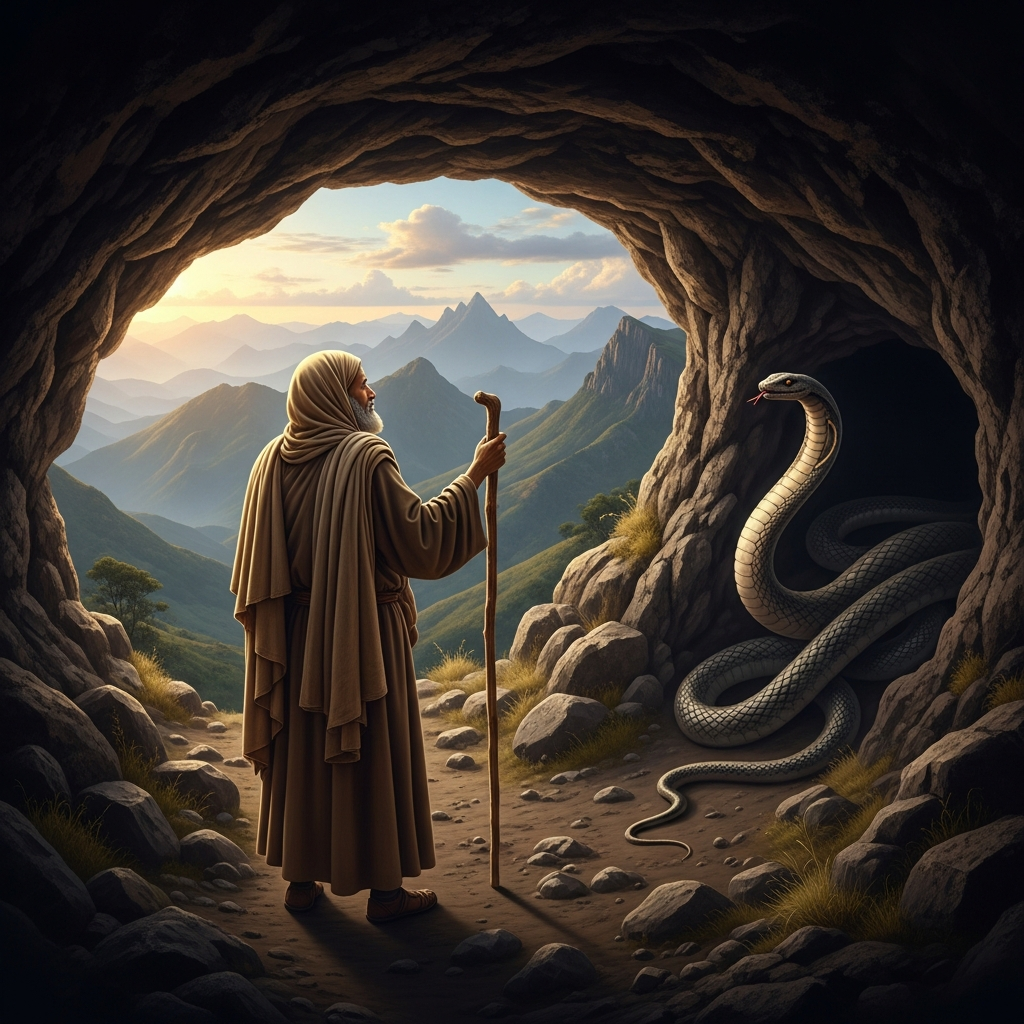
The Nine Saints Who Tamed the Serpents
5th–6th century CE; the Aksumite Empire's Christian conversion · The mountains and valleys of northern Ethiopia (Tigray)
Contents
In the 5th and 6th centuries, nine monks from Syria, Egypt, and Rome walked into Ethiopia's wilderness and each drove out a great serpent from a mountain, lake, or valley — clearing the land for Christianity. Each saint settled in his cleared place and built a monastery. Their monasteries still stand.
- When
- 5th–6th century CE; the Aksumite Empire's Christian conversion
- Where
- The mountains and valleys of northern Ethiopia (Tigray)
They came from different places, which is part of the point.
Aregawi came from Rome, or from Syria, depending on the manuscript. Garima came from Constantinople. Pentalewon came from Antioch. Yemata came from the east. They were, collectively, the multinational Christianity of the late antique world sending its monastics to the frontier: the Aksumite Empire had converted to Christianity under King Ezana in the fourth century, but conversion at the level of royal decree is not the same as conversion at the level of mountain and valley and spring. The mountains and valleys and springs of the Tigray highlands had their own powers, their own resident divinities, their own claims on the land.
The Nine Saints came to renegotiate those claims.
Abba Aregawi came first, or perhaps he is simply the most famous.
He wanted to go up. The cliff face of Debre Damo — a flat-topped mountain rising vertically from the Tigray plateau, its summit accessible only by rope — was not an ordinary mountain. Something lived there, or had lived there, in the caves and the high grass of the summit. A serpent. Not a snake in the ordinary sense but a great serpent, the kind that the land itself produces when a place has been sacred for long enough that the sacredness takes animal form.
Aregawi prayed at the base of the cliff. God sent a serpent — or commanded an existing serpent, the accounts vary — and the serpent descended, and Aregawi took hold of its body, and the serpent carried him up the cliff face to the summit.
This is the version the Ethiopian church maintains: the saint did not defeat the serpent by force. He prayed; a serpent came; the serpent served. The natural power of the place was not destroyed but redirected, put in service of the new order rather than the old. Aregawi built his monastery on the summit, and the monastery of Debre Damo has been inhabited by monks ever since — a community accessible still only by rope, still requiring the same physical act of ascent, still looking out over the Tigray plateau from the flat rock where a serpent once lived.
Abba Garima worked differently.
He had arrived in the Tigray highlands and began translating — the New Testament into Ge’ez, working from the Greek and Syriac texts he had carried from his home. The Garima Gospels, produced in his monastery of Abba Garima near Adwa, are among the oldest surviving illustrated Christian manuscripts in the world, dating to the late fifth or early sixth century. This is the serpent that Garima fought: not a creature in a cave but the absence of scripture in the vernacular, the religious void that exists when the sacred text cannot be read in the language people actually speak.
His translation was the expulsion. The serpent that held the highland population outside the full practice of their own religion was the language barrier between Greek and Ge’ez, between the universal church and the particular place. Garima cut the head off that serpent with a pen.
Abba Yemata chose the most improbable location.
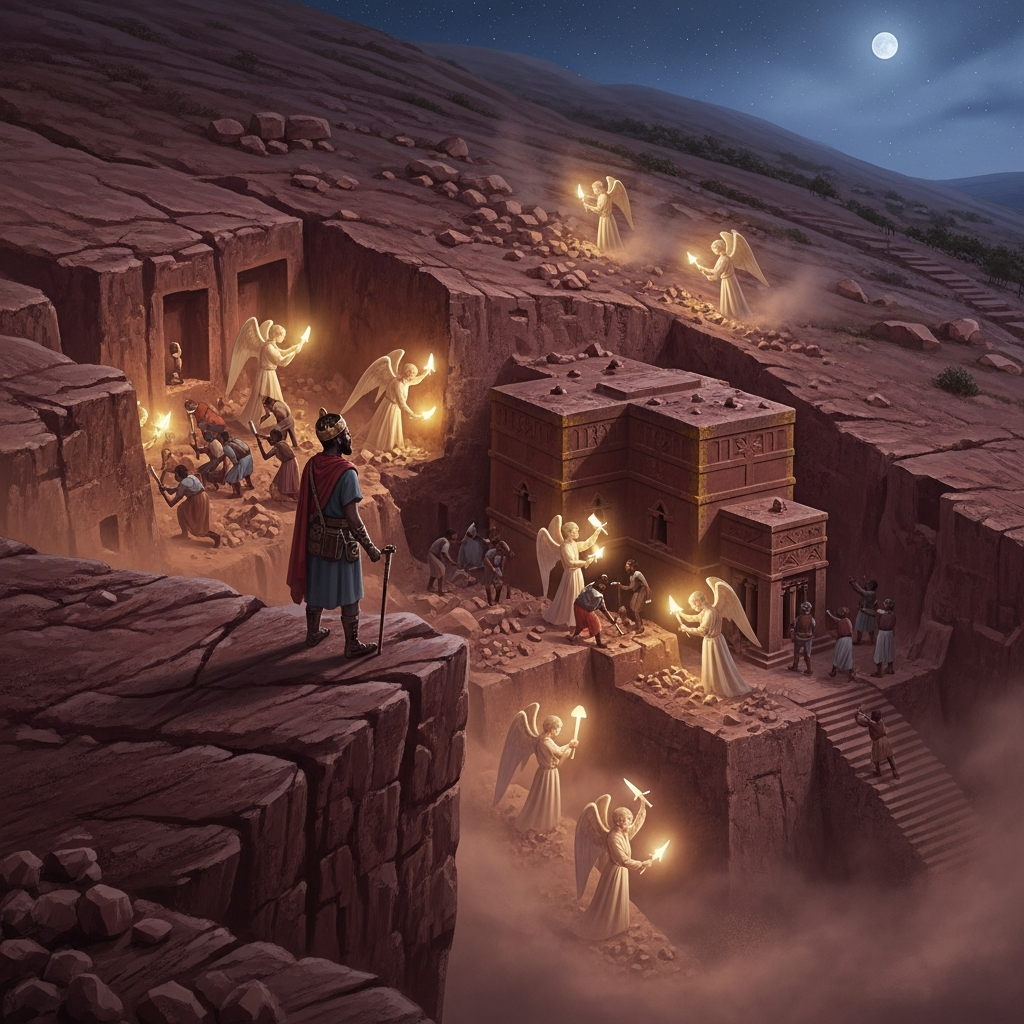
His church is carved into a cliff face near the village of Guh, in the Hawzen district — not a mountain he climbed but a narrow ledge two hundred meters above the valley floor, accessible by a path that requires climbing a near-vertical rock face using hand-cut footholds and then crossing a natural bridge of stone with the valley visible a long way below. There are no safety ropes.
The serpent he expelled from this ledge was presumably the vertigo itself — or whatever the local tradition held about the high place. He built his church in the cave, and the cave church is still there: its interior full of frescoes depicting the Nine Saints, the paint still vivid after fifteen hundred years in the dry highland air. The light comes in through a natural window in the rock, hitting the painted faces of the saints at an angle that changes through the day.
To see it, you still have to climb the cliff.
They completed the Ge’ez Bible. They established the liturgy. They built the infrastructure of a tradition — the rule of fasting, which in Ethiopian Orthodox practice is among the most demanding in the Christian world (roughly two hundred fasting days per year, during which no animal products are consumed and eating is restricted to after 3pm), the specific form of the eucharist, the music of the divine office called zema which uses a notation system and instruments found nowhere else in the Christian world.
Each monastery they founded became a center of learning. The manuscripts multiplied. The monks multiplied. The serpents, if they went anywhere, went far enough that later centuries forgot exactly where each had been.
What remained were the monasteries on the cliffs, the translations in the archives, and the thin trail of footholds cut into the rock below Abba Yemata’s church — someone cut those footholds for a reason, in the same way the Nine Saints arrived for a reason, the way holy people always arrive: because a place was waiting for them, because the serpent could not hold the mountain forever, because the land was ready to be cleared.
Echoes Across Traditions
Entities
- Abba Aregawi
- Abba Garima
- Abba Pentalewon
- Abba Yemata
- the Nine Saints
Sources
- Tadesse Tamrat, *Church and State in Ethiopia 1270–1527* (1972)
- Getatchew Haile, 'The Monastic Tradition in Ethiopia,' *Bulletin of the Society for Ethiopian Studies* (1992)
- Stuart Munro-Hay, *Ethiopia, the Unknown Land* (2002)
- David Phillipson, *Ancient Ethiopia* (1998)
- The Lives of the Nine Saints (Ethiopic hagiographies, medieval period)