Contents
A tyrant tries to build a tower in the mountains; the foundations collapse every night. His magicians say only the blood of a fatherless boy will set the stones. They find such a boy. He laughs at them. He tells the king to dig — and underground, in a sunken pool, two dragons, one red and one white, are locked in eternal battle.
- When
- c. 450 CE (Sub-Roman Britain, mythic time)
- Where
- The mountains of Snowdonia in north Wales, the failing tower at Dinas Emrys, the sunken pool beneath
The high king of Britain in those years was Vortigern.
He had become king by treachery and held it by fear. He had killed Constans, the rightful king, and had taken the throne. Then, when the Picts and Scots had come down from the north and the Britons could not push them back, Vortigern had hired the Saxons — Hengist and Horsa, brothers from across the sea — and had paid them in land and in his own daughter, given to Hengist as a wife after a banquet of poisoned diplomacy. The Saxons had stayed. The Saxons had brought more Saxons. The Saxons were not allies; they were, by the time Vortigern realized, an invading population.
The Britons hated him. The Saxons no longer needed him. The young heirs of Constans — Aurelius Ambrosius and Uther Pendragon — were across the channel in Brittany, growing up, sharpening swords. Vortigern was hated on every side. The kingdom was breaking apart around him. He was old.
He decided to build a tower.
He chose a hilltop in the mountains of Snowdonia — Dinas Emrys, in north Wales, a defensible peak. He would withdraw to it. He would fortify it. He would hold out there with what loyal men he had.
He brought in masons. He brought in stone. They began the foundations.
The foundations did not hold.
Each day they laid stones. Each night, in the dark, the stones collapsed. They came back in the morning to find the work undone — courses tumbled into the ditch, mortar cracked, the whole construction reduced to rubble. They began again. The next morning, ruin again. This went on for days. The masons grew frightened. The supplies dwindled.
Vortigern called his magicians.
He had a council of magicians on retainer — the kind of professional class every Iron Age king maintained — and he asked them what was wrong. They consulted. They came back with an answer.
They said: The foundation can be set only by sprinkling on the stones the blood of a child who has no father. Find such a child. Kill him at the foundation. Spread the blood. The stones will hold.
Vortigern asked: How can a child have no father?
They said: We have read the omens. There is such a child. Send out searchers across Britain. They will find him. The blood will hold the stones.
The advice was characteristic of the magicians of bad kings everywhere. The system is failing. Therefore: a sacrifice. The sacrifice should be innocent and small and unable to defend itself. The sacrifice will not actually fix the system, but the king will feel he has done something, the magicians will be paid, and when the system fails again next quarter they will recommend another sacrifice. The advice, presented to Vortigern, was the same advice that has been given in every period of crisis where the elites do not want to look at the underlying cause.
Vortigern accepted it. He sent searchers out across Britain.
After much searching, they came to a town in south Wales, where they found two boys quarrelling in the street. One boy taunted the other: You have no father. The other — a clever boy, with strange eyes — answered scornfully: Whatever I lack in father I make up for in mother. My mother is a king’s daughter and a nun in the monastery here, and you have no idea what you are talking about.
The taunting boy turned out to be precisely what was wanted: a boy whose mother was real and known, but whose father no one had ever seen. The boy’s mother said an angel — or, in some versions, a being like an angel, a sweet-voiced young man who came to her cell at night — had visited her, and that this boy was the result. She had no other explanation. The townspeople had drawn their own conclusions. The boy had grown up under the cloud of fatherlessness and had become, evidently, sharp-tongued in self-defense.
His name was Myrddin Emrys — Merlin Ambrosius, in the Latinized form Geoffrey of Monmouth gave him.
The searchers brought the boy and his mother to Vortigern’s camp at Dinas Emrys. They told the king they had found the foundation child.
The king, at first politely, brought the boy and his mother into the council. He asked the mother to confirm the story. She did. Vortigern looked at the boy. The boy was perhaps twelve. He had not yet wept; he had not yet asked what they wanted of him. He stood quietly and looked around the council chamber, taking in the magicians, the king, his mother, the soldiers.
The king’s chief magician explained what was about to happen.
The boy laughed.
He looked at the magician. He said: Are you the king’s wisest counselor?
The magician said he was.
The boy said: Then tell the king why his tower falls. Why does the work of the day come down at night?
The magician did not know.
The boy said: Of course you do not. You are professionally ignorant. You are paid to recommend the killing of children, because the killing of children is in the budget and the digging is not. Listen to me, king. There is a pool under this hill. The masons are building over it. Have them dig down. They will find a great cavern. In the cavern there is water. Beneath the water there are two stones. Beneath the stones there are two dragons sleeping. They wake at night. They fight. The hill shakes when they fight, and your tower comes down. Kill me, and you will have my blood, and you will have the dragons still beneath you. Dig instead, and you will see what your magicians cannot see.
Vortigern, who had a politician’s nose for shifting authority, called the magicians forward and asked them whether the boy could be right. The magicians, suddenly less confident, said it was at least possible.
Vortigern ordered the dig.
The men dug down through the foundation course. They came to a layer of rock. They broke through the rock. There was a hollow space. They dug further. They came to a great chamber under the hill — wide, vaulted, dripping. In the chamber was a pool of black water.
The boy ordered the workmen to drain the pool. They cut a channel for it. The water ran out. The pool emptied.
In the bottom of the pool were two flat stones, very large.
The boy ordered the stones lifted. The men, with ropes and beams, lifted them aside.
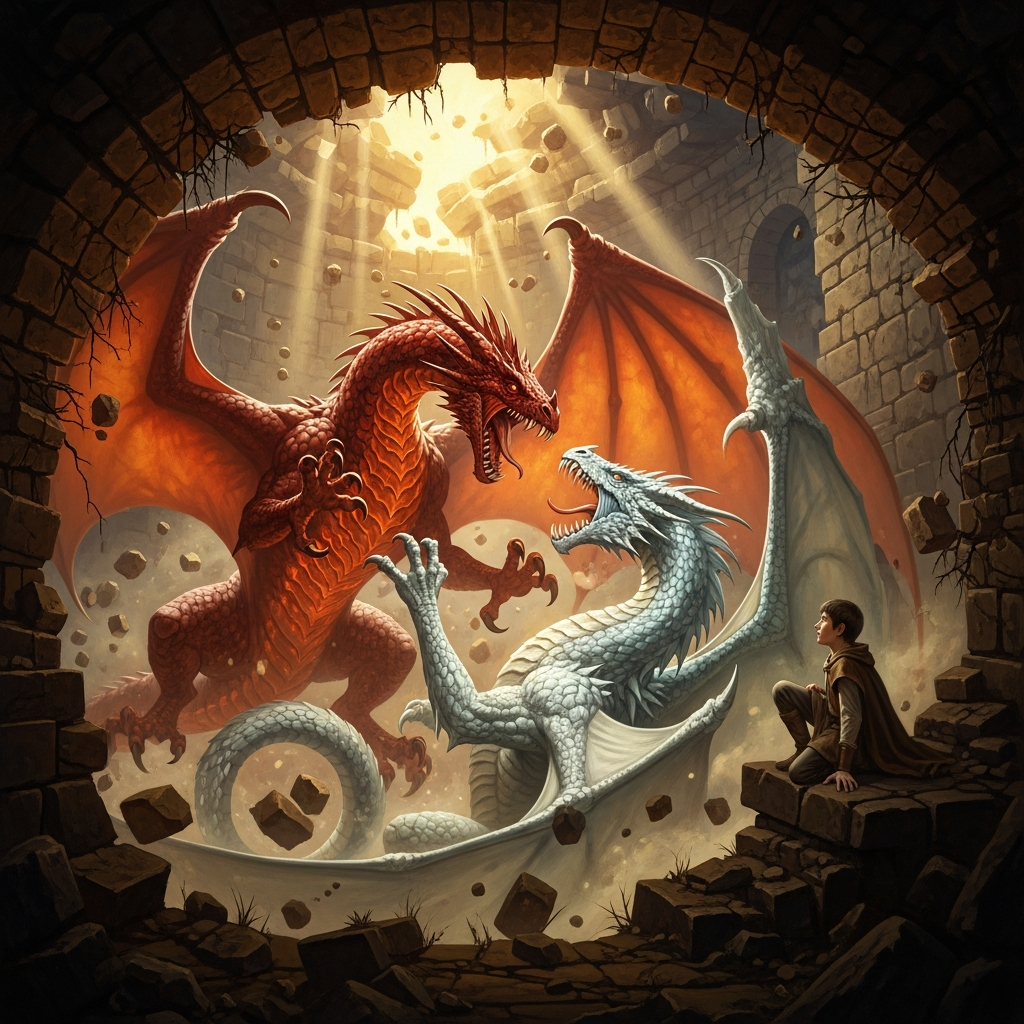
Beneath the stones, in two recesses, were two dragons. One was red. One was white. They had been asleep. They woke now, with the light coming down on them and the pool drained above them, and they came up out of their cavities and into the open chamber. They began to fight.
The court — Vortigern, the magicians, the soldiers, the boy, the boy’s mother — stood at the rim of the chamber and watched.
The fight was vast and wordless. The white dragon, larger and at first stronger, drove the red back. The red was nearly killed. Then the red rallied. It fought back. It seemed to lose ground; then it gained ground; then it lost again. The two dragons rose into the air, fell into the water, came up again, twined around each other, struck, broke apart, struck again. Neither finished the other. They fought for an hour.
Eventually they tired. They returned to their stones. They lay down. The chamber became silent.
The boy turned to Vortigern.
He spoke, and the speech is the longest single prophecy in early British literature — Geoffrey of Monmouth gave it whole pages of Historia Regum Britanniae, and the Prophetiae Merlini circulated independently for centuries afterward. The interpretation: the red dragon is the Britons; the white dragon is the Saxons. They are fighting. They are still fighting. The white dragon is, for the moment, the stronger. But the red dragon, says Merlin, will not be killed. In the end, the red will rally and drive the white back into the sea. But before that ending there will be many ages, many kings, many battles, and the land will run with blood.
He prophesied to Vortigern in particular: You will not finish this tower. You will not save yourself by withdrawing. The sons of Constans are crossing the channel. They will burn you in this very tower. They are already on the water.
Then he prophesied the rest of British history — the coming of Aurelius Ambrosius, the coming of Uther Pendragon, the begetting of Arthur at Tintagel by Merlin’s own magic, the coming of Arthur, the wars of Arthur, the betrayal by Mordred, the wounding of Arthur, the carrying of Arthur to Avalon. Then the long ages of the Saxon kingdoms. Then the Norman conquest. Then prophecies that grow more and more obscure — animal symbols, astrological signs, kings named for their colors — that medieval commentators argued over for five hundred years.
The court listened. The boy did not seem to be reading from anywhere. He was, simply, saying it.
When he was done, Vortigern asked what should be done with him.
The boy said: Let me go. I will make my own way. We will meet again. You should leave this hill while you can.
Vortigern let the boy go.
He did not leave the hill. He completed the tower — once the dragons were exposed, the foundations held — and he settled in there with his troops. Aurelius Ambrosius and Uther landed in Britain shortly after, raised the Britons against him, drove him into his hilltop tower, and burned it down around him. He died in the flames, exactly as the boy had said.
Merlin grew up. He became Aurelius’s counselor. He became Uther’s counselor. He arranged the begetting of Arthur. He withdrew. He returned. He vanished into a wood eventually, sleeping under a hawthorn or trapped in a cave, depending on which strand of the legend you follow.
But the central scene that produced him — that took him from a mocked, fatherless boy in a Welsh village to the great prophet of British history — is the scene at Dinas Emrys. He arrived there to be killed. He left having made the magicians look small and having shown the king the structure of his own predicament. He had known, at twelve, the thing the kingdom’s most expensive counselors did not know: that what is buried determines what stands, that a foundation problem is not solved by adding a sacrifice on top, and that two creatures in a chamber underground are deciding the surface war whether anyone has dug down to look at them or not.
Scenes
The hilltop construction site at Dinas Emrys
The boy Merlin, brought before the king, refusing the executioner
Beneath the surface, in a vast underground chamber, two dragons rear up out of dark water — one scarlet, one bone-white — clawing each other in a fight that has been going on for centuries
Echoes Across Traditions
Entities
- Merlin
- Vortigern
- The Red Dragon
- The White Dragon
- Vortigern's magicians

Sources
- Nennius, *Historia Brittonum* (c. 829 CE) — chapters 40-42
- Geoffrey of Monmouth, *Historia Regum Britanniae* (c. 1136), Book VI
- *Vita Merlini* (Geoffrey of Monmouth, c. 1150)
- Welsh Triads and the *Mabinogion* tale 'Lludd and Llefelys'