Contents
A young knight, raised in the woods by his mother, comes upon a castle in a wasteland where a wounded king reigns. At a feast he sees a strange procession — a bleeding lance, a silver platter, the Grail. He has been told good knights do not ask questions. He says nothing. In the morning the castle is gone.
- When
- c. 500-1200 CE (mythic time, written 12th century)
- Where
- The forest of Wales, the road to Camelot, the castle of the Fisher King in a stricken country
His mother had hidden him in the forest.
She had been the wife of a knight, and the knight had died in some battle, and her two older sons had ridden off to the court of a king and never come back. She had taken the youngest son, when he was small, and gone deep into a wood in Wales, and she had raised him there with no notion of knighthood, no notion of court, no notion of anything but trees and a small farm and the kind of skills a forest boy needs.
She did not even tell him his name. She called him fair son, dear son. He grew up not knowing who he was.
Then one day, in the forest, riding alone after deer, he came upon five men in armor on horses. They had been crashing through the undergrowth and the sun was striking their helmets and their shields and the boy had never seen anything like them. He thought, at first, they might be devils. He fell to his knees. Then he heard them speak, and he saw their faces, and he stood up. He saw they were men.
He asked them what they were. The leader, with patience, said: We are knights.
The boy said: What is a knight?
The leader explained — that knights served the king at Camelot, that they wore armor and rode horses and rescued the weak and won glory. The boy listened. He looked at the armor. He looked at the swords. He looked at the horses. He listened to the words king and Camelot the way another boy might listen to gold and kingdom. When the knights had ridden on, he ran home. He told his mother. He said he was going to Camelot to become a knight.
She wept. She had hidden him for this very reason. But she could not hold him back. She gave him an old linen shirt and a little money and a piece of advice: In every church, pray. To every lady, offer service. To every old knight, show respect. Do not ask too many questions. Good knights do not pry.
She watched him ride away on a farm horse with a leather jerkin and a thrown-together set of armor and a lance and a borrowed shield. She fell, the moment he was out of sight, in the road behind him. She died there. He, riding ahead, did not look back. He did not know.
He came to Camelot. He behaved like a forest fool — bursting into the hall, demanding to be made a knight, killing a Red Knight outside the gates by hurling a javelin through his eye-slit because the Red Knight had insulted Queen Guinevere and because the boy did not know any of the proper ways. Arthur took him in, half-amused, half-impressed. He took the Red Knight’s armor and weapons. He rode out into the world.
He learned things. He came to the castle of an old knight named Gornemant, who took him in for a fortnight and taught him the use of arms — the lance, the sword, the courtesies, how to fight, how to deport himself. Gornemant gave him the same advice his mother had: Do not talk too much. Knights who chatter are despised. Hold your tongue. Do not ask many questions. It is unbecoming.
The boy nodded. He had now received the advice twice, from the two people he most respected. He stored it carefully in himself.
He left Gornemant’s castle. He rode for a while. He came to a country that was wrong.
The trees were dying. The fields were unsown. The few peasants he saw moved without speaking. The streams ran shallow. He rode through this wasteland for hours. He came at last, at dusk, to a wide river. On the river was a small boat, and in the boat was a man fishing — a king, by his bearing, but seated, not standing, propped in some way Percival could not see clearly from the bank.
The fisherman called out to him. There is a castle a half-mile up that road. The drawbridge will be down. Tell them I sent you. You may stay the night. Tomorrow you will see me there.
Percival rode up the road. He came to a castle. The drawbridge was down. He was received with extraordinary honor — bathed, dressed in fine clothes, brought into a great hall where a fire was burning. The lord of the castle was already in the hall, sitting on a couch by the fire. He was the same fisherman from the boat. Up close, Percival saw that the king could not stand. He had been wounded — the texts vary on where, but the wound was somewhere in the thighs or in the genitals, the wound that had also unmade his country — and he had been wounded for a very long time. He could fish from a boat, where the body was supported by the seat, but he could not walk. He was the Fisher King, and the wasteland was his.
They sat to dinner. The king was kind. He gave Percival a sword that had been made for him by a smith of legendary reputation; he warned the boy that the sword would break only at one moment, and only its maker could repair it.
Then a procession came into the hall.
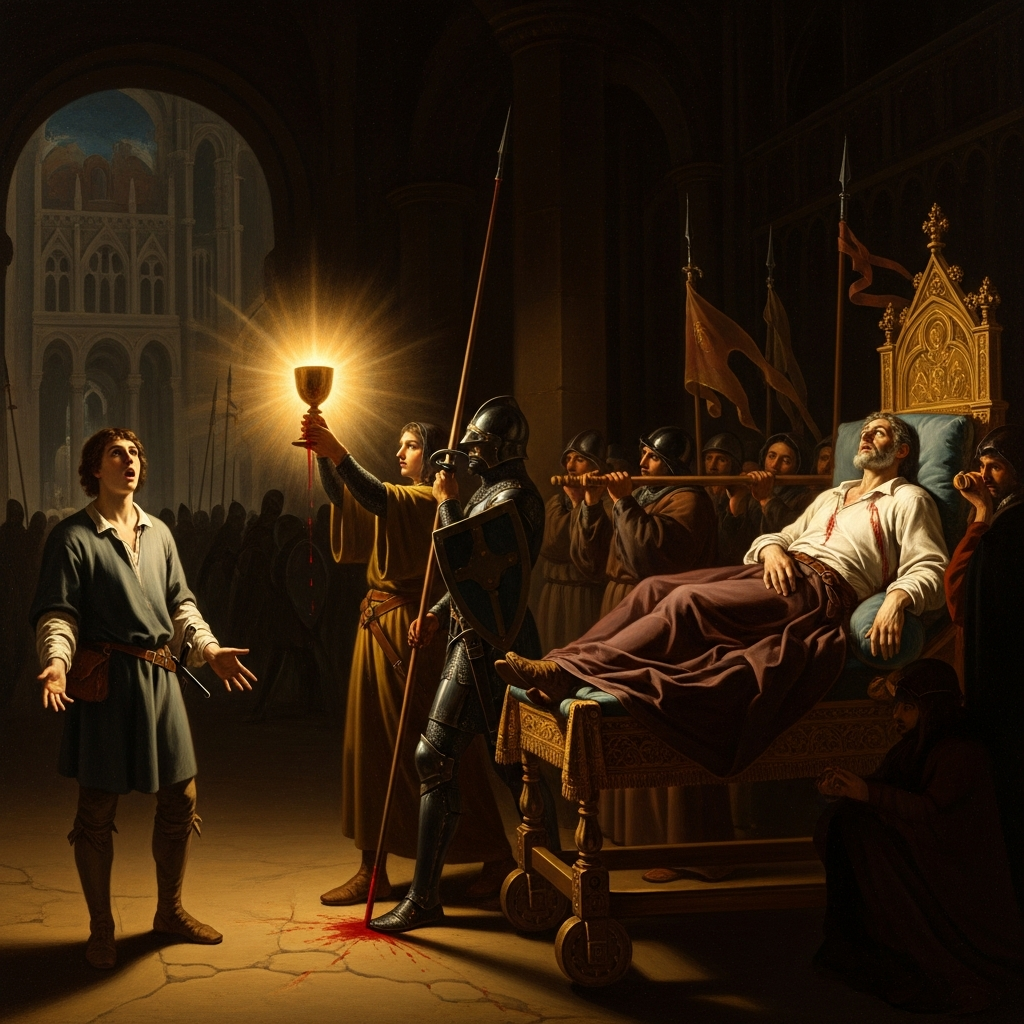
A young man entered carrying a white lance. From the tip of the lance — from the iron point itself — a single drop of blood ran down, slowly, continuously. The blood ran along the wood of the shaft and onto the young man’s hand. He walked through the hall, between the diners, and out at the far end. He did not stop.
Behind him came two more young men carrying golden candelabra, ten candles each.
Behind them, walking alone, came a young woman in white. She carried, in her hands, a graal — Chrétien’s word, an old French word for a kind of wide, deep serving-dish. The dish was made of pure gold and set with precious stones, and from it came such a brightness that the candles seemed dim. She walked through the hall behind the candle-bearers. She did not stop.
Behind her came another young woman, carrying a silver platter.
The procession passed once across the hall, slowly, in silence. It went out at the far end. The Fisher King watched Percival’s face the entire time the procession was passing. The eyes of the king were on the boy.
The boy said nothing.
He had been told. He had been told twice. Do not ask too many questions. Good knights do not pry. He bit back his curiosity. He sat at the king’s table, ate the food that came to him from a similar but ordinary platter, and held his peace.
The procession had passed. The king’s face had darkened. The dinner ended. Percival went up to the chamber that had been prepared for him. He fell asleep in the soft bed of the Grail castle.
In the morning he woke, and the castle was empty.
There were no servants. The fire in the hall had burned out. The candles were stumps. The doors were unbarred but ajar. He called out. There was no answer. He went down to the courtyard. His horse was saddled and waiting. He led it across the empty drawbridge. The bridge began to rise behind him as he crossed; he had to leap clear with his horse to keep from being thrown into the moat. He looked up at the windows. He saw no faces.
He rode away.
He had ridden perhaps an hour when he met, in the wood, an ugly damsel on a yellow mule. She had hair like a rat’s pelt and a hump on her back. She rode straight up to him and stopped his horse. She knew his name, which his own mother had not used.
She said: Percival. You came to the castle. You saw the bleeding lance. You saw the candles. You saw the Grail. You saw the silver platter. You sat at the table of a wounded king, and you said nothing. You did not ask, “Whom does the Grail serve?” You did not ask, “What is the wound?” If you had asked either question, the king would have been healed and the country would have been restored. Because you did not ask, the king is still wounded, the country is still a wasteland, women will become widows and men will be killed, and the suffering is on you.
She rode on past him.
Percival sat on his horse for a long time, in the wood, with this information.
The remainder of the romance — and the long succession of continuations, retellings, and deepenings produced over the next two hundred years — is the story of Percival learning, over decades, what to ask and how to ask it. He becomes a wandering knight, doing knightly works, but also doing penance. He spends years in remorse. He returns, eventually, to the castle. He asks the questions. The king is healed. The wasteland flowers. He himself becomes the new keeper of the Grail.
But the central scene — the scene the Middle Ages remembered, the scene that has been retold every time the West has wanted to talk about the cost of repression — is the moment in the hall. The boy, dressed in fine clothes, sitting at the table. The procession passing. The wounded king watching his face. The questions burning in the boy’s mind: Whom is the Grail for? Why is the lance bleeding? What is wrong with you?
And the boy not asking.
The mother and the old knight had each told him not to ask. They had meant well. They had meant: do not be impertinent, do not be vulgar, do not chatter. They had not meant: when you sit with a wounded man, do not ask after his wound.
But by the time he understood the difference, the castle was empty.
This is the founding scene of European inwardness. The legend says: there is a single right question that, asked at the right moment to the right wounded person, would heal an entire country. The question is not magical. It is the simplest thing — a basic compassionate inquiry. The hero fails, on his first encounter, not by lack of courage or strength but by an excess of training. He has been told to behave correctly. The correct behavior is the wrong behavior. The Grail will pass through his life, in a window of perhaps an hour, and what is asked of him is not a sword-stroke but a sentence.
Most of us, the legend implies, are sitting at this table once or twice in a lifetime. The procession has passed. The candles are gone out. The drawbridge is rising behind us. The peasants in the surrounding country are not eating tonight either. The damsel on the yellow mule will tell us, somewhere down the road, what the visit was for.
Scenes
Young Percival, in homemade armor of leather and ill-fitting iron, riding alone through deep forest
The feast hall of the Fisher King
Dawn at the empty castle
Echoes Across Traditions
Entities
- Percival
- The Fisher King
- Blanchefleur
- Gornemant
- The Grail Maiden

Sources
- Chrétien de Troyes, *Perceval, ou le Conte du Graal* (c. 1180-1190)
- Wolfram von Eschenbach, *Parzival* (c. 1217)
- *Peredur son of Efrawg* (Welsh, in the Mabinogion, c. 1200-1300)
- Wagner, *Parsifal* (1882)