Siyāvash and the False Accusation
The heroic age of the Shahnameh — the reign of Kāvus Shah · The court of Kāvus, the fire ordeal, and later Afrasiyab's Turanian court
Contents
The beautiful prince Siyāvash refuses the advances of his stepmother Sudābeh, who responds by accusing him of assault — and the prince, to prove his innocence, walks through a mountain of fire and emerges unburned, only to be exiled and eventually murdered.
- When
- The heroic age of the Shahnameh — the reign of Kāvus Shah
- Where
- The court of Kāvus, the fire ordeal, and later Afrasiyab's Turanian court
He goes through the fire.
The fire ordeal is Kāvus’s compromise — between his wife Sudābeh’s accusation and his son Siyāvash’s denial, between the word of a queen and the word of a prince, he chooses fire as the arbiter. If Siyāvash is innocent, fire will not burn him. If he is guilty, the fire will declare it.
Siyāvash is innocent.
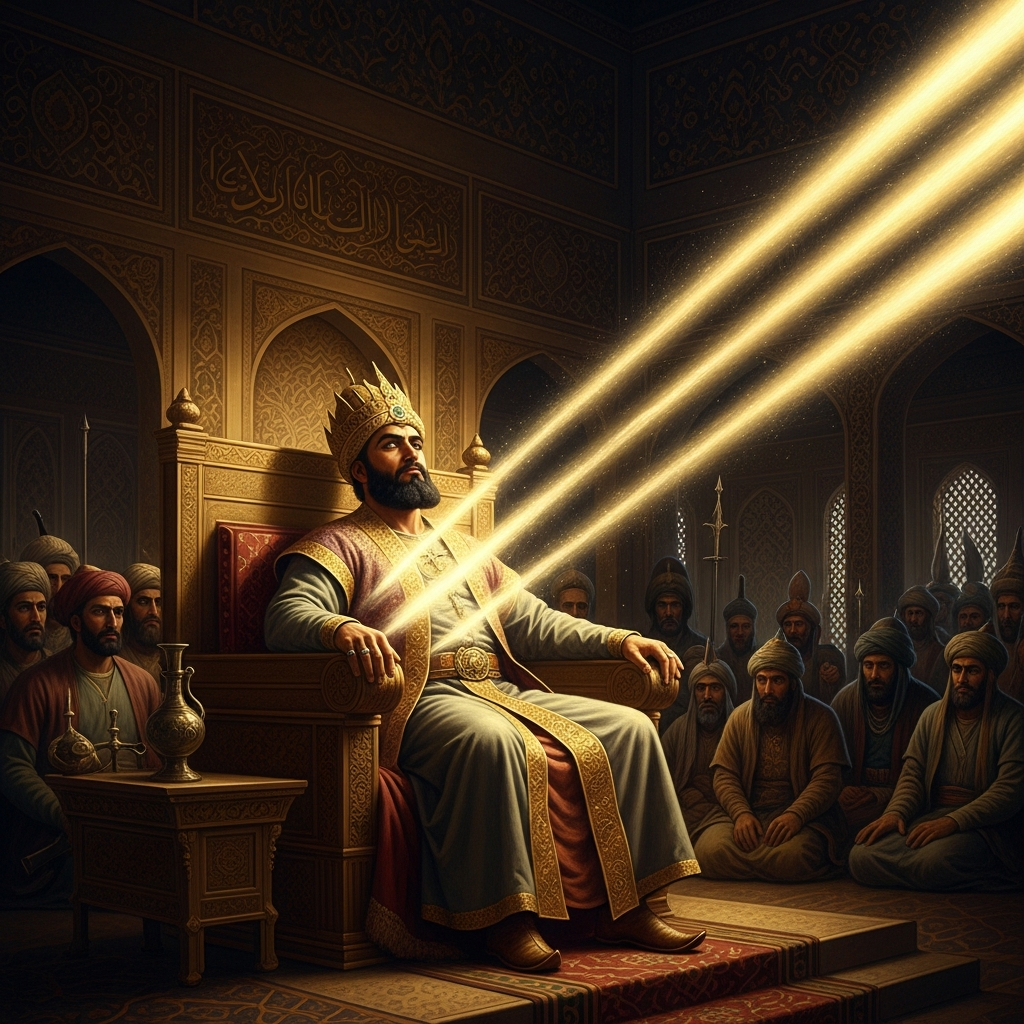
He is so obviously innocent that the entire court knows it, and the entire court also knows that Sudābeh made the accusation because he refused what she offered, and the entire court is watching Kāvus Shah navigate between his desire for his foreign wife and his knowledge of his son’s virtue, and the navigation has landed here: a mountain of fire on the plain, and Siyāvash on horseback riding into it.
Sudābeh’s version of events is precise in its falsehood. She says the prince came to her in the harem, pressed his advances, tore her dress. She shows the evidence: the torn dress. She weeps convincingly. She has the experience of a woman who survived the difficult life before she became Kāvus’s queen, and surviving difficult lives gives you the skills of the difficult.
Siyāvash’s version of events is what happened.
He entered the harem because his father sent him. Sudābeh propositioned him. He refused. She took what she needed for evidence and made her accusation. This is the story. Everyone in the court who was present can reconstruct it. No one says it because the queen is the queen.
The fire mountain is built from cut wood.
The Shahnameh records its size: as high as two spears set end to end. Siyāvash rides his horse to the foot of the pyre. He speaks no prayer — he is confident in the fire, because the divine order he has always served knows the truth even when the human order cannot. He rides in.
The court cannot see him for the smoke.
They wait.
He rides out the other side. His white horse is white. His golden robe is gold. He emerges from the mountain of fire and smoke as though he has ridden through a morning fog, slightly warm, perhaps. His face is calm.
The court is silent.
Kāvus Shah should now, in the logic the Shahnameh has established, exile Sudābeh and honor his son. He does not. He is in love with Sudābeh. He finds a compromise that is no compromise at all: Siyāvash is innocent, Sudābeh is forgiven, everyone returns to the court as though the ordeal produced an ambiguous result rather than the clearest possible verdict.
Siyāvash understands.
He asks his father’s permission to leave. He volunteers to lead the army against Afrasiyab the Turanian, who is threatening the border. He goes north. He fights well. He negotiates a peace with Afrasiyab directly and without his father’s authorization, because the peace terms are good and the war is not necessary. Kāvus, furious at the unauthorized peace, orders him to resume the war.
Siyāvash cannot. He has given his word to Afrasiyab.
He rides into Turan.
He lives at Afrasiyab’s court for years. He marries Afrasiyab’s daughter. He builds a great city called Gang-e Diz. He is everything in exile that he would have been in Iran — wise, just, beloved by the people around him. He is a man who has survived the accusation and the fire and the betrayal by his father’s love, and who has made his life on the other side.
Afrasiyab’s jealous brother Garsivaz destroys it.
He whispers to Afrasiyab over months, turning the king’s suspicion, until Afrasiyab sees in his virtuous son-in-law the thing that jealousy always sees in virtue: evidence of its own inferiority. He has Siyāvash killed.
The blood from Siyāvash’s wound calls from the earth.
A plant grows from the blood that cannot be cut down, that regrows whenever cut, that blooms red every year in the season of his death. The Iranians who learn of his death begin a mourning ritual — the weeping for Siyāvash — that is still performed in some Iranian traditions, a lamentation for the innocent murdered by the world’s incapacity to deserve what it has.
The fire proved him innocent.
The fire was the most honest thing in the story.
Echoes Across Traditions
Entities
- Siyāvash
- Sudābeh
- Kāvus Shah
- Afrasiyab
- Garsivaz
Sources
- Ferdowsi, *Shahnameh*, 'Siyavash,' translated by Dick Davis
- Azar Nafisi, *The Republic of Imagination* — on Siyāvash as archetype
- Shahriyar Adl, 'Siāvaš,' *Encyclopædia Iranica* (2004)
- Ehsan Yarshater, 'Iranian National History,' *Cambridge History of Iran* Vol. 3