Contents
Before humanity existed, the creator gods fashioned people from mud — but the mud could not hold its shape, could not speak, could not praise, and the gods unmade what they had made before it dried.
- When
- Mythic time — before the present era of humanity; Preclassic Maya theological tradition
- Where
- The primordial void — darkness over the face of the water, before land existed
In the beginning there is nothing but sky and sea.
Sky is above. Sea is below. There is no land between them, no mountain, no tree, no animal, no person. There is only the quiet darkness, and within the darkness there are minds. The creators call themselves Tepeu and Gucumatz — Sovereign and Feathered Serpent — and they float in the dark water thinking. They think alongside Heart of Sky, whose name is also Huracán, the hurricane, the one-legged lightning bolt. They think together, and their thinking is a kind of speech, and their speech is a kind of making.
They say: Let there be earth. And earth rises.
The mountains emerge. The trees grow. The animals come: deer in the forest, birds in the air, jaguars in the ravines, snakes in the undergrowth. The creators say to each animal: Speak our names. Remember us. Give us praise.
The animals cannot speak. They honk, they shriek, they hiss, they roar — but they cannot say the names of their makers, and without saying the names they cannot honor them, and without honor the creation has not yet found its purpose. The creators keep the animals for food and set them down in the forest without ceremony. A first disappointment, but not a catastrophe.
Now they try with mud.
They gather the wet earth from the riverbanks and shape it into the form they want: upright, facing forward, with a head and limbs and the general outline of a person who might speak and pray and remember. The mud dries slowly in their hands. While it is wet it holds the shape they give it; when they look away it begins to sag. The mouth they give it goes soft and smears before it can form words. The neck dissolves. The eyes blur.
They try again, more carefully, packing the mud tighter, letting it dry longer. But mud is mud. It cannot stand in rain. It cannot face the sun without cracking. It loosens when it gets wet and crumbles when it gets dry. The mud-person they build can say a few sounds — something almost like speech — but the sounds carry no meaning, no memory, no gratitude. When they pour water over it to test its endurance, it disintegrates.
The creators look at each other.
This one will not do, they say. It softens in the water. It has no strength. It cannot move its head. It cannot look anywhere. It cannot multiply. Its mouth does not work. It does not speak.
They dissolve the mud-person back into the earth.
The failure is instructive. What they have learned is that the material is wrong — not just technically wrong, the way a craftsperson learns that the clay is too sandy or too wet, but wrong in a deeper sense. They are not simply trying to build a creature that can stand and eat and reproduce. They are trying to build a creature that can look up at the sky and recognize who made the sky. They are trying to build a creature that carries, inside its chest, the capacity to be grateful.
Mud cannot do this.
Mud is the earth unmixed, the earth before it has been transformed by any other element. It holds shape only when held from outside. It has no internal coherence, no memory of the form pressed into it, no desire to remain what it was made. The mud-person is a mirror for the question: can gratitude be modeled in clay?
The answer is no.
The creators will try wood next. The wooden people will speak and multiply and fill the earth — and they will still fail, because wood, though more durable than mud, also has no interiority, no heat, no recognition of what it owes. The animals will attack them, the grinding stones will rebel against them, the pots will cook them in revenge for years of careless use. The wooden people, too, will be unmade.
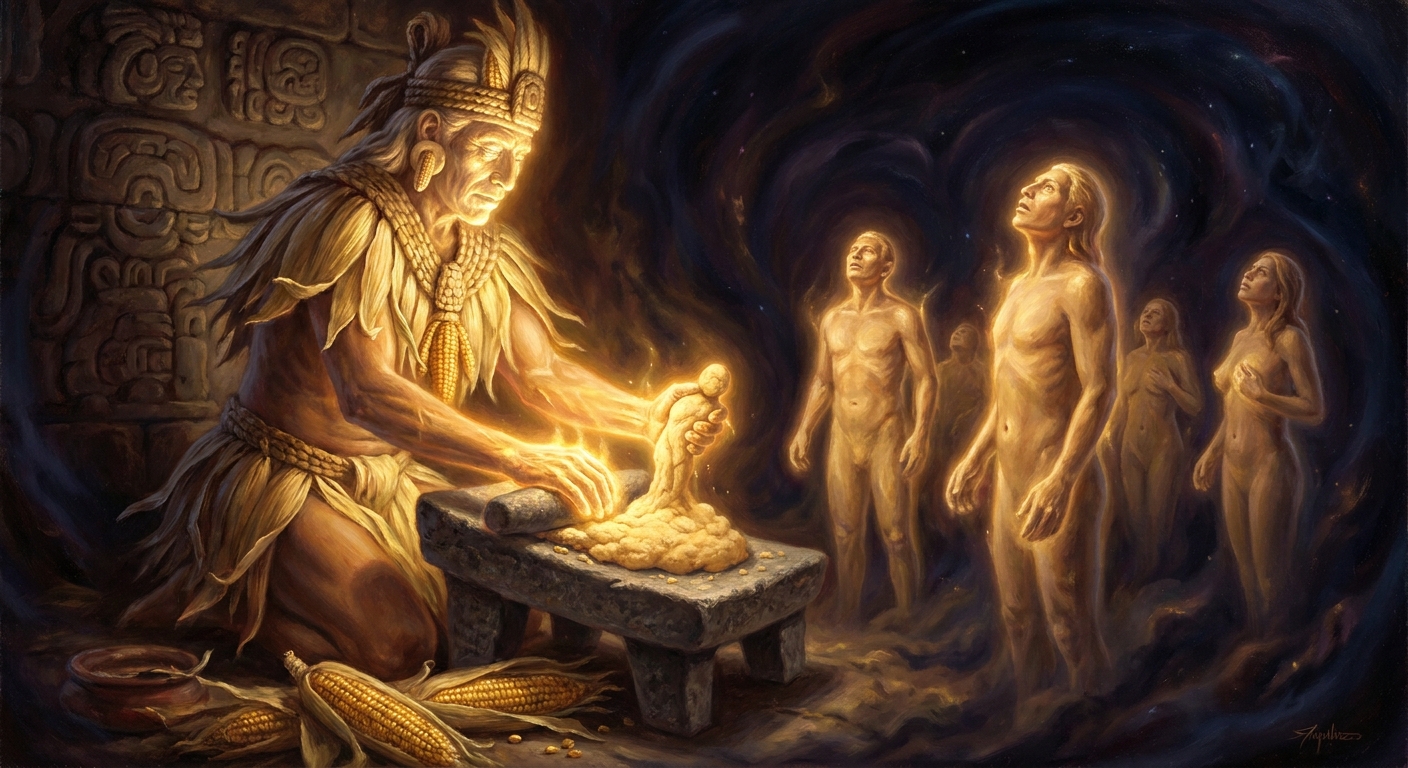
It will take three failures before the creators find the right material: white corn, yellow corn, the flesh of the maize plant, ground and mixed with water into dough. The people made of corn will speak. They will remember. They will look east and west and north and south and name each direction. They will give thanks.
But that is later.
For now there is only the dark water and the dissolved mud and the creators thinking again in the quiet, trying to understand what a person truly is.
Echoes Across Traditions
Entities
- Tepeu
- Gucumatz
- Heart of Sky
- Heart of Earth
Sources
- Popol Vuh, translated by Dennis Tedlock (Simon & Schuster, 1985)
- Allen J. Christenson, *Popol Vuh: The Sacred Book of the Maya* (University of Oklahoma Press, 2007)
- Michael D. Coe, *The Maya* (Thames & Hudson, 8th ed., 2011)