Contents
A teenager goes looking for his foster-brother's missing sword on the morning of a tournament. He finds an unattended sword stuck through an anvil in a churchyard and pulls it out. The sword has been waiting for him. The kingdom turns over in his hands.
- When
- c. 500 CE (mythic time, written 12th-15th century)
- Where
- London at the great tournament, the churchyard with the stone, the lake where the arm rises
There were two stories about the sword.
The medieval romances tangled them together; modern retellings have separated them out and put them back together in different orders. The first sword was the sword in the stone. The second sword was Excalibur, given by the Lady of the Lake. Many tellings conflate them; many tellings keep them separate. The standard version, by Malory and after, treats them as two distinct moments in the legitimating of a king.
The first moment was the moment in the churchyard.
Britain had been without a high king for some years. Uther Pendragon had died — having begotten, by Merlin’s enchantment, a son on Igraine of Cornwall the night her husband was killed in battle. Merlin had taken the infant from Uther at his birth and had given him to a knight named Sir Ector to raise in secret, far from the court, with no public knowledge of his parentage. Even Ector did not know exactly whose son the boy was. He raised him with his own son, Kay. The boy was simply Arthur, an unremarked younger sibling, and Kay was the elder.
In the years after Uther’s death, the kingdom fell into faction. Many claimed the throne. None of them could secure it. There were small wars. There were broken treaties. The kingdom needed a king, and the kingdom could not agree on one.
Merlin, in the absence of agreement, arranged a test.
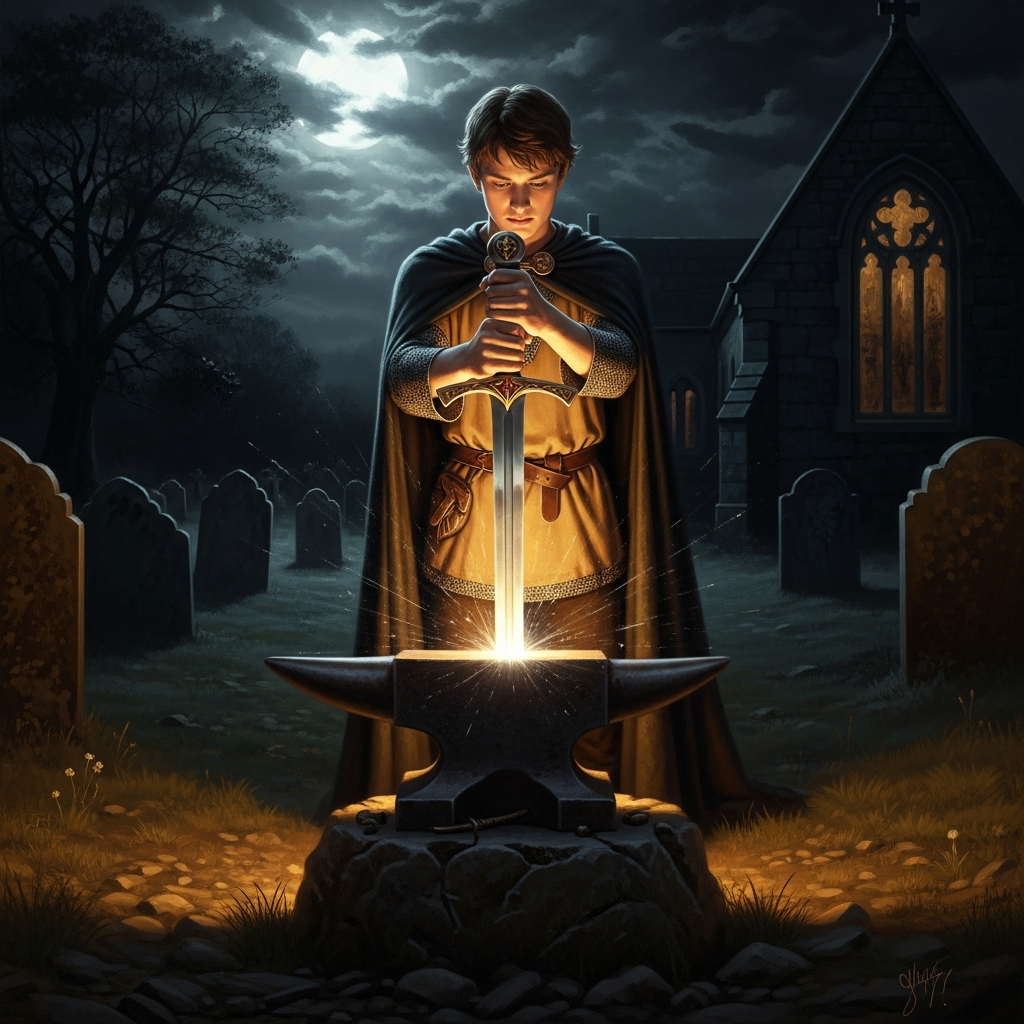
In a churchyard in London, on a particular Christmas, a great gray stone appeared overnight. The stone was the size of a small altar. On top of the stone was an anvil. Through the anvil and into the stone — driven so deeply that no part of the blade was visible above the anvil’s flat — was a sword. Around the stone was an inscription, carved in gold letters: Whosoever pulls this sword from this stone is rightwise King of all England.
The Archbishop of Canterbury was consulted. He pronounced the test legitimate. He summoned a great tournament for New Year’s Day. Every nobleman in England was to come; afterward, every man who wished could try the sword.
They came. They tried. The first day, the great barons. None could move it. The second day, the lesser knights. None could move it. The third day, men of every rank — soldiers, sergeants, even — by some accounts — peasants who had heard the proclamation and made their way to London. None could move it. The sword stood in the stone untouched.
The tournament was running through that morning, and Sir Ector was there with his son Kay, who had been knighted only two months earlier and was riding his first major engagement. Arthur — younger by five or six years than his foster-brother, not yet knighted, serving Kay as squire — was attending him.
In the press of the morning, Kay realized he had forgotten his sword at the inn. He turned to Arthur. My sword is at the inn. Ride back. Get it for me.
Arthur rode back. The inn was locked. Everyone was at the tournament. He could not get in.
Riding back through the streets, he passed the churchyard. He saw the stone. He saw the sword in it. He had heard — in the way a younger boy hears talk and only half-understands — that there was a sword for the taking that morning. Practical, in a hurry, thinking only of his brother’s needs, he dismounted at the churchyard fence, walked over to the stone, gripped the hilt, and pulled.
The sword came out smoothly. It came out the way a sword comes out of a scabbard.
Arthur took it. He rode back to the tournament. He found Kay. He handed him the sword.
Kay looked at it. He recognized it. He did not say anything to Arthur for a moment. He found his father.
Sir Ector took the sword in his hands. He looked at the engraving along its blade. He looked at his elder son. Where did you get this?
Kay hesitated. He saw, in his father’s face, that the answer mattered. Then — to his credit, in most versions, though the texts vary — he told the truth. I did not draw it. Arthur drew it. He went back for my sword and could not get into the inn, and he came past the stone, and he drew it. He gave it to me.
Sir Ector was silent. He took both his sons by the shoulders and walked them out of the tournament field, away from the crowd, into the churchyard. The stone was empty.
Sir Ector said: Put the sword back in the stone, Arthur.
Arthur set the sword’s point on the slot from which he had drawn it. He pushed gently. The sword went back in, all the way, until it was standing in the anvil as it had been before.
Sir Ector tried to draw it. He could not move it. Kay tried. He could not move it. Sir Ector said to Arthur: Now draw it again.
Arthur drew it again. It came out in his hand.
Sir Ector dropped to one knee. Kay, after a moment, dropped to one knee beside his father. Arthur, alarmed, said: Father — why are you kneeling?
Sir Ector said: Because I am not your father, my lord. I have known this day might come for sixteen years and I have not wanted to know it. You are king of England. The sword has shown it. The kingdom is yours.
Arthur did not understand at first. He understood, slowly, over the following weeks. There were objections. Many of the great lords refused to accept what a fifteen-year-old in a churchyard had done. They said the test was rigged. They said Merlin had cheated. They demanded that the sword be tried again, and again, by every man who claimed the throne, in front of the assembled barons. The sword was tried four times — at Christmas, at Candlemas, at Easter, at Pentecost. Each time only Arthur could draw it. By Pentecost, even the most stubborn of the great lords could no longer pretend. The Archbishop crowned him. The boy was king.
So went the first sword. The first sword was an instrument of recognition. It did not give power; it identified the person to whom power belonged.
The second sword came later.
Arthur had won several wars. He had unified Britain. He had, in some account or other, broken the first sword in a particular battle — most often the battle against King Pellinore, a single combat in which Arthur had pressed too hard and the sword had snapped at the hilt. He needed a sword. He had, since the breaking of the first sword, been wielding inferior blades.
Merlin took him to a lake.
The lake was in the western country — exactly where varies by version, but it was a remote lake, deep, surrounded by forest, with the look of water that was older than the surrounding land. They came down to the shore. They got into a small boat. They rowed to the middle of the lake.
In the middle of the water, an arm came up.
It was a woman’s arm — clothed in white samite, mystic, wonderful, in Tennyson’s later phrase — emerging from the surface of the lake with no visible body to which it was attached. The hand at the end of the arm held a sword, hilt upward, the blade pointing into the lake. The sword was extraordinary. The hilt was set with jewels. The blade — when, later, Arthur drew it — had a cutting edge that would not dull.
Merlin said: That is your sword. Row over and take it.
Arthur rowed over. He reached out. He took the hilt. The arm — the woman’s arm — released the sword to him, slowly, deliberately, as though the giving were itself a ritual. The arm withdrew under the water and disappeared.
Merlin said: That sword’s name is Excalibur, which means cut steel. Its scabbard is more precious even than the sword. So long as you wear that scabbard, you will lose no blood from any wound. Guard the scabbard more carefully than you guard the sword.
Arthur received both. He carried them for the rest of his reign. He won wars with the sword. He survived wounds because of the scabbard. (Eventually his half-sister Morgan le Fay would steal the scabbard, replace it with a counterfeit, and so make him mortal again — but that is a much later episode.)
When Arthur was at last mortally wounded at Camlann — Mordred’s spear in his side, his army destroyed around him, only Sir Bedivere remaining — he asked Bedivere to take Excalibur to the lake and throw it in.
Bedivere went. He could not bring himself to throw away a sword of such value. He hid it in the reeds and came back. Arthur asked: What did you see? Bedivere said: I saw nothing but the wind on the water. Arthur said: You have not done it. Go and do it. Bedivere went again. He could not do it. He came back. Arthur, dying, looked at him with the fading patience of a man who understands what his men think their loyalty is. He sent him a third time.
The third time Bedivere went down to the lake. He took out the sword. He looked at it for a long moment. He drew his arm back. He threw it, hard, out over the water — far out, into the deep middle.
The same arm, clothed in samite, rose up from the water. It caught the sword by the hilt as it fell. It brandished the sword three times above the water in a slow, grave salute. Then it sank back beneath the lake with the sword in its hand.
The sword was returned to its source.
Bedivere came back to the dying king and reported what he had seen. Arthur, hearing it, smiled. He said: Now I am ready to go. The black ship of the queens of Avalon — Morgan le Fay, the Queen of North Wales, the Queen of the Wastelands, and others — came up the lake. They took him aboard. They sailed away into the mist with him, weeping. He was not dead, says the legend. He was being taken to Avalon, where his wounds would be healed. He would return when Britain needed him most. Rex quondam, rexque futurus, the inscription on his tomb reads — the once and future king.
Both swords return to where they came from. The first sword goes back into the stone the moment Arthur sets the point in the slot to demonstrate the truth to his foster-father, and stays there, theoretically, available to the next person who can draw it (no one ever does). The second sword is given by the lake and returned to the lake. Neither sword belongs to the man who carries it. Both are loans.
This is what the legend is finally about. The sword in the stone is not the king’s possession. It is a device for recognizing the king. The sword Excalibur is not the king’s possession. It is given to him by an older power and reclaimed by that power when his work is done. The kingdom itself is not the king’s possession. He is its custodian for the duration of his life. When he goes, the kingdom does not go with him; the kingdom waits. The sword goes back into the lake. The boy in the churchyard becomes king. Some other boy in some other churchyard, the legend implies, will pull a different sword from a different stone, when the next age requires.
The legend keeps being retold because the question keeps being asked. Who should rule? On what basis? By what test that cannot be falsified? The medieval answer was: a sword that knows. The modern answer is constitutions and elections — elaborate, fragile, often disappointing, and modeled, for what it is worth, on the ancient hope that the legitimate ruler can be identified by a test that political faction cannot rig. We have not done a much better job than the medieval romancers. We have not done much worse.
Scenes
The London churchyard at dawn
Young Arthur, alone, drawing the sword
Years later, on a lake at twilight: a white arm clothed in samite rises from the dark water, holding aloft a second sword that catches the last red of the sun
Echoes Across Traditions
Entities
- Arthur
- Sir Ector
- Sir Kay
- Merlin
- The Lady of the Lake
- Uther Pendragon


Sources
- Robert de Boron, *Merlin* (c. 1200)
- Geoffrey of Monmouth, *Historia Regum Britanniae* (c. 1136)
- Sir Thomas Malory, *Le Morte d'Arthur* (1485) — Book I
- T. H. White, *The Sword in the Stone* (1938)