The Fire That Has Never Gone Out
The Sassanid period and continuing to the present — the great fires lit in the 5th–7th centuries CE · Yazd, Iran — and the fire temples of Navsari, Udvada, and the Parsi diaspora
Contents
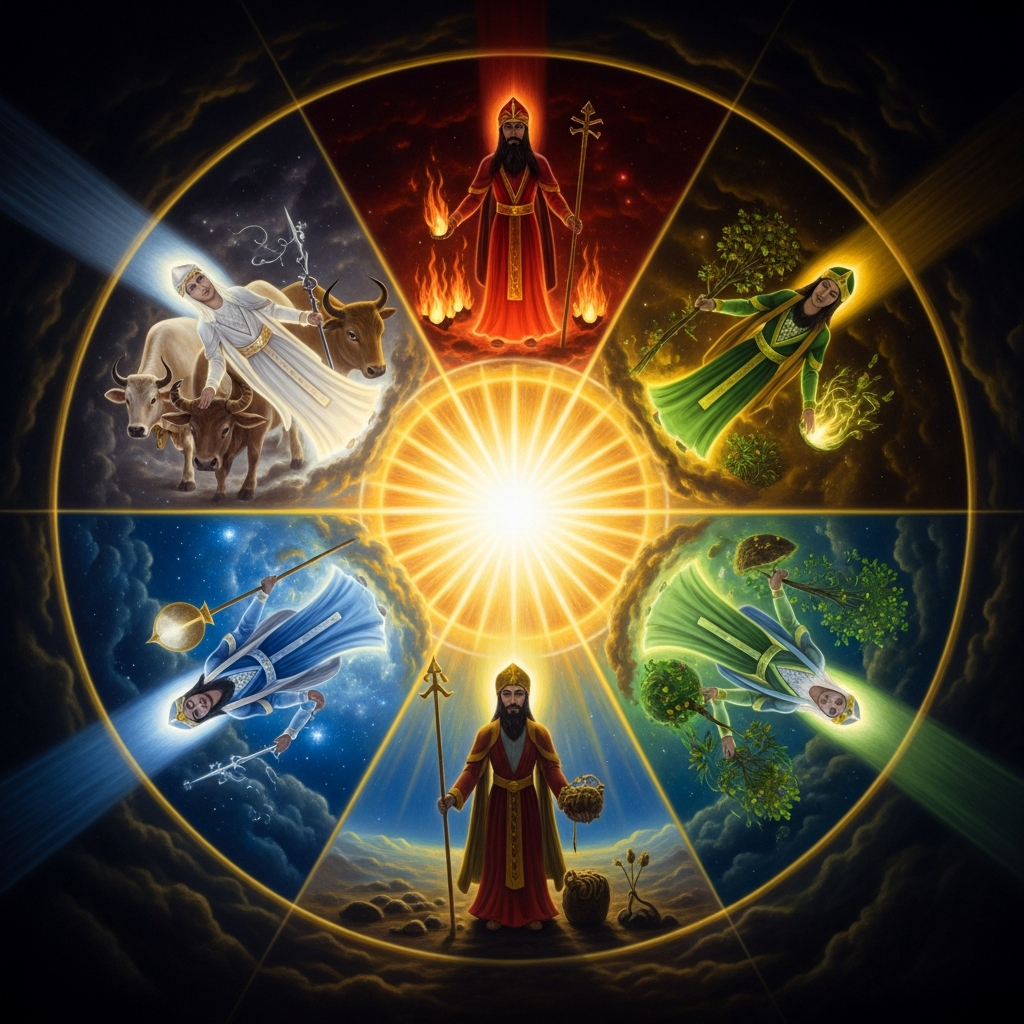
In the fire temples of Yazd and beyond, priests tend flames that have burned continuously for fifteen centuries — not as a symbol of God but as God's presence in the material world, the yazata of fire maintaining its divine function through unbroken light.
- When
- The Sassanid period and continuing to the present — the great fires lit in the 5th–7th centuries CE
- Where
- Yazd, Iran — and the fire temples of Navsari, Udvada, and the Parsi diaspora
The fire has been burning since your grandfather’s grandfather’s grandfather was young.
In the city of Yazd — the desert city in the center of the Iranian plateau that has been a Zoroastrian stronghold since before the Islamic conquest — the Atash Bahram burns in its silver urn behind glass, tended by priests in white robes with white cloth over their mouths so that their breath does not pollute the flame.
The word Atash Bahram means Fire of Victory — named for Verethragna, the yazata of victory who has ten forms, the most powerful fire classification in the Zoroastrian system. To establish an Atash Bahram requires gathering sixteen different fires: the fire of a goldsmith, a silversmith, a blacksmith, a potter, a armorer, a mint worker, a glass-worker, a brick-maker, a baker, a brewer, a dyer, a fortress, a king, a thunder-struck tree, a funeral pyre, and the fire of the Zoroastrian hearth. These sixteen fires are amalgamated through a purification ritual that takes months, and the resulting fire is classified as the highest earthly expression of Atar, the fire yazata.
In the Zoroastrian theology of fire, Atar is not merely a symbol of God.
He is the son of Ahura Mazda, and he is present in the fire in a way that is more than metaphorical. Every fire contains the divine spark that was in the original fire Ahura Mazda set burning when he created the world. The fire on the hearth and the fire in the sun are the same Atar in different material expressions. When the priest tends the Atash Bahram, he is not maintaining a symbol; he is tending a living divine being whose material expression is flame.
The three great fires of ancient Iran each had a social function corresponding to the three classes.
Adur Farnbag, the fire of the priests, was in Khorasan, in the east — or possibly on the Caspian coast, the sources disagree. Adur Gushnasp, the fire of the warriors and kings, burned at Takht-e Suleiman in Azerbaijan, carried to war by the Sassanid emperors and returned to its temple at the campaign’s end. Adur Burzin-Mihr, the fire of the farmers and ordinary people, burned on Mount Reivand in northeastern Iran.
These three fires were said to have been lit in the mythic age — not by human hands but by the divine fire that fell from the divine realm at creation. They were tended continuously for centuries or millennia, carried in their silver urns when the temples were threatened, hidden in the mountains when invaders came, kept burning by priests who understood that the extinction of the flame was not merely a ritual failure but a cosmic wound.
When the Arab armies came in the seventh century and the Sassanid empire fell, the great fires were not extinguished. They were carried.
Some priests fled east to the Alborz mountains and kept their fires burning in the high passes where the armies did not follow. Some fled further east to Khorasan and kept fires burning in remote temples. And some — perhaps in the ninth or tenth century, the Parsi tradition says 936 CE, though the exact date is disputed — took their fire across the sea to India, where the King of Sanjan on the Gujarat coast gave them land and permission to keep the fire burning.
The Iranshah fire has been burning at Udvada, Gujarat, ever since.
The Atash Bahram at the Yazd fire temple — the Atash Behram — has been burning for fifteen hundred years by the temple’s own count, possibly longer. The priests who tend it cannot be entirely certain of the unbroken continuity through the conquests and migrations and political upheavals of fifteen centuries. What they are certain of is the intent: never let it go out. Whatever the difficulties, keep feeding it.
The white-robed priest who tends the fire each morning and evening carries the fuel and the tongs and the prayer with the same attentiveness that Zarathustra brought to the dawn ritual at the river. The specific fire may have been re-lit from another source at some point in the long centuries. The intention has been continuous.
In Zoroastrian theology, the intention matters more than the continuity of the flame. The flame is a vehicle for Atar. The vehicle can be renewed. The consecration — the recognition of what the fire is and why it burns — is what must not be extinguished.
The fire keeps burning.
That is the point.
Echoes Across Traditions
Entities
- Atar (Fire Yazata)
- Zoroastrian Priests (Mobads)
- Adur Farnbag
- Adur Gushnasp
- Adur Burzin-Mihr
Sources
- Mary Boyce, *A Persian Stronghold of Zoroastrianism* (Oxford, 1977)
- Jamsheed Choksy, *Purity and Pollution in Zoroastrianism* (University of Texas, 1989)
- Mary Boyce, *Zoroastrians: Their Religious Beliefs and Practices* (Routledge, 1979)
- Almut Hintze, 'Fire Temples,' *Encyclopædia Iranica* (1999)