Contents
Batradz, the greatest warrior of the Nart legends, is not born — he is forged. Struck from his father's back as a red-hot lump of iron, he is thrown into the sea to cool and emerges tempered and invincible. When Batradz is finally killed by a trick, the sea itself rises in mourning: the Narts must throw his sword into the sea, but they keep lying about having thrown it until a young boy finally does it — and the waters run red.
- When
- Nart Sagas — oral tradition of the Ossetians and other North Caucasian peoples; collected 19th–20th century CE
- Where
- The North Caucasus; the sea that receives his sword
Khamyts, the Nart hero, had a tumor growing from his back.
This was not a disease. Khamyts understood, in the way the Narts understand such things — through the specific knowledge that comes to people whose lives are embedded in the supernatural — that the growth was a child. The child had chosen to gestate in his father’s back rather than in the ordinary way, which was not unprecedented among the Narts, who were not ordinary people.
When the growth was ready, the blacksmith Kurdalagon was summoned. Kurdalagon is the smith of the Nart cosmos — the divine craftsman who inhabits the same position that Hephaestus holds in the Greek world and Goibhniu holds in the Irish: the maker, the one who works with fire and metal, the one who can turn raw material into form. He looked at Khamyts’s back and he understood what was needed.
He struck the growth with his hammer.
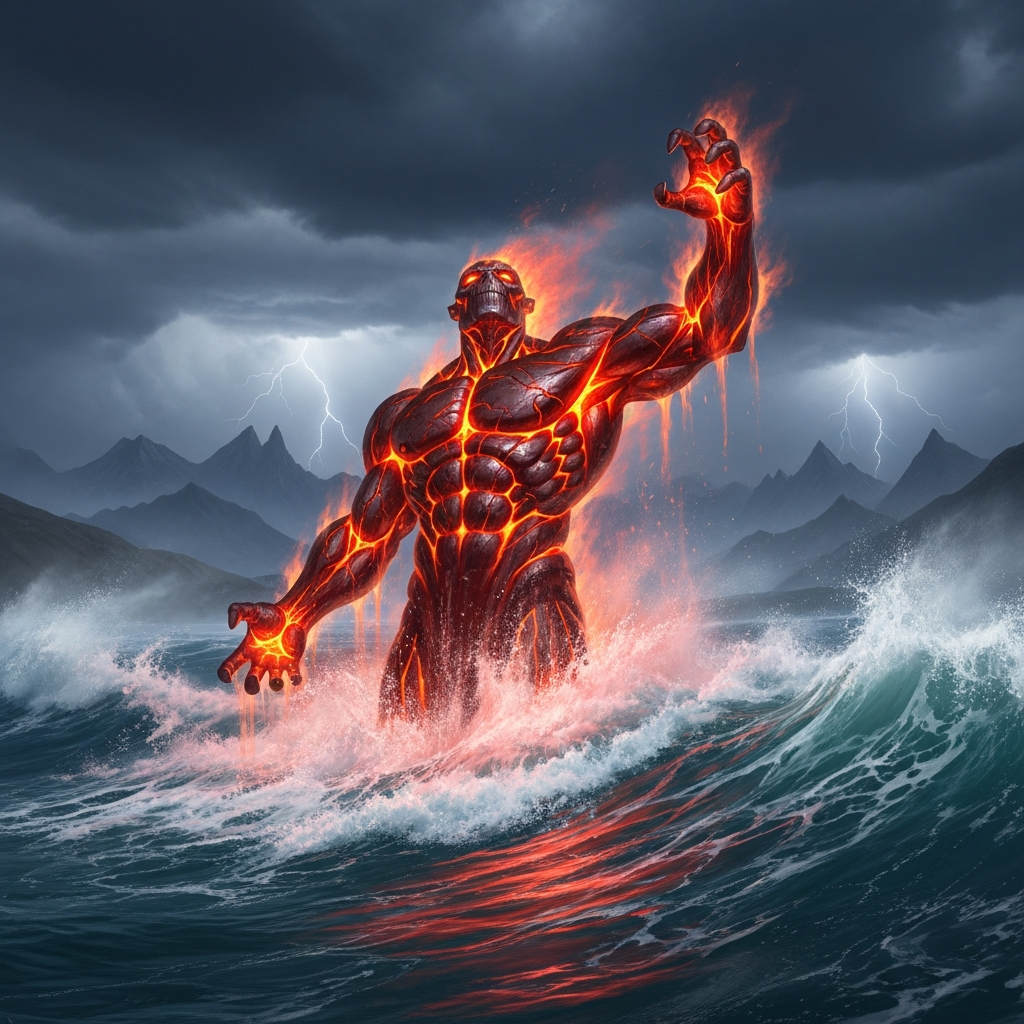
Out came a red-hot lump of iron the size of a child.
Kurdalagon held the iron in his tongs. It was a child — it moved, it had the form of a child, it was alive inside the iron — but it was not cooled, and it could not be handled, and the first question was what to do with it. He carried it to the sea. He threw it in.
The sea received the iron child with a hiss of steam and a column of water rising where the heat met the cold, and the sea worked on the child for the time it needed, cooling the iron by degrees — not quickly, the way a forge-quench cools iron, but slowly, the sea’s temperature being gentler than a bucket of water, so that what emerged from the sea when the cooling was complete was tempered in the deepest sense: not brittle with fast cooling, but resilient with slow, the iron of the body hard and flexible together.
Batradz walked out of the sea.
The Narts are the race of heroes in the mythology of the Ossetians and the other North Caucasian peoples who share the tradition — the Kabardians, the Abazins, the Chechens and Ingush in their own variants. They are not gods; they are not human; they are the generation between, the era of heroes that exists before the ordinary human world begins. Their councils are held in the great hall of Nart society; their decisions shape the world that comes after them; their defeats are the explanation for why the world is the way it is.
Batradz among the Narts is what Achilles is among the Greeks: the strongest, the most beautiful in war, the one around whom the cycle turns. He is also the most difficult. He has the temper of iron — sudden, extreme, not interested in the social arrangements that make community possible. He kills enemies that no one else can kill. He also kills allies when something offends him, which happens with some frequency.
He is invincible in direct combat. His iron skin is proof against ordinary weapons; divine weapons can affect him, but the knowledge of how to use them against Batradz is not widely distributed among his enemies.
The enemies eventually find the knowledge.
He is killed through a trick involving divine arrows. The specific mechanism varies by version. What all versions agree on is that Batradz’s death, when it comes, is the death of an age — not just the loss of one warrior, however exceptional, but the passing of the Nart epoch itself. The great heroes die; the world becomes smaller; the people who remain inherit a reduced world.
As he is dying, the Narts face their obligation.
His sword must be thrown into the sea. This is the requirement — the ritual disposal of the hero’s weapon, the return of the martial principle to the source from which Batradz himself emerged. The sea received him as a hot iron child and cooled him into the warrior he became; the sea is the appropriate receiver of the weapon that expressed that warrior’s nature.
The elder Narts take the sword to the shore.
The first elder looks at the sword. It is a significant object — heavy, magnificent, the kind of weapon that accumulates meaning over a lifetime of use. He looks at the sea. He looks at the sword again. He throws a stone into the sea instead and returns to the dying Batradz and reports: I threw it. The sea accepted it.
Batradz asks: What did the sea do?
The elder describes the small splash and the ripples of a thrown stone.
You did not throw the sword, Batradz says.
The second elder goes. He also cannot bring himself to do it. He also throws something else — a piece of wood, a ring, the sources vary. He returns with a false report. Batradz asks the same question. The second elder describes the same unremarkable response. Batradz recognizes the falseness again.
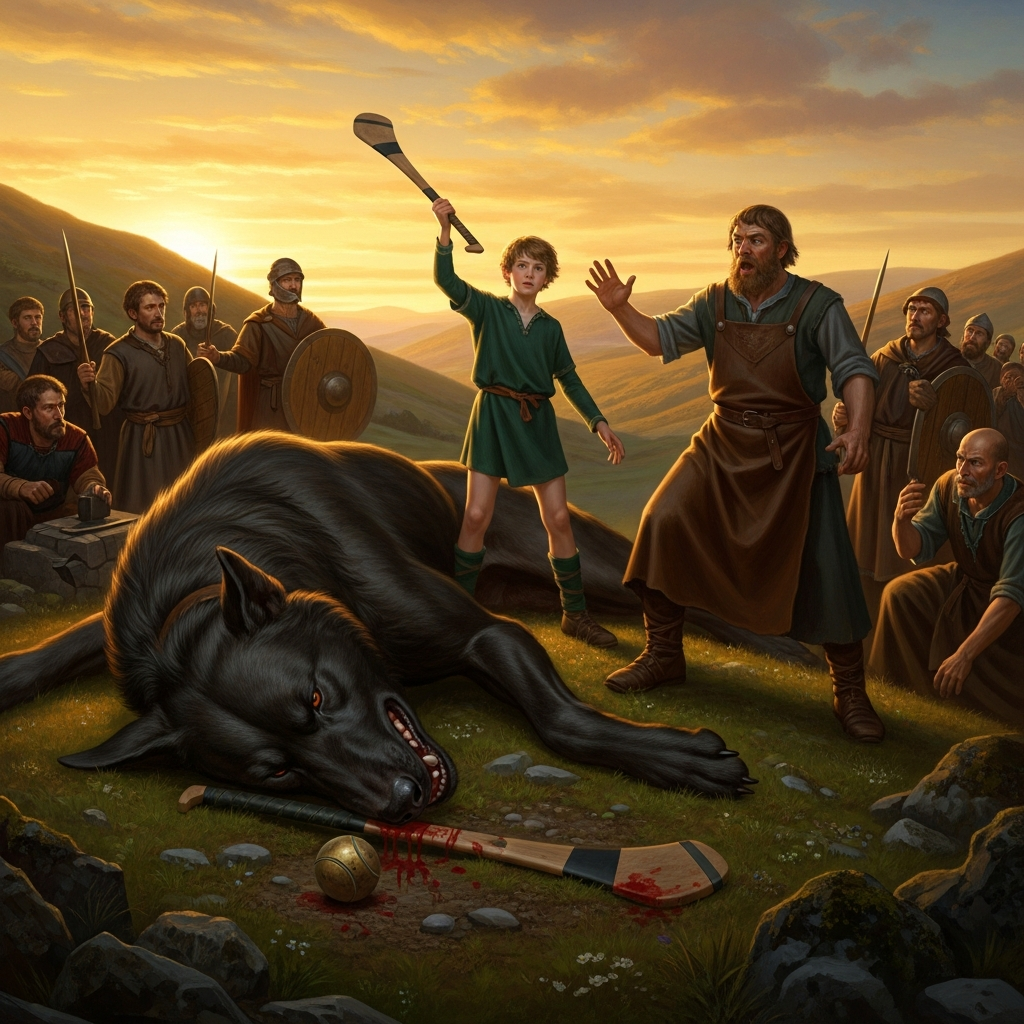
A young boy is sent. He has not yet developed the attachment to the weapon that prevented the elders from releasing it. He has not learned yet the logic of preservation that makes old men hide beautiful things from the loss they deserve. He carries the sword to the shore, swings it once, and throws it as far as he can into the water.
The sea rises.
It does not rise in a small way. It rises as if struck, as if the impact of the sword reaching the water is the signal for a grief the sea has been waiting to express — a churning, a wall of water, a redness spreading outward from the point of impact that is the color of iron-rust or blood.
The waters run red.
The boy returns and tells Batradz what happened. Batradz, hearing the true answer, releases what he has been holding — not his breath exactly, but the specific tension of the dying who wait for a final thing to be completed before they can let go. The tension releases.
He dies.
The Nart tradition as a whole ends with a vanishing.
The great heroes die one by one, or they are transformed, or they ascend into the mountains in a way that recalls Khusrow and Arthur and Elijah. The world after the Narts is our world — reduced in scale, without the thirty-meter warriors and the divine swords and the blacksmiths who temper children in the sea. What we have instead is the memory, preserved in the oral tradition of the Ossetian and Kabardian and Abkhazian peoples, carried through the catastrophes of Mongol invasion and Russian conquest and the deportations of the Soviet era.
The Nart Sagas were first written down by folklorists in the nineteenth century, when the tradition was very much alive and the Soviet scholars of the twentieth century collected thousands of variants. The corpus is enormous — larger than the Iliad and Odyssey combined. Most of it is untranslated into English.
Batradz is the heart of it. The warrior who is forged rather than born, who is cooled in the sea and returned to the sea, whose sword the faithful cannot throw and a child must throw instead, whose death causes the waters to run red — he is the myth’s clearest statement about what a hero is: not a man who does not die, but a man whose death costs the world something the world cannot replace.
The sea is still red in the right light, at the right hour, when the sun hits the water at an angle the Narts would have recognized.
Echoes Across Traditions
Entities
- Batradz
- his father Khamyts
- the Narts (the legendary warrior caste)
- the sea
Sources
- John Colarusso, *Nart Sagas from the Caucasus* (Princeton University Press, 2002) — primary collection and translation
- Dumézil, Georges, *Légendes sur les Nartes* (Paris, 1930) — foundational comparative study
- C. Scott Littleton and Linda Malcor, *From Scythia to Camelot* (Garland, 1994) — Sarmatian migration and Arthurian parallels
- Édouard Siecle, *Ossetic Studies* (various, 1960s)
- Encyclopaedia Iranica, s.v. 'Narts' and 'Batraz' (online edition)