Verethragna in His Ten Forms
The eternal cycle of the cosmos — Verethragna's forms repeat throughout divine time · Everywhere that victory over evil is achieved — the battlefield, the hunt, the moment of personal courage
Contents
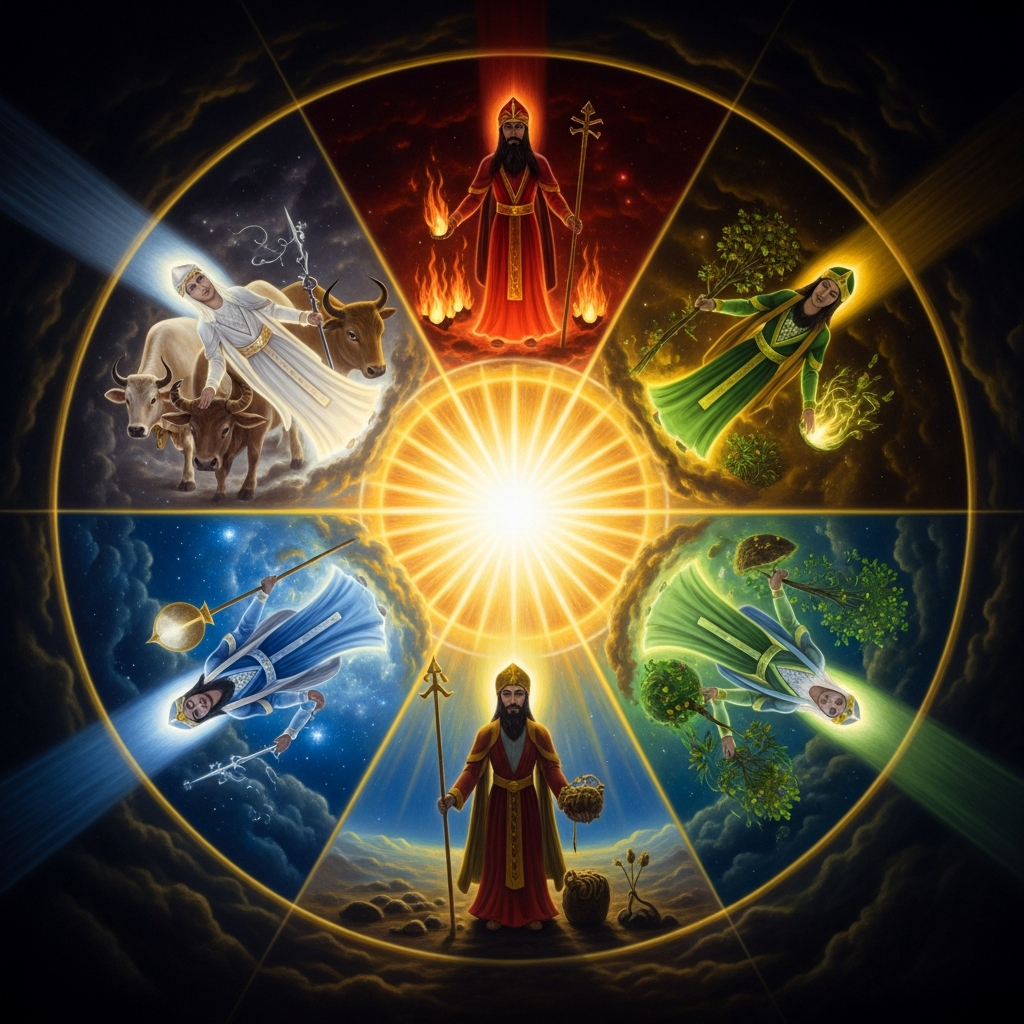
The yazata of victory Verethragna appears to the faithful in ten successive animal and human forms — as a wind, a bull, a white horse, a camel, a boar, a falcon, and more — each form embodying a different quality of divine conquest over the forces of evil.
- When
- The eternal cycle of the cosmos — Verethragna's forms repeat throughout divine time
- Where
- Everywhere that victory over evil is achieved — the battlefield, the hunt, the moment of personal courage
He comes first as the wind.
Verethragna — the Victorious, the Smasher of Fortresses, whose name means literally the one who smashes Verethra, Verethra being the demon of obstruction — appears to the faithful in his first form as a swift wind that smells of pure air and carries away the breath of the daevas. This is victory in its subtlest form: the clearing of the atmosphere, the removal of the contamination that fogs the mind and makes right action difficult. Every crisp morning wind that seems to blow the previous day’s confusion away is Verethragna in his first form, doing what victory always does first: clearing the field.
He comes second as a golden-horned bull.
The bull is the most powerful domestic animal of the ancient world, and Verethragna in bull form represents victory through raw power — the force that breaks through the obstacle rather than flowing around it. His horns are golden because victory in this form is not destructive but creative: the bull that breaks new ground is also the bull that makes new fields possible.
He comes third as a white stallion with golden caparisons.
The horse represents the victory of speed and beauty together — the conquest that is also graceful, the defeat of the enemy that comes so swiftly the enemy barely knows what happened. The white color is purity: victory that has not been soiled by the means used to achieve it.
He comes as a camel, a boar, a youth of fifteen years full of divine light, a raven, a ram, and finally as a man. The list is the Bahram Yasht’s sustained meditation on the forms that victory takes in different circumstances and different cosmic zones.
The boar is the most dramatic.
When Verethragna appears as the boar, the Bahram Yasht breaks into a different register — the description of the boar is longer, more intense, more physically specific than any of the other forms. A sharp-toothed boar, that kills at one stroke, unapproachable, with a sharp tusk that kills with a single strike. The boar form is victory through unstoppable forward momentum — the animal that does not stop when wounded, that charges through every obstacle, that cannot be deflected by pain or fear. This form is what victory looks like when the obstacle is particularly entrenched, when subtlety and speed have failed and what remains is the sheer refusal to be stopped.
He invests kings with his divine power.
This is his social function: to give kings the quality of victory, so that their wars are just wars and their outcomes are righteous outcomes. The Achaemenid and Sassanid kings sought Verethragna’s favor before campaigns, and his favor showed in the Bahram Fire — the highest grade of Atash Bahram — named for him, which kings would consult before major military decisions.
But his victories are not only military.
The Bahram Yasht records a range of victories he enables: victory over drought, victory over slander, victory over disease, victory over stupidity, victory over the evil eye. He gives the faithful protection from the arrows of enemies and the words of liars and the plans of those who wish them harm. His victory is the comprehensive triumph of everything that sustains ordered life over everything that corrodes it.
He meets Zarathustra in his tenth form — as a man of twenty years, carrying the divine glory (xvarənah) in his hands like a visible fire. This is the most direct form: divine victory embodied as a human being in the fullness of physical prime. This is the form in which Verethragna can be most completely emulated — the vision of what a fully righteous, fully vital human being looks like when Angra Mainyu’s attacks have been repelled and the quality of victory inhabits the body.
The Bahram bird — the raven-like bird of the Zoroastrian tradition, whose feathers are used as protective amulets — is named for him. To carry a Bahram feather is to carry a token of divine victory, a small piece of the cosmic pattern that says: the obstacles are real, and they can be broken.
He smashes fortresses for a living.
The fortress he smashes, in the end, is the one the Hostile Spirit built around the human soul.
Echoes Across Traditions
Entities
- Verethragna
- Ahura Mazda
- Zarathustra

Sources
- Avesta, *Bahram Yasht* (Yasht 14), translated by James Darmesteter
- Gherardo Gnoli, 'Bahrām,' *Encyclopædia Iranica* (1988)
- Mary Boyce, *A History of Zoroastrianism*, Vol. I (Brill, 1975)
- Franz Grenet, 'Mithra, Verethragna, and the Royal Glory,' *Studia Iranica* (1988)