Cú Chulainn: The Warp-Spasm and the Death of Ulster's Hero
The *Táin Bó Cúailnge* is set in a legendary Iron Age Ulster, c. 1st century CE in Irish mythological chronology; the manuscripts are c. 1100 CE · Ulster (the northern province of Ireland); the ford at the River Dee; the plain of Muirthemne where Cú Chulainn stands alone; the cattle-lands of Cooley
Contents
Cú Chulainn, Ulster's champion, defends the province alone during the Cattle Raid of Cooley. His body transforms in battle into something inhuman. The Morrígan circles him. He will not outlast his own geis.
- When
- The *Táin Bó Cúailnge* is set in a legendary Iron Age Ulster, c. 1st century CE in Irish mythological chronology; the manuscripts are c. 1100 CE
- Where
- Ulster (the northern province of Ireland); the ford at the River Dee; the plain of Muirthemne where Cú Chulainn stands alone; the cattle-lands of Cooley
The men of Ulster cannot fight.
This is the condition that makes Cú Chulainn necessary. Macha, a divine woman who was forced to race against the king’s horses while pregnant, cursed the men of Ulster as she died: in their hour of greatest need, they will be struck with the pains of childbirth. The curse takes all the Ulster warriors at the worst possible moment — when Queen Medb of Connacht marches east with her army to steal the great Brown Bull of Cooley.
Only two beings are exempt from Macha’s curse. Cú Chulainn, because he is the son of the god Lugh and not fully human. And Fergus mac Róich, exiled king of Ulster, who fights for Medb’s side now — against the province he once served.
So Cú Chulainn stands alone at the ford.
He is seventeen years old, or thereabouts.
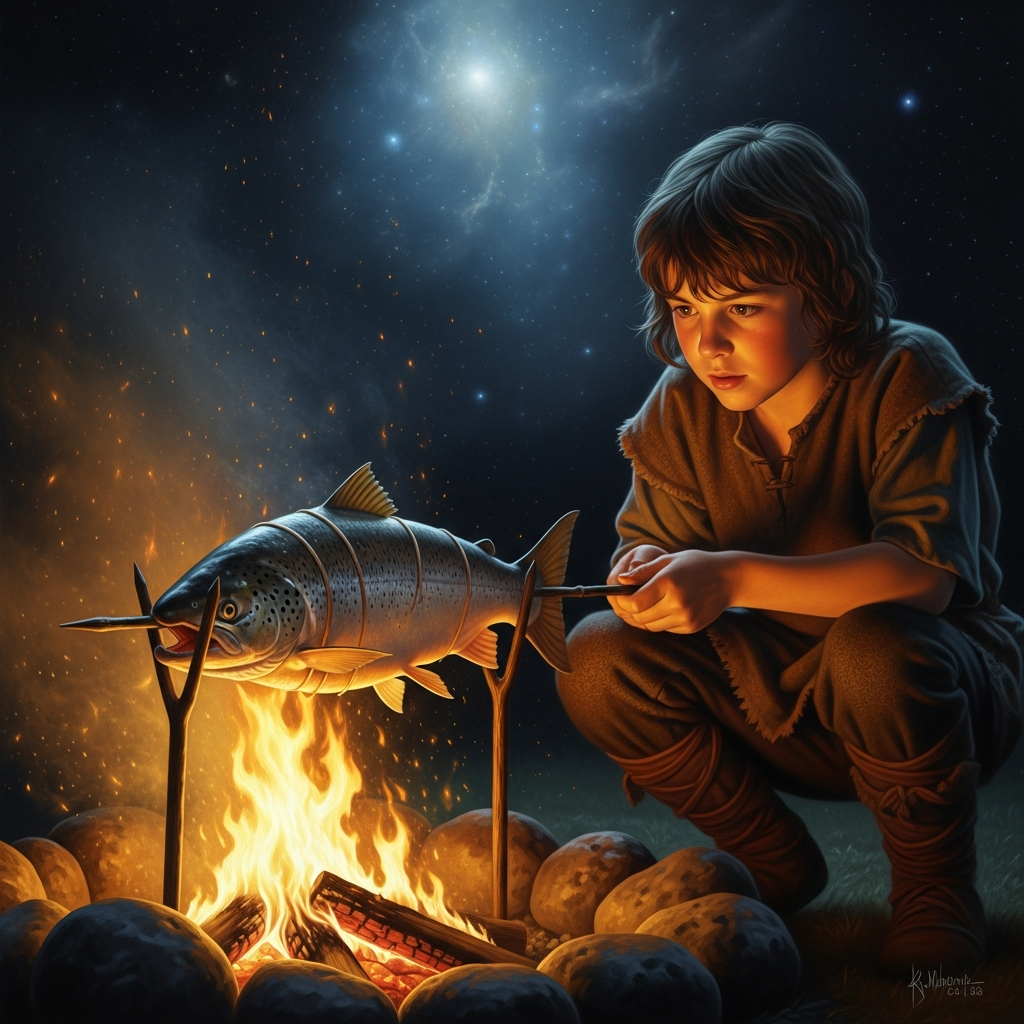
His birth name was Setanta. He became Cú Chulainn — the Hound of Culann — after killing a great guard-dog as a boy and offering to serve as the smith Culann’s watchdog himself until a replacement could be trained. The name stuck. The substitution embedded itself in who he became: the boy who takes the place of what he has destroyed.
He is described in multiple ways across the Táin: small and dark-haired, with seven toes on each foot, seven fingers on each hand, seven pupils in each eye. When he is in his normal state, women fall in love with him. He is beautiful. When he enters the ríastrad, he is something else.
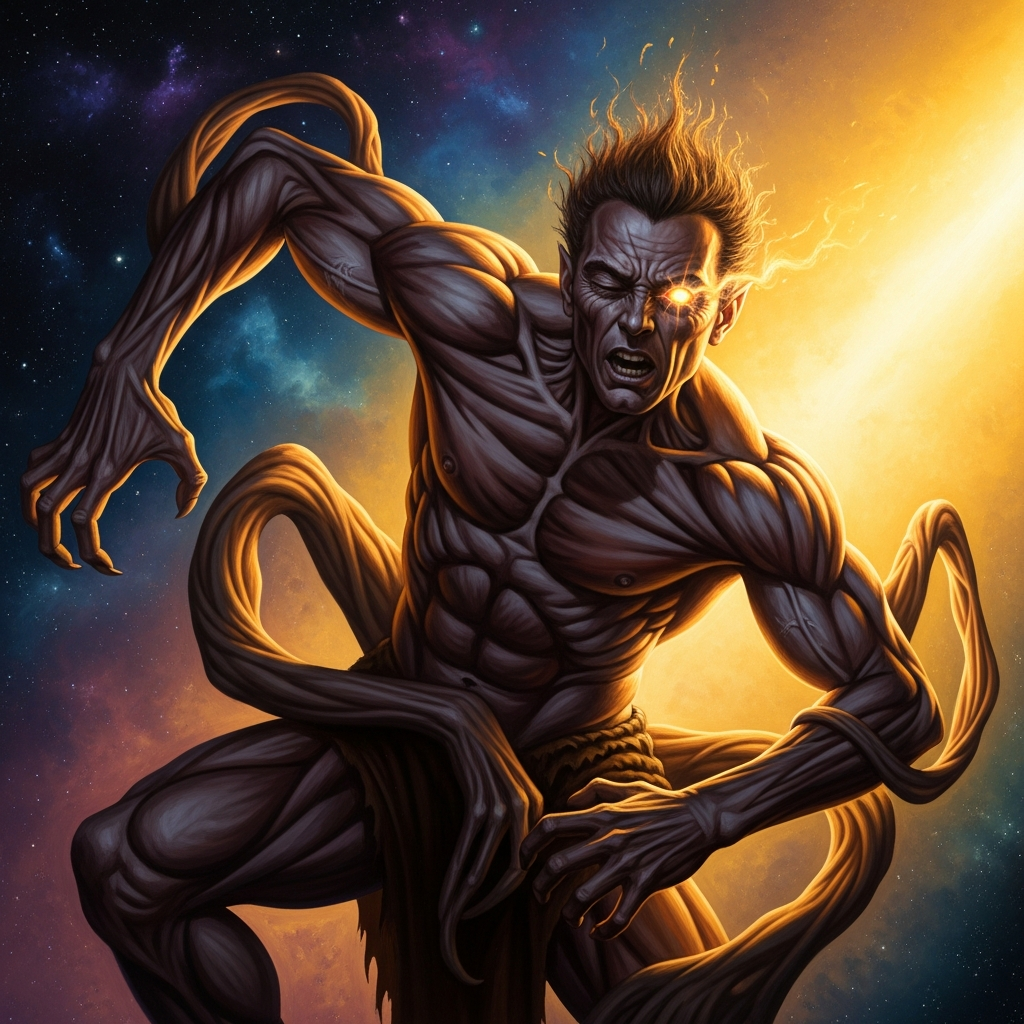
The warp-spasm.
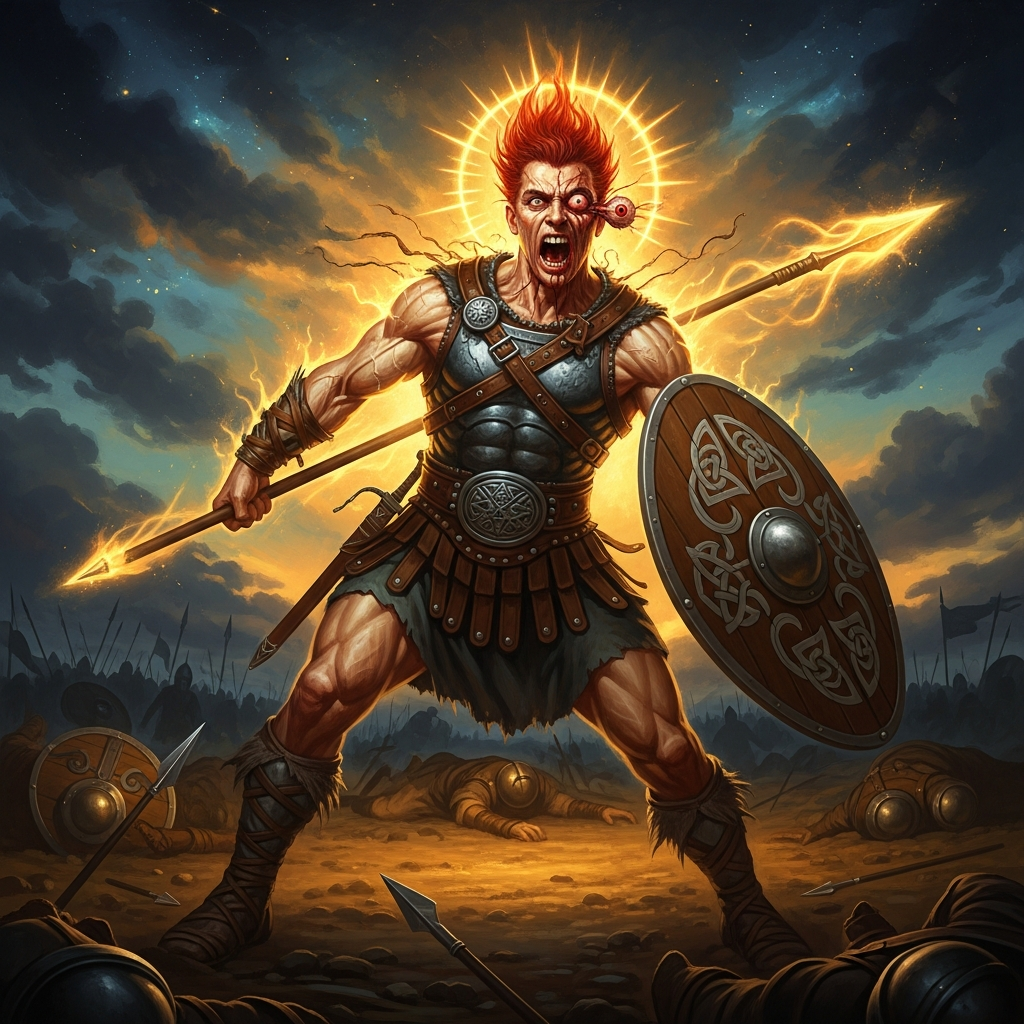
The ríastrad is unique in world literature — a description of combat-fury that goes beyond any comparable passage in the Iliad, the Mahabharata, the Nibelungenlied. The Táin describes it with clinical specificity:
His body revolves inside his skin. His feet and knees turn to the back, his heels and calves to the front. The muscles of his calves rise to the front of his shins. His cheek swallows his ear; his mouth opens until his gullet is visible. One eye recedes into his head until a heron’s leg could barely reach it; the other balloons outward until it is as large as a cauldron. A hero’s light rises from his forehead. His hair becomes sharp as hawthorn and the color of blood. Heat radiates from him. He is unrecognizable.
He lifts the gae bolga — the barbed spear that enters the body as a single point and spreads into thirty barbs inside — and fights in a state that is not human.
The ford runs red.
The Morrígan is watching.
She is the triple goddess of battle, sovereignty, and fate: Badb (the crow of battle), Macha (the goddess of the land), and Nemain (frenzy). She appears to Cú Chulainn before the war and offers her love. He refuses her. He doesn’t know who she is; or he does know and refuses anyway; the texts offer both readings.
She attacks him three times during the Táin in three animal forms — an eel, a wolf, a heifer — while he fights a champion at the ford. She does not defeat him; he wounds her each time while she hampers him. Afterward she appears as an old woman milking a cow, her wounds from the ford on her. He blesses her each time she gives him milk, not knowing he is healing the wounds he made. The healed wound on the crow goddess is, in Irish mythological logic, an obligation: he has healed her. She has, in some sense, withdrawn her enmity. Or not: the sources differ on what Morrígan’s final disposition toward Cú Chulainn is.
What is certain is that she perches as a crow on his shoulder when he dies.
His death takes time to arrange.
The enemies who want him dead know they cannot kill him in direct combat. They target his geis instead.
Cú Chulainn has multiple geis — sacred obligations that are also prohibitions. He cannot refuse hospitality. He cannot eat dog meat. He cannot refuse the challenge of a warrior who names him. These are not arbitrary; they are the structure of the heroic code, the web of obligation that defines what it means to be Cú Chulainn.
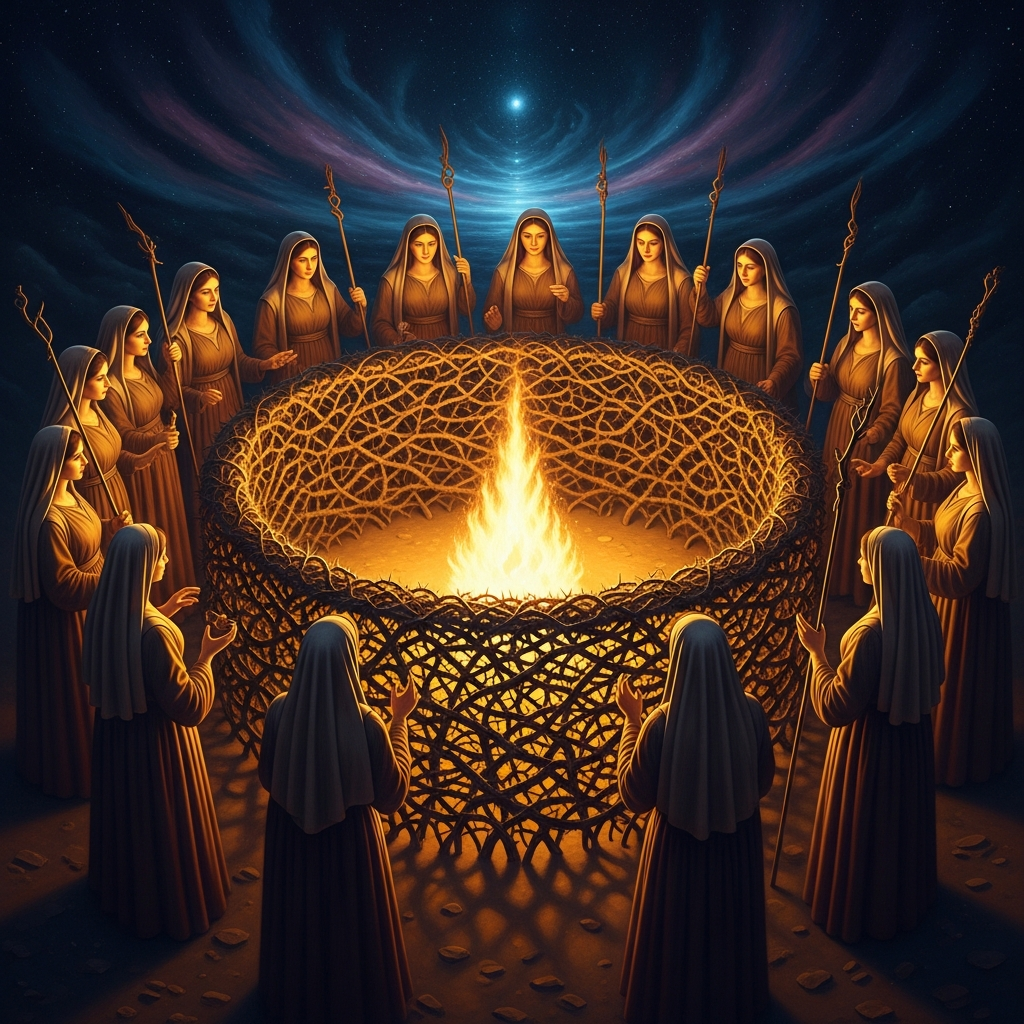
His enemies prepare his death carefully. Three crones (who are druids in disguise) sit at a fire beside the road to the battlefield, roasting a dog on a spit. He cannot refuse hospitality at a fire. He cannot refuse food he is offered. He cannot eat dog.
He stops. He accepts. He eats.
As he does, strength leaves his arm — the arm that holds the spear becomes weak.
He continues to the battlefield.
Three successive spear-throws from his enemy Lugaid — each one using spears that have been prophesied to kill a king — take his charioteer, his chariot horses, and finally Cú Chulainn himself.
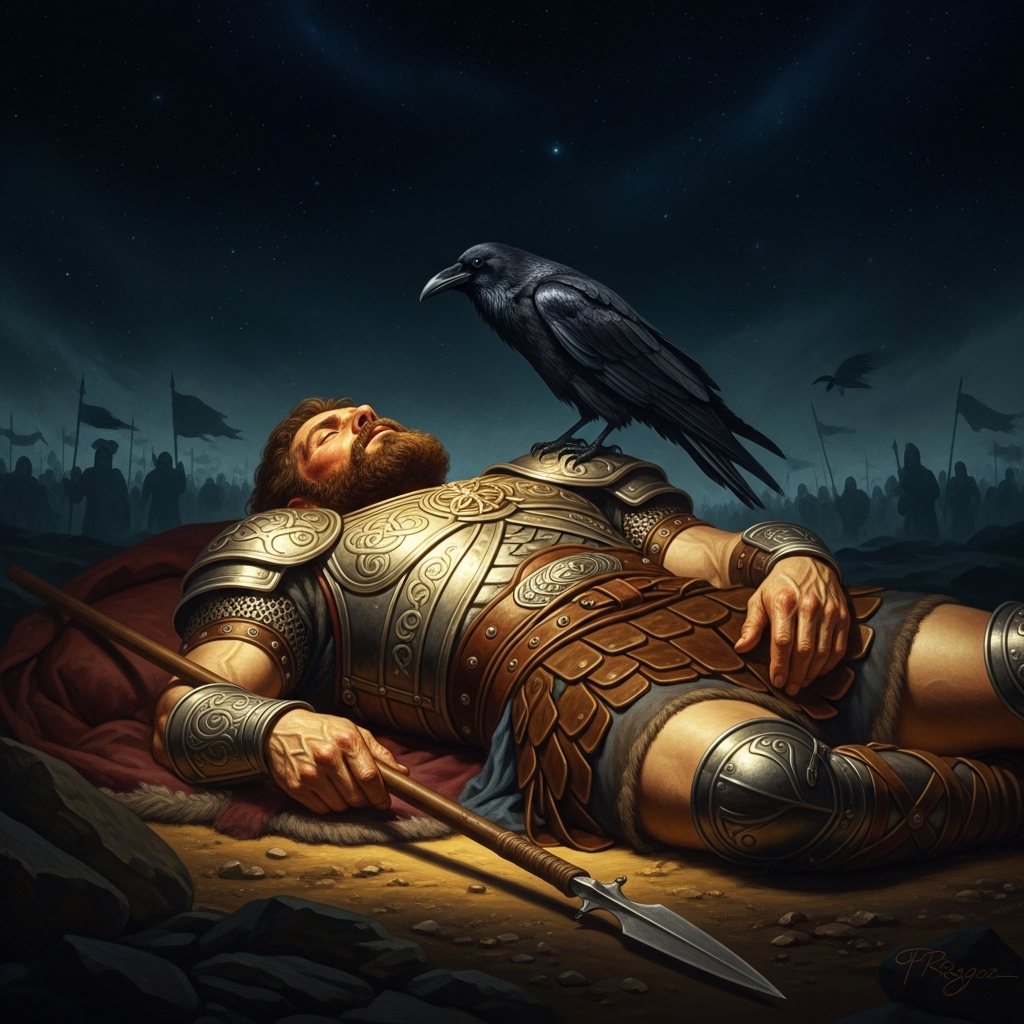
He is mortally wounded. He walks to a stone pillar at the center of the plain and ties himself to it with his belt so he will die standing. He doesn’t want to die on his back.
The Morrígan lands as a crow on his shoulder.
His enemies wait. They are not certain he is dead. Even wounded and standing at a stone pillar, no one wants to come close enough to find out.
An otter drinks the blood that has pooled at his feet.
Lugaid approaches and lifts Cú Chulainn’s sword hand to cut off his head. As he does, the falling sword takes off Lugaid’s own hand. The death takes its reciprocal.
The men of Ulster wake from their curse and come to the plain.
What makes Cú Chulainn’s story resonate beyond Irish tradition is not the warp-spasm, spectacular as it is. It is the geis — the sacred obligation that cannot be violated without destroying the hero. Every tradition has this: the thing the hero cannot do, the rule that is so fundamental to who they are that breaking it is the same as ceasing to be themselves.
He cannot eat dog meat and remain Cú Chulainn. He cannot refuse hospitality and remain Cú Chulainn. He cannot refuse a named challenge and remain Cú Chulainn. The geis is not a weakness arbitrarily imposed from outside. It is the code that makes the hero who he is, and the code is exactly what the enemies target.
You do not destroy a hero by being stronger than them. You destroy a hero by finding the rule that defines them and engineering a situation where following the rule kills them.
This is what the Irish tradition understood that most others did not say quite so plainly.
The strength and the vulnerability are the same thing.
The hero is always killed by what made them the hero.
Echoes Across Traditions
Entities
- Cú Chulainn
- Morrígan
- Queen Medb
- Fergus mac Róich
- Conchobar mac Nessa
- Lugh
- Emer

Sources
- *Táin Bó Cúailnge* ('The Cattle Raid of Cooley'), earliest extant version in *Lebor na hUidre* (c. 1100 CE), translated by Thomas Kinsella (1969)
- *Togail Bruidne Dá Derga* ('The Destruction of Da Derga's Hostel')
- Thomas Kinsella, *The Táin* (1969)
- Marie-Louise Sjoestedt, *Gods and Heroes of the Celts* (1949)
- Proinsias Mac Cana, *Celtic Mythology* (1970)
- Kim McCone, *Pagan Past and Christian Present in Early Irish Literature* (1990)
- Gregory of Tours — noted parallel with Roman sources on Celtic warrior cult