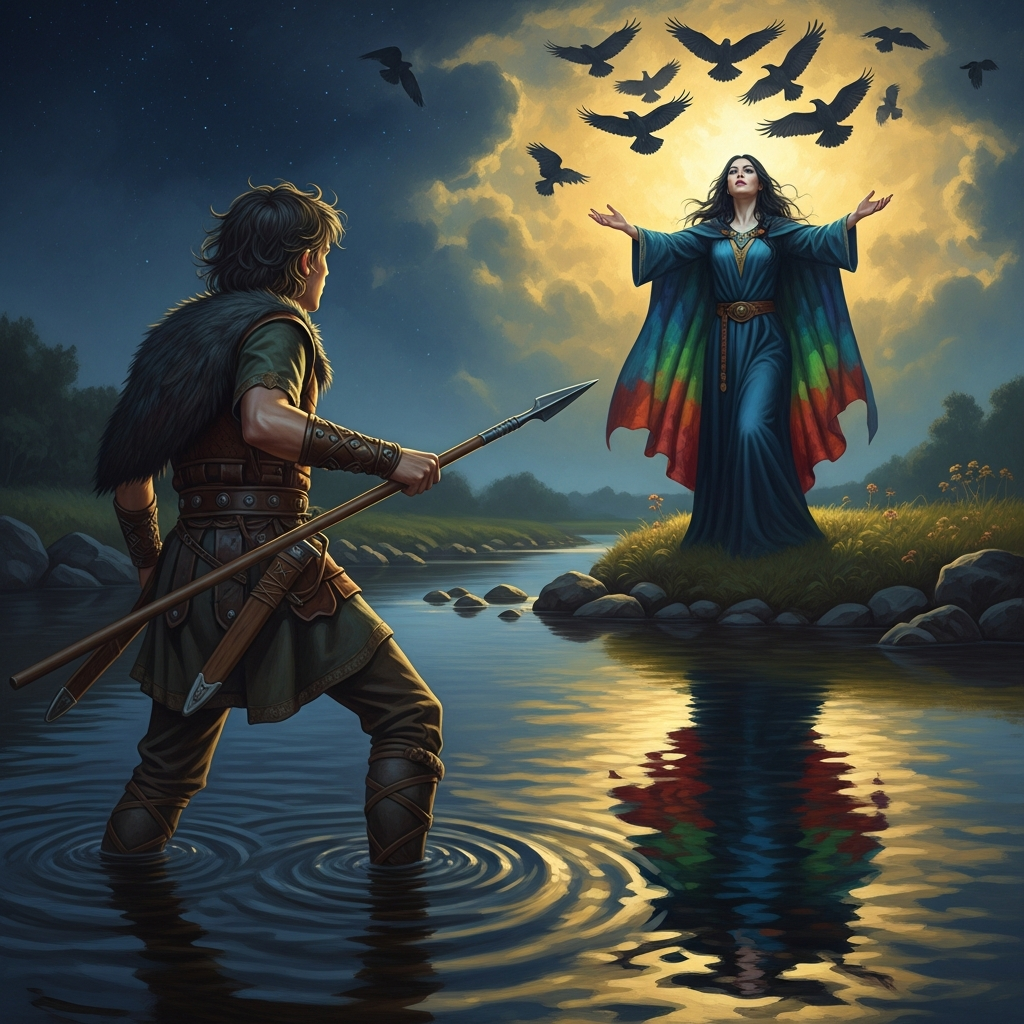
The Morrigan Chooses Her Champion
circa 100 BCE — during the Cattle Raid of Cooley, the mythic Iron Age of Ulster · A ford on the River Cronn, then the battlefield of the Cooley peninsula, Ulster
Contents
The goddess of battle and fate approaches Cú Chulainn in the form of a beautiful woman, offers him her love and her power, and when he refuses her, swears to destroy him at the very moment of his greatest victory.
- When
- circa 100 BCE — during the Cattle Raid of Cooley, the mythic Iron Age of Ulster
- Where
- A ford on the River Cronn, then the battlefield of the Cooley peninsula, Ulster
She comes to him at the ford when the war is at its highest pitch.
The Táin is underway — the great cattle raid that has set all of Connacht against Ulster — and Cú Chulainn stands alone at the River Cronn defending the bull Donn Cuailnge against every champion Medb can send against him, one by one, as Ulster’s warriors lie helpless under the curse of Macha. He has been fighting for weeks. He is brilliant and exhausted in equal measure, holding the ford by the sheer technical precision of a man who has nothing left but skill.
She appears on the far bank in the form of a young woman of extraordinary beauty, dressed in a mantle of many colors, her hair the red-black of a raven’s wing. She calls across the water. “I have been watching you, Cú Chulainn. I have watched every fight. I have loved you since before this war began.”
He looks at her without lowering his spear. He does not recognize the goddess yet. He sees only a woman appearing at a ford in the middle of a war, which is a strange place for a woman to appear, and strangest of all that she comes without fear.
“This is not the time,” he says. “I am in the middle of defending Ulster. I cannot concern myself with a woman.”
It is, in its way, one of the most consequential things he ever says.
She tells him plainly: she is the Morrigan. She is the sovereign goddess of battle and fate and the land’s fertility. She has the power to stand with him at every ford, to turn his enemies’ spears aside, to guarantee his survival through every combat that remains in this war. She has watched him because she has chosen him. The choosing of a champion by the Morrigan is not a small thing — it is the divine machinery of fate moving.
And he says no.
Not rudely, not with contempt. He says it the way a professional says it: “I did not train for this war with a woman’s help. I will not win it with a woman’s help.”
The silence on the far bank is not the silence of injury. It is the silence of something pivoting.
When she speaks again her voice has changed. Not anger — the Morrigan does not traffic in anger, exactly. Something colder and more permanent. “Then I will be your enemy,” she says. “At the very moment of your hardest combat, when you can least afford a second enemy, I will come against you. As an eel at your feet. As a wolf driving the cattle over you. As a red heifer leading them back.”
She says it the way a mathematician states a theorem. Not a threat — a prediction.
She keeps the promise with precise cruelty. When Cú Chulainn faces Lóch mac Mofemis at the ford, an eel winds between his feet and trips him. A wolf drives the cattle across him when he struggles. A red heifer brings them stampeding back. Each time he manages to wound the creature, and each wound sticks — when she appears to him later, disguised as an old woman milking a cow, he blesses the three injuries without knowing they are hers, and his blessing heals them. Even this is circular: he cannot undo what the Morrigan sets in motion, he can only, sometimes, unknowingly ease it.
After the battle is won — after all the impossible duels at the ford, after the slaughter and the glory and the brown bull finally driven home — she comes to him one final time. She is an old woman now beside a cow, milking. She offers him three drinks of milk. He accepts them, and with each drink he blesses her wounds, and with each blessing she is healed.
She becomes a raven and watches from a stone wall as he drives on.
The raven is the form she takes at the end of things. She perches on the standing stone at the ford of Ferta when Cú Chulainn dies — lashed to the stone, holding himself upright even in death so his enemies must approach him — and she is still there when the raven lands on his shoulder and his enemies finally dare to come close.
She chose him at the River Cronn. He refused the choice. And she was his anyway, the way fate is yours whether you accept it or not, circling above the body you refused to share a bed with, claiming it in the only way left.
Echoes Across Traditions
Entities
- Cú Chulainn
- The Morrigan
- Donn Cuailnge
- Emer

Sources
- Thomas Kinsella, trans., *The Táin* (Oxford University Press, 1969)
- Rosalind Clark, *The Great Queens: Irish Goddesses from the Morrígan to Cathleen Ní Houlihan* (Colin Smythe, 1991)
- Miranda Jane Green, *Celtic Goddesses: Warriors, Virgins and Mothers* (British Museum Press, 1995)