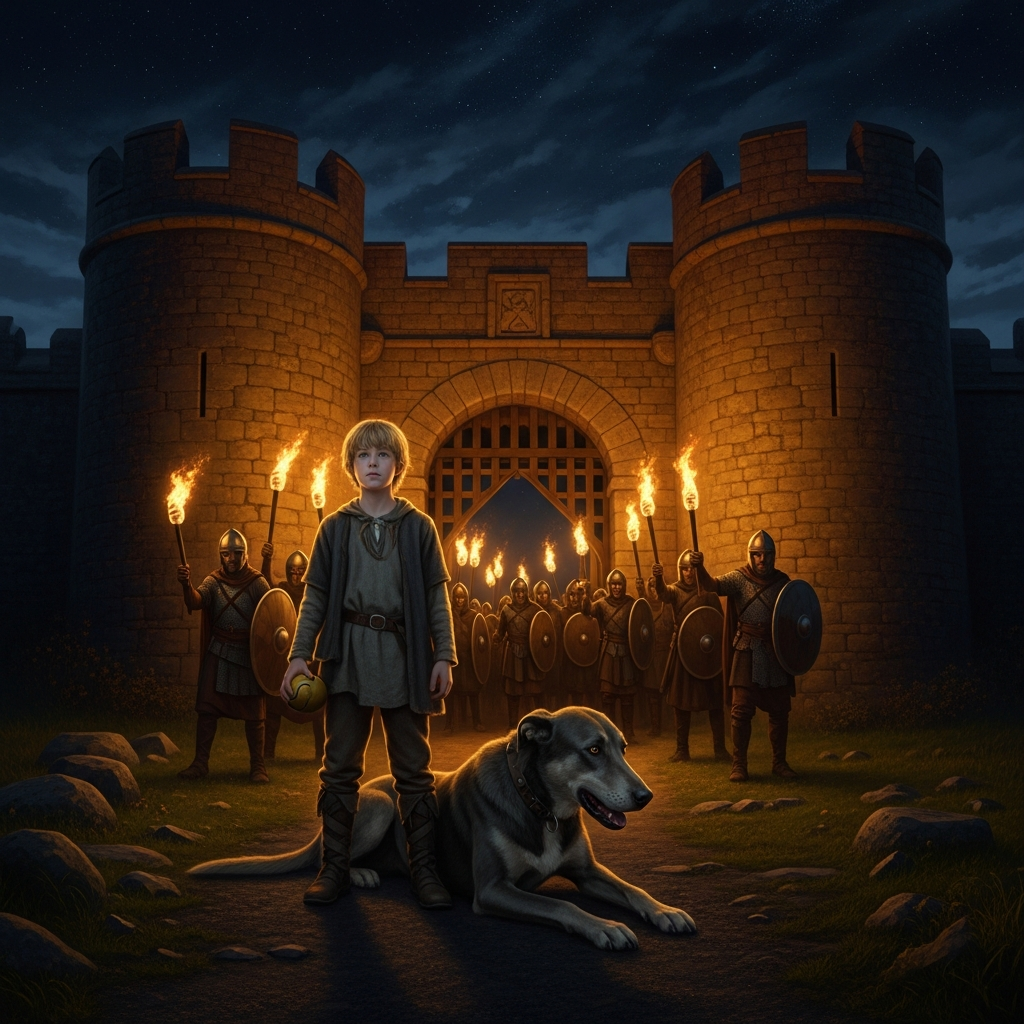
The Hound of Culann: How Setanta Became Cú Chulainn
circa 100 BCE — the age of the Ulster heroes, the mythic Iron Age of Ireland · The forge-fortress of Culann the Smith, somewhere in the iron hills north of Emain Macha, Ulster
Contents
A boy of seven slays the mightiest guard-dog in Ireland with his bare hands, then volunteers to take the dead hound's place — and in doing so earns a name that will outlast every king who ever ruled Ulster.
- When
- circa 100 BCE — the age of the Ulster heroes, the mythic Iron Age of Ireland
- Where
- The forge-fortress of Culann the Smith, somewhere in the iron hills north of Emain Macha, Ulster
The boy is playing hurling alone on the plain of Emain Macha when the king’s chariot slows beside him.
Conchobar Mac Nessa, High King of Ulster, looks down at the child — seven years old, perhaps eight, no larger than a hound himself — and watches him drive the ball the full length of the field against fifty of the king’s own youths and beat them all without breathing hard. The king is impressed the way a man is impressed who recognizes something he cannot yet name.
“Come with us to the feast at Culann’s forge,” the king calls. “Your mother Deichtire is my sister. You are welcome.”
Setanta — for that is the boy’s name still, the name his parents gave him — holds the bronze ball in one hand and his hurley in the other. “Finish the game first,” he says. “I’ll follow.”
The king laughs and drives on. He forgets to tell the smith a child is still coming.
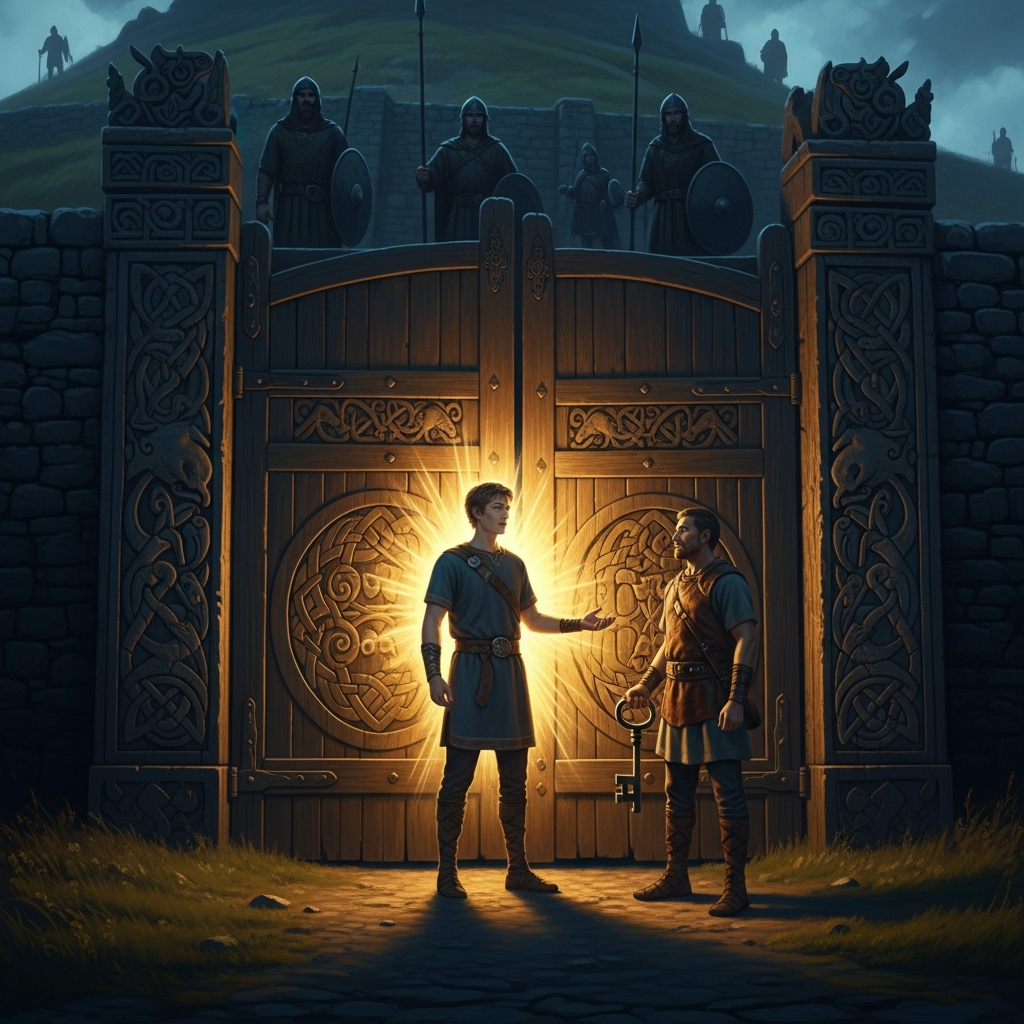
Culann the Smith is the finest metalworker in all of Ireland, a man who makes the swords and spear-heads and chariot fittings on which Ulster’s war-machine runs. He is also a man of property, and his property is guarded by a hound so massive that three chains hold it, each chain held by three men. When Conchobar and his retinue have entered the fort and the gates are sealed for the night, Culann unlooses the hound. It circles the walls in silence. Nothing moves past it and lives.
No one has remembered the child behind them on the plain.
Setanta follows the chariot’s wheel-tracks through the long Irish dusk. He is still playing as he walks, tossing the ball against the sky and catching it, working the hurley. He comes to the stone walls of Culann’s fortress and the hound finds him in the fading light — a creature of darkness and iron muscle, mouth wide enough to swallow a man’s thigh, the guard-dog of the finest smith in Ulster.
Inside the fort, the men hear the sound. The king goes white. He remembers.
What happens next takes no longer than a breath. Setanta hurls the bronze ball with a force that drives it down the dog’s throat. Then he seizes the animal by the hind legs and swings it against the stone gatepost until it is still.
The gates burst open. Every man in the fort runs out expecting to find nothing but a red smear on the ground. Instead they find the boy, standing in the torchlight, entirely calm, the dead hound at his feet.
Culann comes out last. He looks at the dog — his guardian, his companion, the animal that has kept his family safe for years — and his face changes. “The boy lives,” he says slowly, “which is good. But my house is now unguarded. My livelihood, my family, my forge. What good is a smith without a gate-ward?”
Setanta looks at the smith for a long moment. Then he says: “I will be your hound.”
Everyone goes quiet.
“I will guard your house until a pup can be trained from the same bloodline to take my place. I know dogs. I can do what this dog did.”
The druid Cathbad, standing just inside the gate, draws a breath. He is the man who reads omens, who watches names the way other men watch weather. He has seen what Setanta does not yet know he has done.
“From this night,” Cathbad says, “the boy’s name is Cú Chulainn. The Hound of Culann.”
The child looks at the druid, then at his own hands, then at the king. He is seven years old. He has just killed the greatest guard-dog in Ulster with his bare hands and offered his own body as atonement. He has earned a name in the space of one evening that every bard in Ireland will be singing for three thousand years.
He picks up his hurley ball. The feast begins.
The boy who was Setanta walks inside the firelight as someone else entirely. The hound-name settles on him like armor already fitted to his bones, and he wears it the way a man wears his fate: as if he had always known, and had only been waiting for someone to say it aloud.
Echoes Across Traditions
Entities
- Setanta
- Cú Chulainn
- Culann the Smith
- Conchobar Mac Nessa
- Cathbad the Druid
Sources
- Thomas Kinsella, trans., *The Táin* (Oxford University Press, 1969)
- Lady Augusta Gregory, *Cuchulain of Muirthemne* (John Murray, 1902)
- Proinsias Mac Cana, *Celtic Mythology* (Hamlyn, 1970)