The Wild Hunt Across Connacht
mythic time — undated, associated with Samhain night throughout Irish and Scottish tradition · The plains of Connacht, Ireland — particularly the boglands and hill-paths of the west
Contents
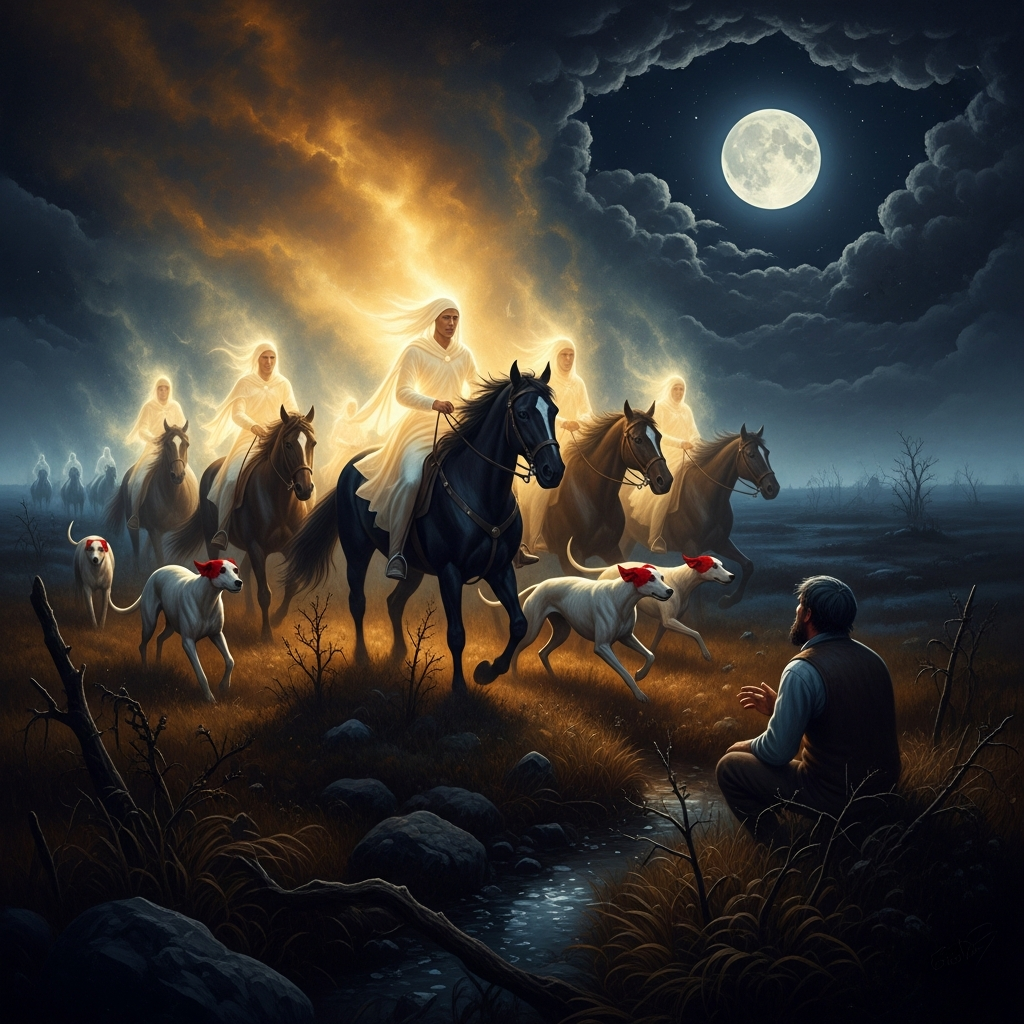
On a Samhain night, the spectral riders of the Otherworld sweep across the plains of Connacht with their white dogs and their thundering horses — and any mortal who crosses their path must choose between joining them or being left in their wake, forever changed.
- When
- mythic time — undated, associated with Samhain night throughout Irish and Scottish tradition
- Where
- The plains of Connacht, Ireland — particularly the boglands and hill-paths of the west
They come from the west at the hour when the night is most itself.
The old people of Connacht know the sound: hooves that don’t quite touch the ground the right way, the baying of white dogs with red ears, a music that isn’t music exactly but is what music sounds like when it comes from somewhere that has different rules about sound. The Sluagh Sídhe — the fairy host, the spectral riders — move through the air above the bogs and the hill-paths on the nights when the Otherworld’s membrane is thin.
They move from west to east, always west to east, always at speed, always with the particular quality of urgency that belongs to a pursuit or a departure. They are the Tuatha Dé Danann in motion — the divine race that was defeated and driven underground, released by the Samhain opening of the mounds, flying the surface of their old country one night a year.
A man crossing the bog on Samhain night hears it first as wind. Then the wind has direction, and the direction is wrong for the weather. Then the wind has sound inside it, the baying and the hoof-fall and the thin wild music. He has two choices: lie flat on the ground and cover his head until they pass, or stand and look.
If he stands and looks, he may be taken up.
Being taken into the Sluagh Sídhe is not automatically a death sentence, though it is the kind of thing that leaves marks. The person swept up into the ride moves across Connacht at supernatural speed, sees the landscape from a height and a velocity that no mortal sees it, experiences the cold and the sound and the terrible freedom of riding with creatures who have been riding since before his great-great-great-grandmother was born. He may be deposited somewhere miles from where he began. He may be kept for the night’s duration and returned at dawn.
He will not be entirely the same afterward.
The white hounds run alongside the horses. Their ears are red, which is the specific coloring of Otherworld animals throughout the Celtic world: the white of purity, the red of blood, the combination that marks a creature belonging to the place where the living world meets the dead one. They are hunting something, these dogs, or they are always hunting, the hunt itself being the point rather than any prey.
Fionn Mac Cumhaill, in the Fenian Cycle, has a different relationship to the hunt: he and the Fianna sometimes run alongside it rather than crossing its path, the mortal warrior-band and the fairy host moving across the same landscape on Samhain night, mutual awareness without direct encounter. Two kinds of hunters acknowledging each other in passing.
The Sluagh Sídhe sweeps east across Connacht and is gone over the horizon. The bog is silent. The man on the ground lifts his head and the night is ordinary again, the clouds covering the stars, the wind from the Atlantic carrying rain.
He gets up. He walks home. He does not tell his family where he was or what he heard, because there are no words for the specific longing that the Sluagh Sídhe leaves in the person who heard it and did not go: the knowledge that somewhere above the bog, the divine race is still riding their old country, still moving, still present just above the surface of the world that used to be theirs.
Echoes Across Traditions
Entities
- Fionn Mac Cumhaill
- The Sluagh Sídhe
- The Tuatha Dé Danann
- The white hounds with red ears
Sources
- Katharine Briggs, *A Dictionary of Fairies* (Allen Lane, 1976)
- Dáithí Ó hÓgáin, *Myth, Legend and Romance: An Encyclopaedia of the Irish Folk Tradition* (Prentice Hall, 1990)
- W.Y. Evans-Wentz, *The Fairy-Faith in Celtic Countries* (Humphrey Milford, 1911)