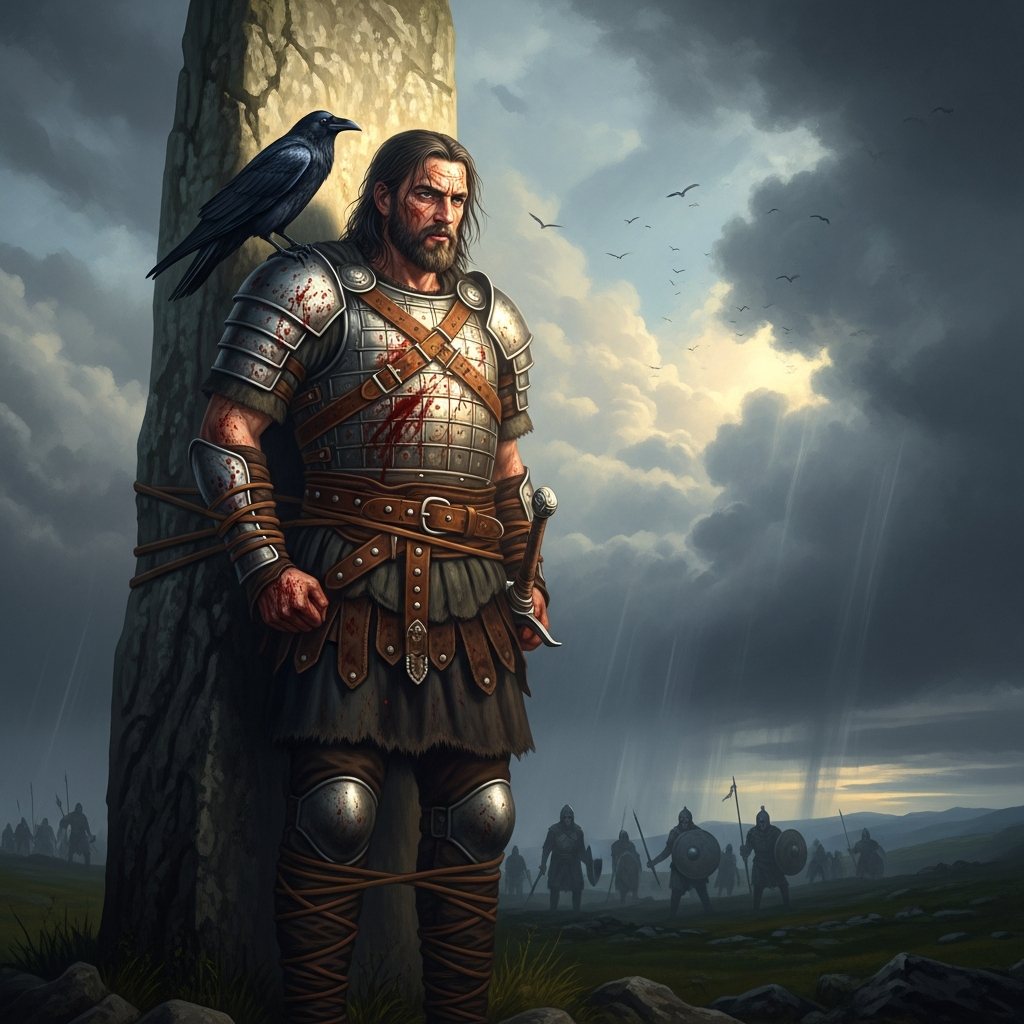
Cú Chulainn Tied to the Stone
circa 100 BCE — the final days of the Ulster Cycle, at the Ford of Ferta · The Ford of Ferta, Muirthemne Plain, County Louth, Ireland
Contents
Mortally wounded and refusing to fall, the greatest warrior of Ulster binds himself upright to a standing stone so he may die on his feet — and even in death holds his enemies at bay for three days.
- When
- circa 100 BCE — the final days of the Ulster Cycle, at the Ford of Ferta
- Where
- The Ford of Ferta, Muirthemne Plain, County Louth, Ireland
His horse knows before he does.
Liath Macha — the Grey of Macha, the horse that has carried him through every battle of his life — refuses the harness that morning. The animal weeps actual tears, the old sources say, tears of blood that run down its grey face and puddle in the mud of the stable. Cú Chulainn spends an hour coaxing the horse into gear. He takes it as an omen and harnesses up anyway. That is also who he is.
He is riding to meet his doom assembled: his three enemies — Lugaid, Erc, and the sons of Calatín — have gathered the full weight of Connacht against him. Worse, they have gathered the magic. Three spears have been forged with cursed purpose, each one destined to kill a king: one to kill a king of charioteers, one to kill a king of warriors, one to kill a king of Ireland. All three are aimed at Cú Chulainn, because in him those three kingships converge.
The battle goes badly from the beginning, which is to say it goes the way all battles go for a man whose horse has wept tears of blood before the gates.
The first spear takes his charioteer Láeg. The second takes Liath Macha, who gallops away with the spear in its flank to die in a lake — and the horse circles the lake three times, returning once to lay its head on its master’s shoulder, then going to the water. Cú Chulainn watches the grey horse walk into the lake and does not follow. The third spear takes him in the belly.
He knows, with the spear in him, that he is dying. The wound is mortal. The question now is not whether he dies but how he dies, and Cú Chulainn has always been a man with an opinion about the how.
He asks his enemies for permission to go to the lake and drink. They let him — he is obviously dying and they know it, which means they have underestimated what dying looks like in a man who has been defining it on his own terms since he was seven years old.
He drinks at the lake. He looks at the water where his horse went in.
Then he finds the standing stone at the Ford of Ferta, the old pillar-stone that marks the crossing, and he takes the belt from his own body and lashes himself to it upright. He will not die lying down. He will not give his enemies the satisfaction of watching him crumple. He stands himself to the stone and stands.
His enemies gather at a distance and wait. They are not sure he is dead. They are not sure they want to find out. For three days, by some accounts — though other tellings compress the time — no one crosses the ford, because the figure lashed to the stone still looks like a man who will kill you if you come within spear-reach.
It is the Morrigan who settles the question. She comes in the form of a raven and lands on his shoulder, and he does not move. The raven perches.
His enemies read the sign. They approach.
Even then — even in the final approach, in the grim practical work of taking the head they need for proof — Cú Chulainn offers a last gesture. His sword drops from his dying hand and takes the hand of the man who beheads him, takes it cleanly at the wrist. The sword falls but it does not fall without doing something.
The light changes at the moment of his death. The sword from his slackening grip glints once in the grey Irish light, and then the ford is just a ford, the stone just a stone, and the river runs on past the place where the greatest warrior Ulster ever produced stood upright through the whole of dying and refused, to the very last, to sit down.
They write the name on the stone eventually. Cú Chulainn. The Hound of Culann.
He was right not to sit down. The name is still standing.
Echoes Across Traditions
Entities
- Cú Chulainn
- Lugaid
- Erc
- The Morrigan
- Liath Macha

Sources
- Thomas Kinsella, trans., *The Táin* (Oxford University Press, 1969)
- Lady Augusta Gregory, *Cuchulain of Muirthemne* (John Murray, 1902)
- Kim McCone, *Pagan Past and Christian Present in Early Irish Literature* (Maynooth, 1990)