Contents
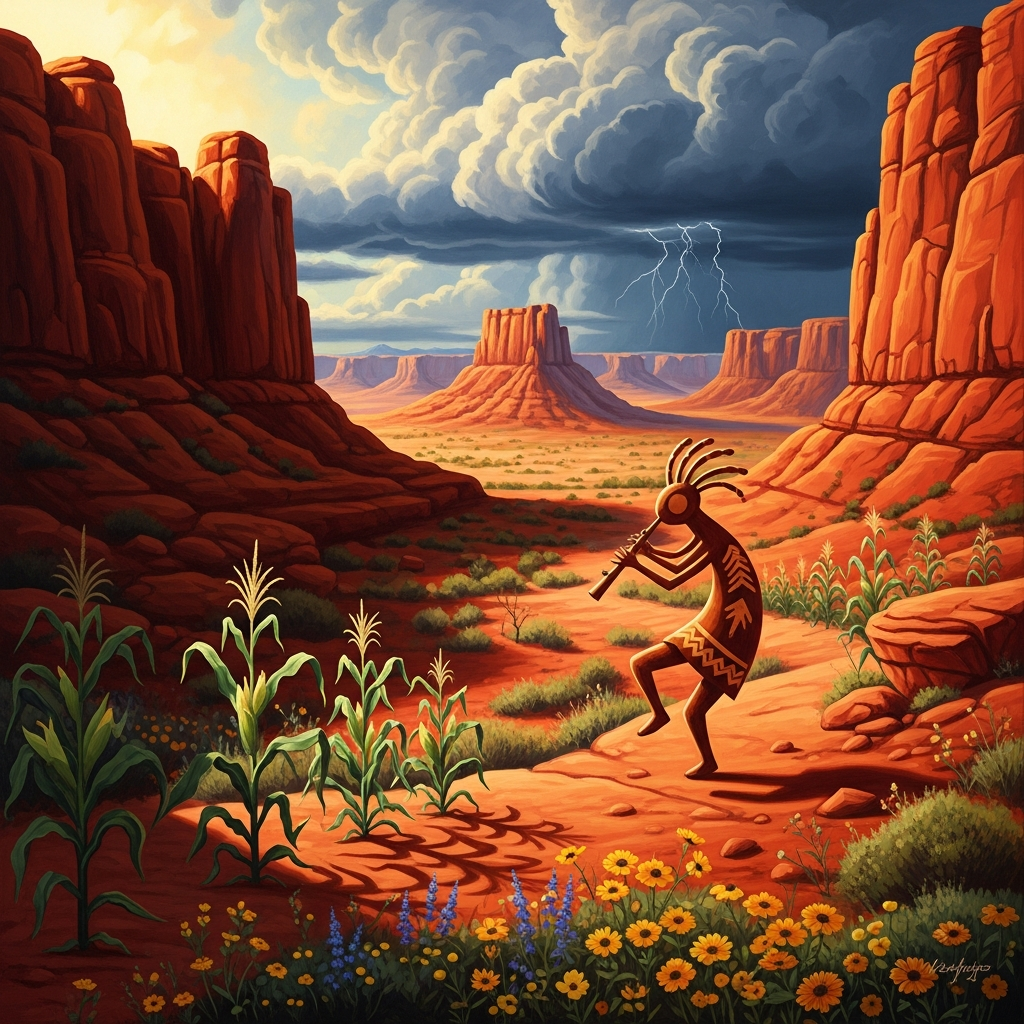
The humpbacked flute player dances across the desert playing his flute, and where he plays, the seeds sprout and the clouds gather — a figure of fertility, music, and mischief who appears in petroglyphs across the Southwest and has never stopped traveling.
- When
- All times — Kokopelli is always traveling, appearing in each village as needed
- Where
- The Colorado Plateau — canyons, mesas, and desert landscapes of the Southwest
He is always traveling.
You see him in the rock — carved into sandstone cliffs, painted in canyon walls, scratched into boulders at the edges of ancient trails. He is always in motion, bent forward under the weight of his hump, his flute raised, his legs bent in the attitude of someone who has been walking a long time and is walking still. He is in the Hopi mesas and the Anasazi canyon lands and the Rio Grande valley and the Sonoran desert. He has been carved into rock for nearly three thousand years.
The hump carries seeds.
He appears at the edge of a village in the spring, when the planting songs are needed. The children hear him first: a sound from the direction of the desert, a flute playing something that isn’t quite music and isn’t quite birdsong and isn’t quite the wind, but has the quality of all three and is more interesting than any of them. They run toward the sound.
The elders smile when the children run toward the flute.
The elders remember what Kokopelli’s music means: that planting time is here, that the seeds in the ground are ready to hear the music that will call them upward, that the clouds in the northwest are organizing themselves into something that will arrive in three days if the music is good enough. In a desert that receives seven inches of rain a year, the music that brings rain is a serious matter.
He dances through the village, playing. Where he passes, the women check the seed baskets they have been keeping dry all winter. The men look at the sky with the particular attention of people who have been watching the sky all their lives. The children follow him from house to house, through the planting fields, down to the spring.
His hump is full of seeds.
In some stories, he carries the seeds of every plant that the people will need — corn, squash, beans, tobacco — and distributes them as he travels, which is why the same plants grow in villages that have no trade contact with each other. He carries the knowledge of what to plant and when to plant it along with the seeds themselves, and leaves both wherever the music leads him.
In other stories, the hump is full of babies.
He carries unborn children to the couples who are waiting for them, delivering them with music rather than with a stork, and the music is the announcement: a new child is coming to this house, begin the preparations. This is why hearing the flute at night is auspicious rather than alarming.
He does not stay.
He never stays. Fertility requires movement — the movement of pollen, of seeds on the wind, of water across dry ground. A flute player who stopped playing would not be Kokopelli. The music requires the journey and the journey requires the music, and so he walks, bent under his hump, through the canyons that have been carved by water, through the desert that becomes garden when the rain comes.
The petroglyphs are still there.
He is somewhere beyond the next mesa, playing.
Echoes Across Traditions
Entities
- Kokopelli
- the villagers who hear the flute
- the seeds in his hump
Sources
- Alfonso Ortiz, ed., *Handbook of North American Indians, Vol. 9: Southwest* (Smithsonian, 1979)
- Dennis Slifer and James Duffield, *Kokopelli: Fluteplayer Images in Rock Art* (Ancient City Press, 1994)
- Polly Schaafsma, *Rock Art in New Mexico* (Museum of New Mexico Press, 1992)