When the Kachinas Return
Hopi ceremonial cycle; oral tradition of the Hopi people · The San Francisco Peaks, Arizona; the Hopi mesas; the space between the seen and unseen worlds
Contents
From the winter solstice to the summer solstice, the Kachinas — spirit beings who are neither human nor quite divine — descend from their home in the San Francisco Peaks and live among the Hopi people. They dance. They bring rain. They teach. Then in July they return to the spirit world, carrying the people's prayers. The dolls carved in their image — Kachina tithu — are not toys: they are teachers left behind.
- When
- Hopi ceremonial cycle; oral tradition of the Hopi people
- Where
- The San Francisco Peaks, Arizona; the Hopi mesas; the space between the seen and unseen worlds
They leave in July.
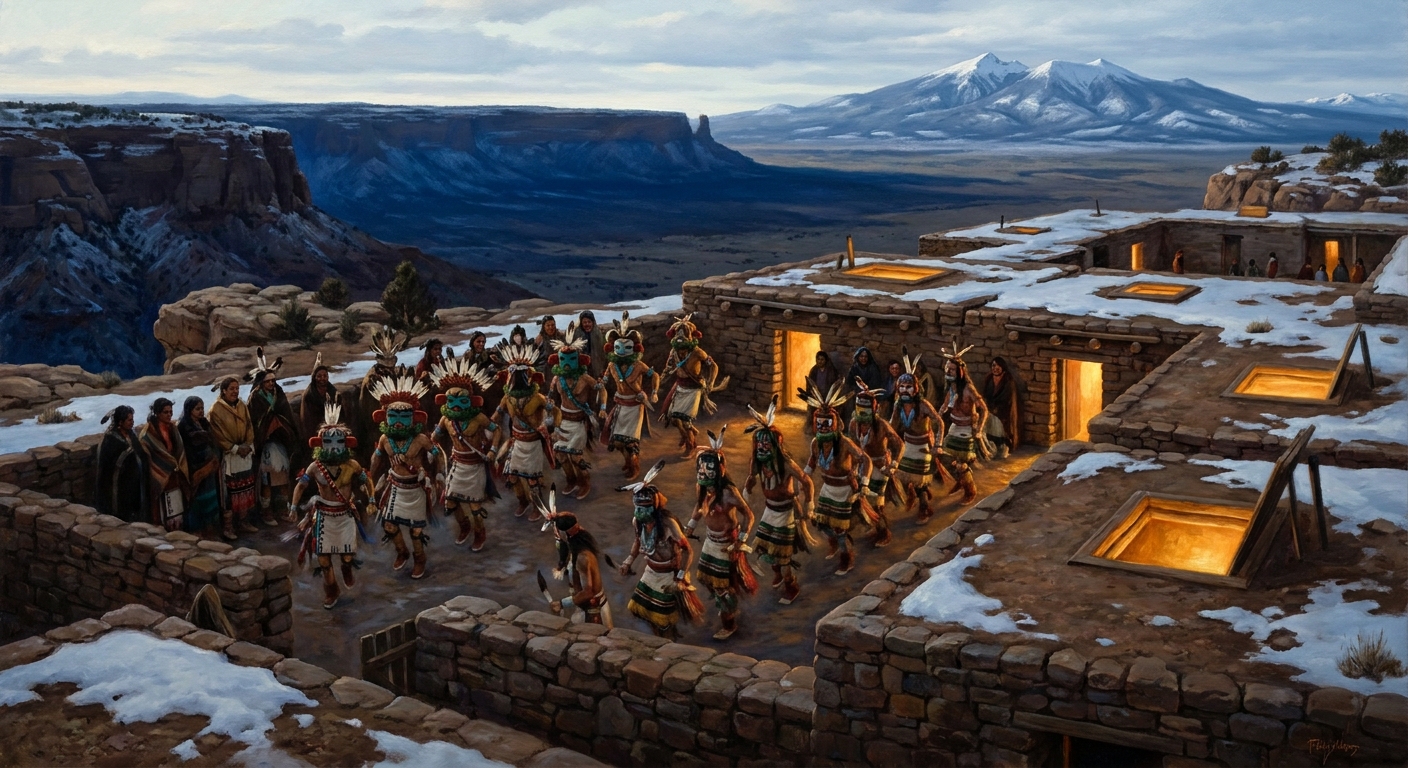
The Niman ceremony — the Home Dance — is the Kachinas’ farewell. They have been with the Hopi people since Soyal, the winter solstice ceremony in December, when they descended from their home in the San Francisco Peaks and entered the first kiva. For six months they have been here, dancing in the plazas, bringing rain, teaching the children, carrying the prayers of the people between the visible world and the invisible one. Now, at the height of summer when the corn is tall, they return.
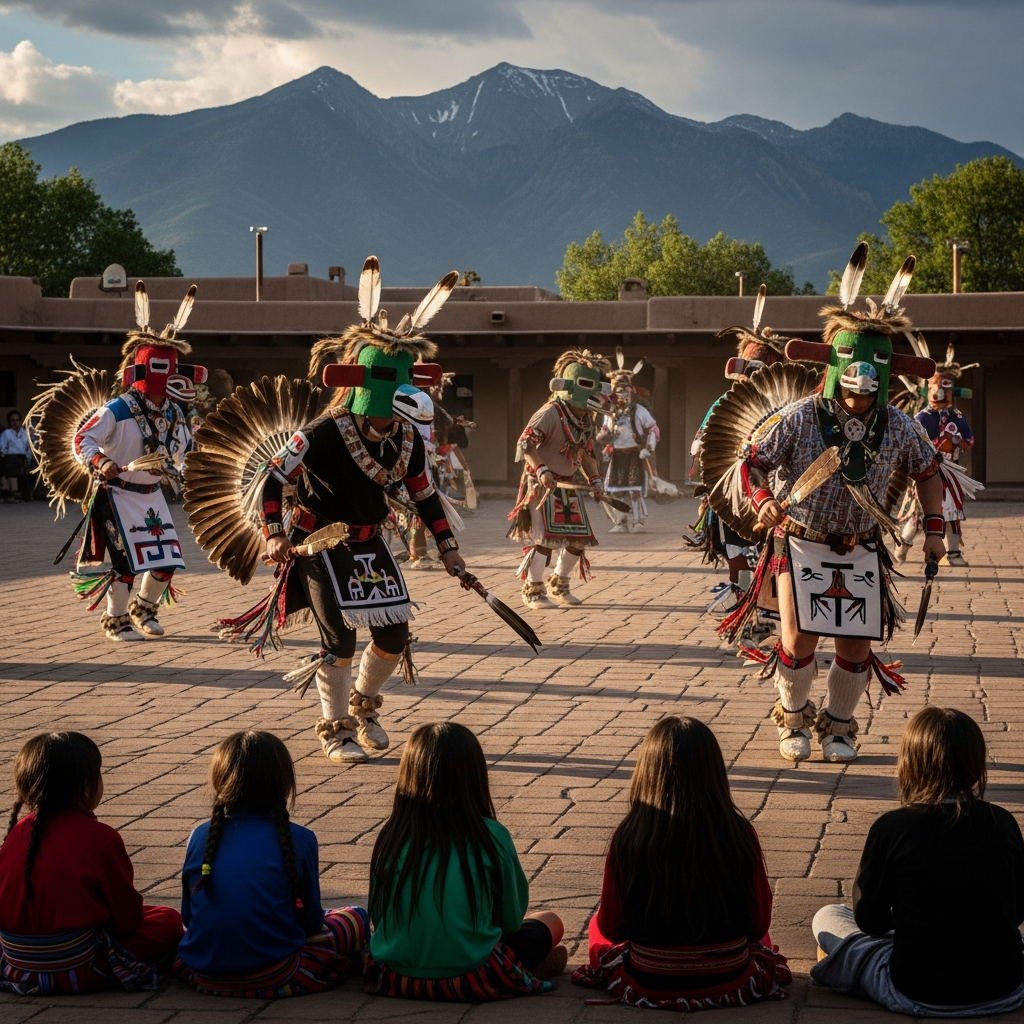
The dancers in the plaza are wearing the masks. But this requires the correct understanding.
The mask is not a costume. Or it is a costume in the sense that when it is worn correctly, something real comes to inhabit it — the way the Hopi understand the relationship between form and spirit, which is that form is not separate from spirit but is its vehicle, and the correct form, worn in the correct way with the correct ceremony, calls the spirit into presence. The dancer does not become the Kachina. The Kachina arrives and the dancer, for the duration of the ceremony, is where the Kachina is.
This distinction matters more than it might appear.
The Kachinas are not gods.
They are something more specific: spirits of the natural world — of rain, clouds, animals, ancestors, places, forces — who take on form in order to be in relationship with people. There are hundreds of them. Each has a specific character, specific songs, specific dances, a specific prayer it carries and a specific blessing it returns. The Hemis Kachina is the great one of the Niman — the most important, the one who carries the summer prayers back to the peaks. The Crow Mother brings corn to the children. The Ogre Kachinas visit in February and tell children what happens to those who do not live according to the teachings. Even the frightening ones serve the relationship.
The relationship is what produces rain.
This is not a transactional theology in which the correct ceremony mechanically produces the correct result. It is something more intimate and more uncertain: when the Hopi people live correctly — when they are in right relationship with the land, with each other, with the ceremonial obligations they inherited — the Kachinas want to bring rain. The rain is not a reward for good behavior. It is what happens when beings who love you are pleased to be with you.
When rain is withheld, it is not punishment. It is the natural consequence of a relationship that has deteriorated.
The children receive the tithu.
During the ceremonies, the Kachina dancers move through the crowd and give the carved wooden figures to the children — specifically the girls, and the infants who are being presented to the Kachinas for the first time. The tithu are carved from the root of the cottonwood tree, painted in the precise colors of the specific Kachina, adorned with feathers and cloth and the same symbolic details that mark the full-size dancer.
For a century, anthropologists and collectors called these dolls. They are not dolls.
A toy doll is an object for play. A tithu is a teaching object: its purpose is to help the child memorize the Kachina — its form, its colors, its meaning — so that when the Kachina dances in the plaza the child recognizes a being she knows, and when the Kachina leaves in July the child still has a material teacher to study. The tithu is the Kachina’s ambassador to the household, the presence that remains after the presence has gone.
The girl who receives the tithu is expected to observe it, to ask her mother about it, to gradually learn what it represents. When she is older, she will learn more. When she is initiated, she will learn the full truth — and the full truth is not a betrayal of the teaching given in childhood but its completion. The Kachina ceremonies are a curriculum that unfolds across a lifetime.
At Niman, the people bring gifts.
The Kachinas are fed before they leave — prayer meal is sprinkled on the dancers, and the reciprocity runs in both directions. They have given rain, protection, teaching, presence; the people have given ceremony, attention, the labor of preparation, the maintenance of the sacred calendar year after year after year. Neither party can perform their role without the other. The Hopi people do not depend on the Kachinas; the Kachinas depend on the Hopi people. This is explicit in the theology: if the Hopi people ceased to perform the ceremonies correctly, the Kachinas would cease to come, and the natural forces they represent would become unregulated. Rain would fail. Corn would not grow.
This is not a story about human helplessness. It is a story about human responsibility.
The departure ceremony is beautiful, and it is sad.
The masked dancers leave the plaza in a long line, moving toward the edge of the mesa. They disappear over the horizon in the direction of the San Francisco Peaks, which rise nearly thirteen thousand feet from the desert south of Flagstaff, where they are understood to live from July to December. The children who are old enough to feel the year’s rhythm watch them go and understand something about the nature of things: that what you love will leave on schedule, and will come back on schedule, and the correct response to this is to live in a way that makes you worthy of the return.
The masks are stored carefully.
The kiva holds them between ceremonies. They are not objects in the ordinary sense — they are presences in storage, which is a category the Western world has largely given up. The mask of a Kachina that has been worn correctly in ceremony carries something of what it carried during the ceremony. It is treated accordingly.
The Hopi calendar is built around this rhythm. Soyal in December — the Kachinas arrive. The spring ceremonies — the Kachinas dance. Niman in July — the Kachinas depart. The winter half-year, when the Kachinas are gone, is filled with other ceremonies, other obligations, other ways of maintaining the relationship while the Kachinas are in their other home.
The Hopi do not stop living correctly in July.
This is the discipline the Kachina cycle teaches: the ceremonial relationship is not a contract in which you pay in order to receive. It is a marriage in the deepest sense — a commitment to behave in certain ways regardless of whether the other party is currently present to observe it. The tithu in the girl’s hand during the long winter months is the reminder of that commitment: the Kachina is not here, but you know who it is and what it represents, and you are expected to live accordingly.
The San Francisco Peaks are visible from the mesas on clear days.
They are always there — always the home of the Kachinas, always the destination of the prayers, always the point on the horizon toward which the June dance moves when the ceremony is over and the spirits turn for home. They have not moved. The relationship has not changed. The ceremonies have been going on for longer than any written record and will go on, the tradition trusts, for as long as the Hopi people hold to the agreement Masauwu offered at the emergence: live humbly, tend the world, keep the ceremonies.
When the ceremony is kept, the Kachinas come.
When they come, the rain comes.
When the rain comes, the corn comes.
When the corn comes, the people live.
This is not magic. It is the logic of a relationship maintained faithfully across generations by people who understood that the world requires participation, not only occupation.
Echoes Across Traditions
Entities
- Kachinas (Katsinas)
- Masauwu
- Soyal (the winter solstice ceremony)
- Hemis Kachina
- The Kachina tithu (dolls)
Sources
- Barton Wright, *Hopi Kachinas: The Complete Guide to Collecting Kachina Dolls*, 1977
- Emory Sekaquaptewa and Dorothy Washburn, 'They Go Along Singing,' *American Indian Quarterly* 28:1-2, 2004
- Mischa Titiev, *Old Oraibi: A Study of the Hopi Indians of Third Mesa*, 1944
- Ekkehart Malotki, *Hopi Animal Tales*, 1998
- Peter Nabokov, ed., *Native American Testimony: A Chronicle of Indian-White Relations*, 1978