Contents
A Greenlandic Inuit shaman constructs a tupilak from the bones of dead animals and forbidden materials, animated by his own life-force and directed at an enemy — but the weapon has a fatal design flaw: if the target is spiritually stronger, it turns back.
- When
- traditional time — before Christianity reached the Greenlandic communities
- Where
- Greenland — the East Greenland communities where the tupilak tradition was most developed
It is built in secret, on the sea ice, before dawn.
The angakkuq works alone in the dark. The community is not supposed to know what he is doing — making a tupilak is not forbidden exactly, but it carries enough ethical weight that it is not done openly. He has spent two weeks gathering the components: the bones of several dead animals, collected from places where the animals died by natural causes rather than by hunting, the specific materials that tradition specifies without which the tupilak will have no power.
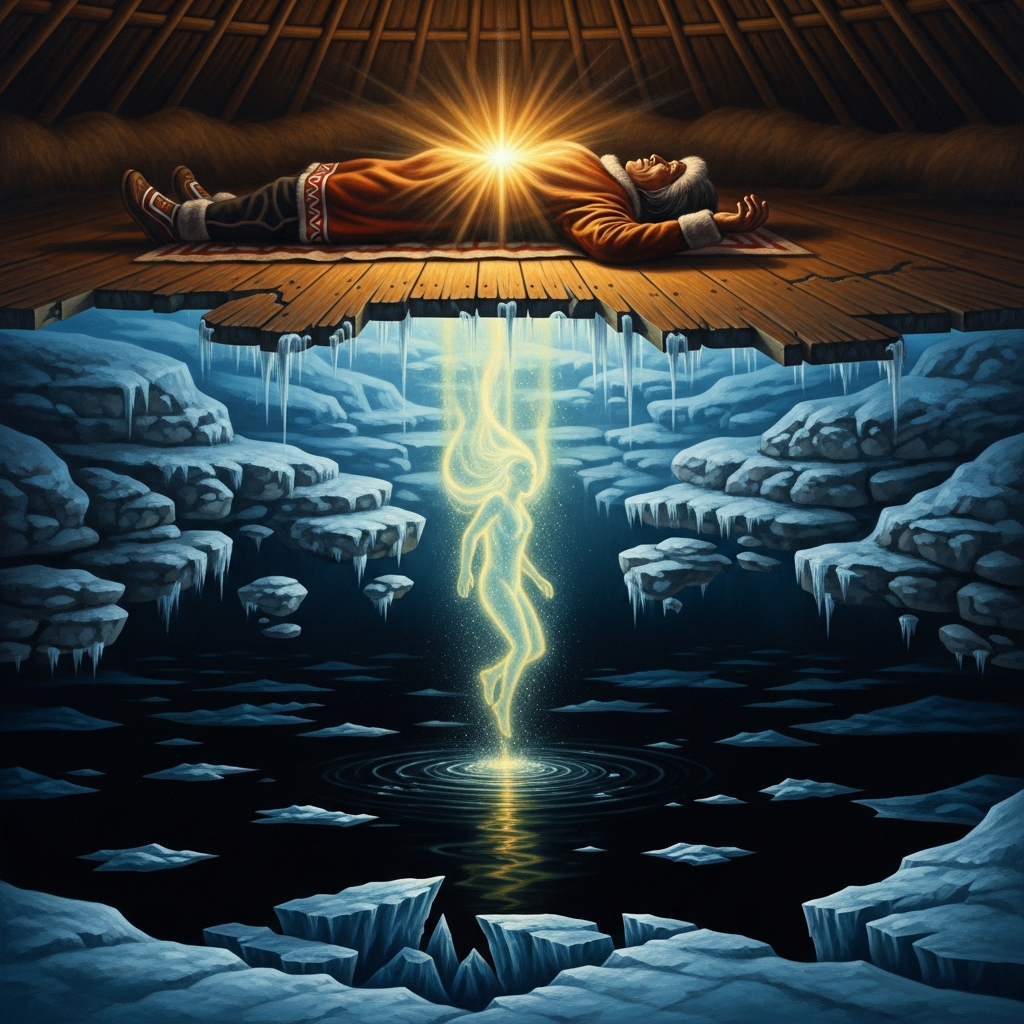
The construction is ritual, not craftsmanship. He assembles the bones into a body-shape — no particular animal, something between forms, with a head that could be a seal’s and legs that could be human — and then comes the part that costs him something: he breathes life into it. Not figuratively. He places his mouth over what will be the tupilak’s nostrils and exhales deeply, giving it a portion of his own life-force, the same force that animates his own body.
The tupilak, thus animated, is placed in the sea.
It swims toward the enemy.
The enemy is a man who has been making the angakkuq’s life impossible in ways that are hard to address directly. He has been spreading stories that undermine the angakkuq’s reputation as a healer. He has been favoring his own family’s hunters when dividing the communal meat. He has been, in small and persistent ways, using his social position to diminish the angakkuq’s spiritual authority.
These are not crimes that can be brought before the community council. They are too subtle, too accumulated, too deeply enmeshed in the social fabric to be addressed by direct confrontation. The tupilak is the response to the untreatable wound.
The angakkuq knows the risk.
Every practitioner in the tradition knows the risk. If the target is spiritually weaker than the attacker, the tupilak will reach him and do its work. But if the target has stronger spirit-protection — a powerful angakkuq advisor, a strong personal spirit, a clear conscience that provides its own kind of armor — the tupilak will not be able to attach to him. And if the target is spiritually stronger than the attacker, the tupilak will turn.
It will swim back.
The enemy, it turns out, has been visiting a different angakkuq in a neighboring community for reasons of his own — a love matter, nothing related to the conflict — and this angakkuq has, over the course of several visits, casually strengthened the man’s spiritual protection as a byproduct of the other work.
The tupilak reaches him. It circles. It cannot attach.
It turns.
The original angakkuq is kayaking three days later when the sea changes around him in a way he has never felt before. The water is wrong. Something is below him that should not be there. He recognizes, with a cold that has nothing to do with the Arctic air, what he has made and what is now coming for him.
He has two choices. He can fight the tupilak in the spirit world, which will require his full power and may not succeed. Or he can do the thing that the tradition says is the safest choice, which costs him more: he can tell someone.
If a man confesses to making a tupilak openly — tells another person what he has done — the tupilak loses its power. It is a loophole in the monster’s design. The secrecy of its making is part of its animating force; exposure disables it.
He paddles to shore and tells the first person he sees what he has done.
The tupilak dissolves somewhere below the water. The man he targeted survives. The angakkuq survives.
The story travels through the community immediately, as these confessions always do. His reputation suffers. The man he targeted knows, now, that the angakkuq sent a thing to kill him, and this cannot be unknown.
They live, afterward, with more wariness and more honesty between them than they have managed before. The community council, which could not address the original grievances directly, now has a public incident to work with.
Some conflicts are resolved by weapons that turn back on their users.
Echoes Across Traditions
Entities
- the angakkuq who makes the tupilak
- the enemy target
- the tupilak itself (the constructed monster)
- the sea spirits who receive it
- the community that must live with the consequences
Sources
- Laugrand, Frédéric and Oosterens, Jarich, *The Sea Woman* (Alaska, 2008)
- Merkur, Daniel, *Powers Which We Do Not Know* (Idaho, 1991)
- Lynge, Finn, *Arctic Wars, Animal Rights, Endangered Peoples* (Dartmouth, 1992)