Contents
For half the year the Kachina spirits live in the Hopi villages, dancing and bringing rain and blessing the children — then in July they return to their home in the San Francisco Peaks, carrying the people's prayers upward to the sky.
- When
- Annual ceremony — the Kachina cycle from winter solstice to Niman ceremony in July
- Where
- Hopi mesas, Arizona; the San Francisco Peaks (Nuvatukyaovi) north of Flagstaff
They come at winter solstice.
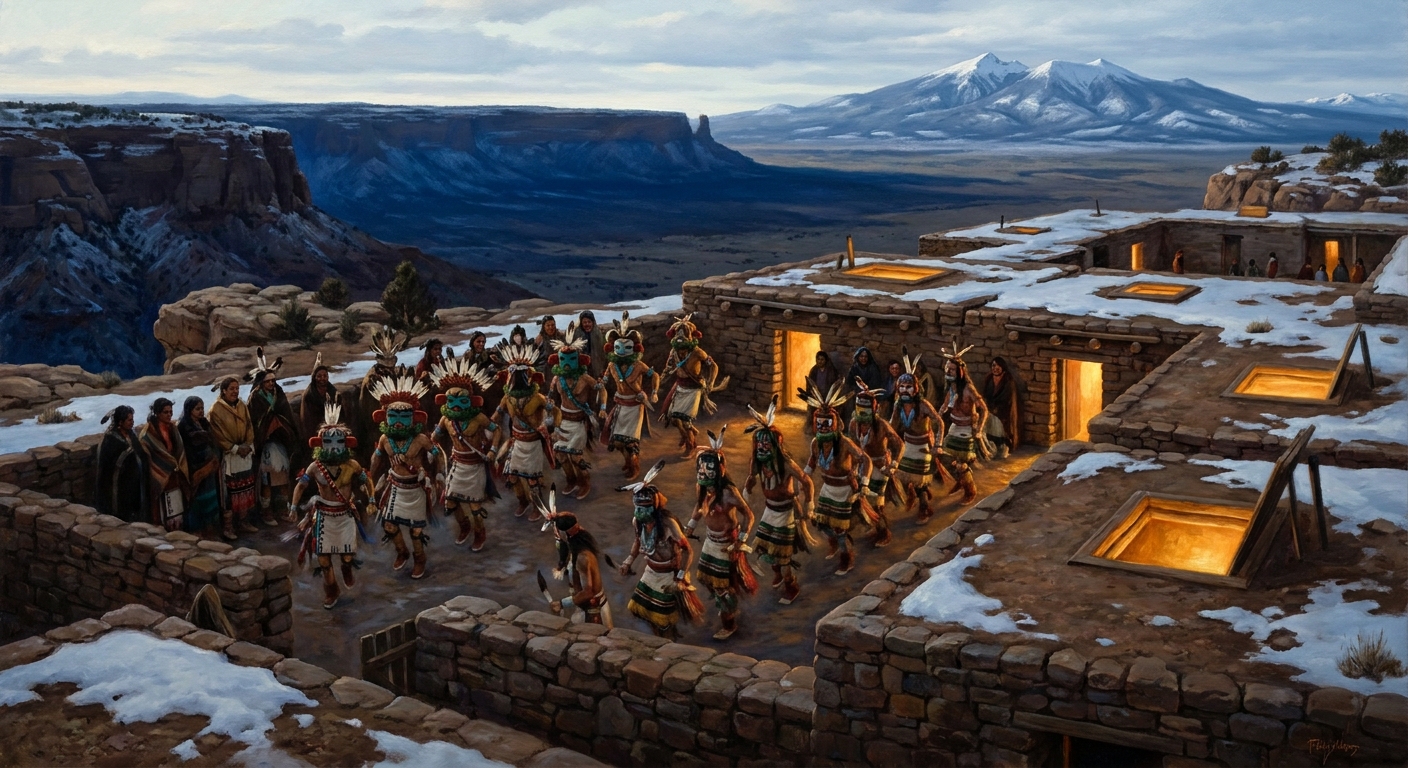
The men of the village have been preparing for months — carving the masks, rehearsing the songs, fasting and purifying themselves in the kiva. At the ceremony called Soyal, the world is renewed: the sun is turned back from its southward journey, the new ceremonial year begins, and the first Kachinas of the season appear in the plaza.
The children have been told: the Kachinas are real beings from the San Francisco Peaks, spirits who have accepted the responsibility of living among the people for half the year. They come because the people ask them to come. They stay because the people treat them correctly. This is not performance; this is visitation.
Through the winter and into spring the ceremonies continue.
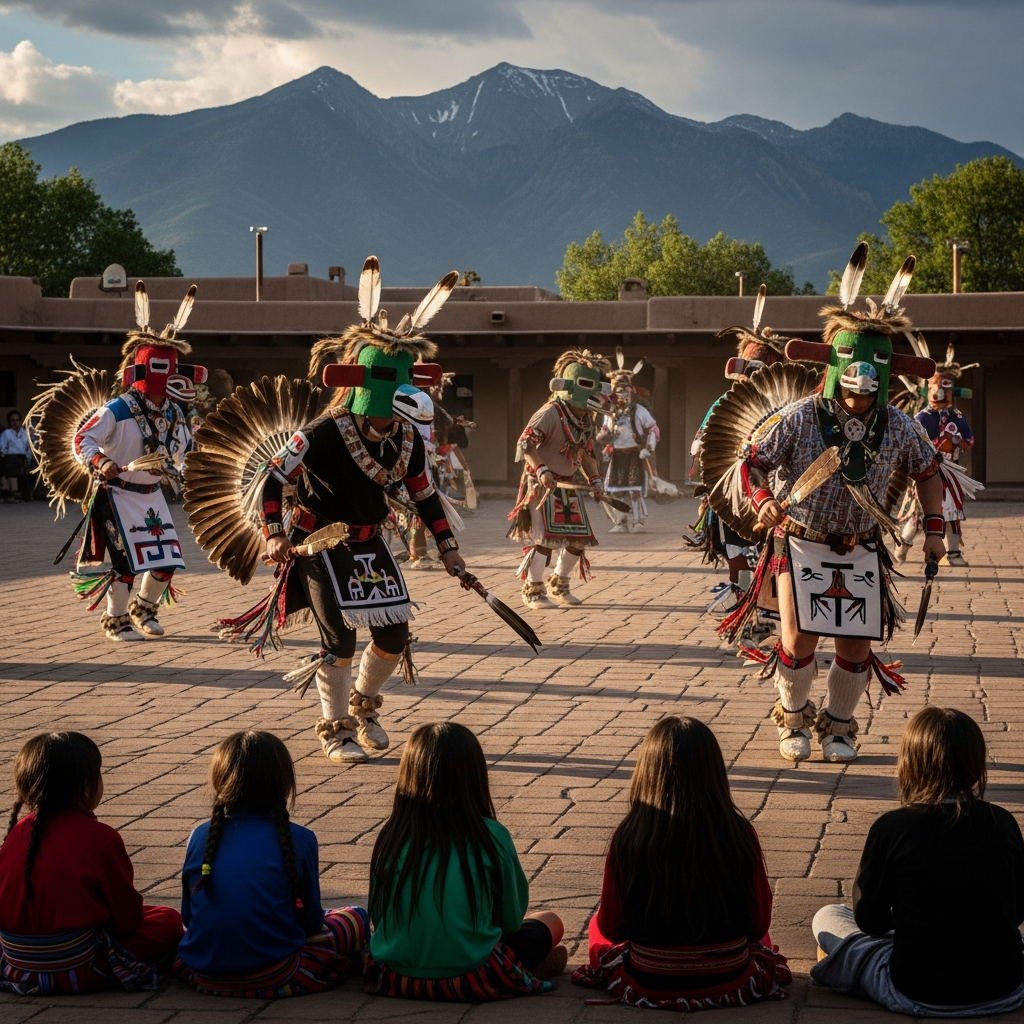
The Kachinas dance in the plazas for hours, sometimes all day, their masks transforming the men who wear them into the beings the masks represent. The transformation is understood to be genuine: when the mask is on and the songs are right and the preparation has been correctly done, the man is not dancing as the Kachina — the Kachina has entered the man and is dancing. The mask is the face. The dancer is the vessel.
Different Kachinas come for different purposes. Some bring rain. Some teach proper behavior to children — the Soyoko, the ogre Kachinas, come in the spring and demand to know whether children have been lazy or disrespectful, threatening to carry them away in baskets. The children are terrified. Their parents intercede with gifts of food, explaining that the children have been good, that they have ground the corn and carried the water. The Soyoko accept the explanation and leave, and the children understand viscerally what is expected of them.
In midsummer, at the ceremony called Niman — the Home Dance — the Kachinas prepare to leave.
It is the most emotionally complex ceremony of the year. The Kachinas have been present for six months; they have danced for rain and the rain has come; they have blessed the new crops; they have given the children Kachina dolls as teaching gifts. Now they must return to their mountain home to carry the prayers of the people upward to the forces that govern rain and growth.
The last dance before departure is long. The Kachinas bring gifts — the first fruits of the season, green corn, melons — and distribute them to the watchers. They dance in the plaza as the sun moves from morning to afternoon to the long gold of the late day.
Then they file out of the plaza and walk east toward the edge of the mesa.
The village watches them go. There is grief in this watching, the same grief that attends any departure of loved and necessary beings. The children who received dolls hold them and watch. The rain that was prayed for during the ceremonies has come or has not come, but either way the prayers have been made correctly, and the Kachinas carry them.
The masks are removed at the edge of the village and the men walk home.
But the Kachinas have truly departed, up toward the San Francisco Peaks, carrying six months of Hopi prayer into the sky.
In December they will return.
Echoes Across Traditions
Entities
- the Kachinas (Katsinam)
- the masked Kachina dancers
- Crow Mother Kachina
- Soyoko (the ogre Kachinas)
- the children who receive Kachina dolls
Sources
- Alfonso Ortiz, ed., *Handbook of North American Indians, Vol. 9: Southwest* (Smithsonian, 1979)
- Barton Wright, *Hopi Kachinas: The Complete Guide to Collecting Kachina Dolls* (Northland Press, 1977)
- Frank Waters, *Book of the Hopi* (Viking Press, 1963)
- Mischa Titiev, *Old Oraibi: A Study of the Hopi Indians of Third Mesa* (Papers of the Peabody Museum, 1944)