The Birth of Gesar of Ling
Legendary horizon c. 11th c. CE; oral epic developed from at least 12th c. onward · The kingdom of Ling, eastern Tibet (modern Kham region)
Contents
The divine warrior Gesar of Ling was born in the sky before he descended to earth. His mother was a naga princess; his father was a celestial god. He came to earth in a difficult time, born poor and dismissed as a half-mad boy, racing his horse across the plateau to prove himself to a kingdom that did not want him.
- When
- Legendary horizon c. 11th c. CE; oral epic developed from at least 12th c. onward
- Where
- The kingdom of Ling, eastern Tibet (modern Kham region)
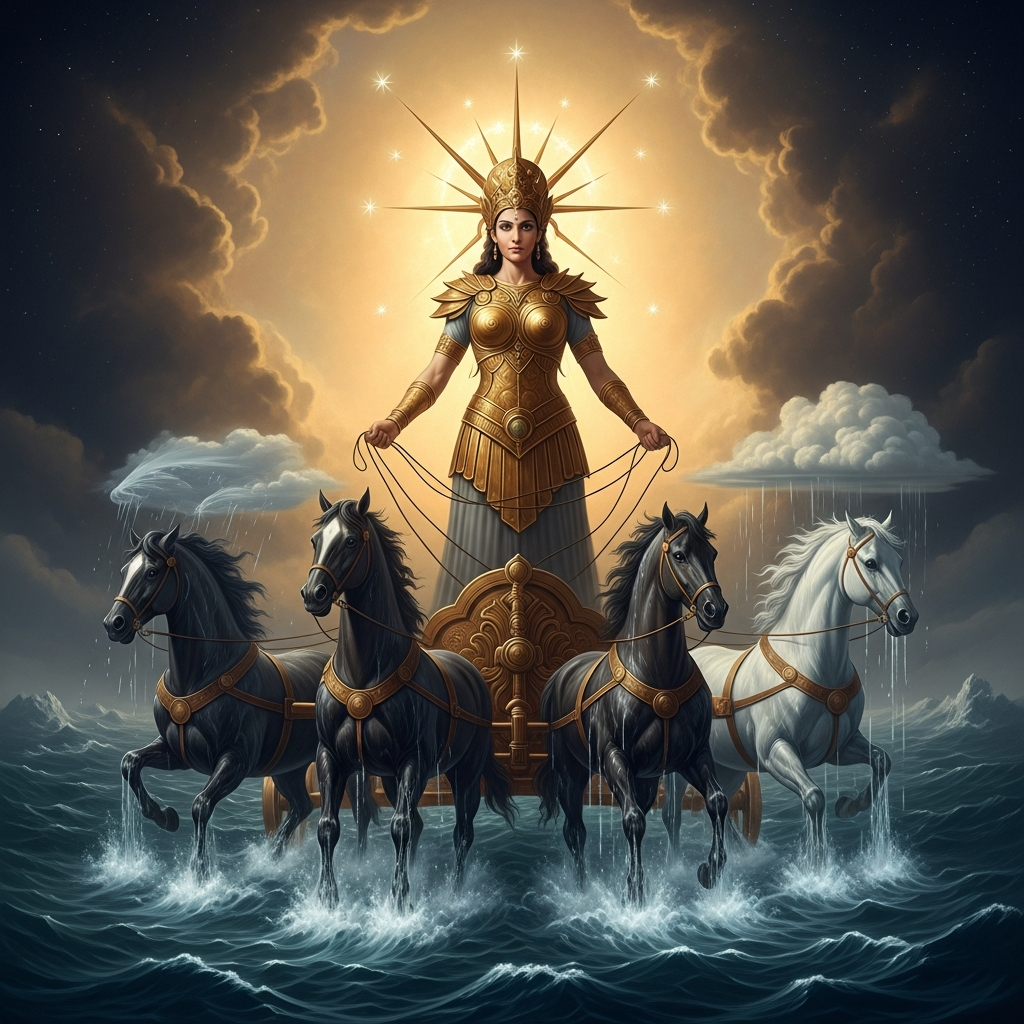
He was born in the sky.
This is where every version of the Gesar epic begins, and every version begins differently — because the epic is oral, and every bard who sings it shapes the opening to the audience and the season and the particular kingdom whose history is being honored — but the core of the opening is consistent. Before Gesar was born on earth, he was already a being in the sky. He was a divine prince, a son of heaven, residing in one of the high heavens of the Tibetan cosmos, with brothers and sisters and a mother and a father who were also celestial. He had not yet been told his mission. His mission was being prepared.
The world below — the world of human Tibet, the eleventh-century kingdoms of the high plateau, the small confederated tribes and the trade routes and the monasteries — was in difficulty. Demons had infiltrated the political order. Kings had become corrupt. The teachings of the Buddha, brought to Tibet only a few centuries earlier by Padmasambhava and the founders of the early diffusion, were being threatened by sorcerers and warlords and the indigenous Bon shamans who resented the new faith. The pure dharma was endangered. A correction was needed.
The high gods convened. The decision was made. A divine being would be sent down to take human form, fight the demons in their human disguises, and restore the proper order. The being chosen was the prince who would become Gesar. He was given his instructions. He was promised support from the divine realm — wind horses, weather-spirits, the assistance of Padmasambhava himself, who in the Tibetan understanding had not died but had withdrawn to the copper-colored mountain of Zangdok Palri, from where he continues to act on the world. Gesar was, in some sense, a project of Padmasambhava, sent down to do work that Padmasambhava had begun and could not yet complete.
Gesar agreed. The condition of his agreement, in some versions of the epic, was that his mother on earth would be of nāga lineage — that he would have, through his earthly mother, the serpent-blood of the underwater world, the access to the ancient pre-Buddhist powers of the rivers and lakes and the deep places. The high gods consented. A naga princess was selected.
The naga princess was already on earth, in a difficult situation of her own.
She had been married to a chief of the kingdom of Ling — Ling being a small but real kingdom in the upper Yangtze valley of eastern Tibet, in the region now called Kham, with its center in modern Dêgê (Sde-dge) — and the marriage had been complicated. Her husband had several wives. She was the youngest. The senior wives were jealous of her, and the kingdom’s political situation was unstable, and her position as a foreign princess of nāga descent was not secure. She had no children. She was, when the divine choosing happened, a woman whose social standing was precarious and whose divine importance was about to become enormous.
Gesar entered her womb in a manner the epic describes with its characteristic mix of mystical precision and rough humor: in some versions through her crown chakra, in some versions through a vision in which she swallowed a small egg of light, in some versions through more direct means involving Padmasambhava arriving in her dream and instructing her body to receive a celestial guest. The pregnancy was unusual. The child moved differently. The child sang from inside her, in a language that was not Tibetan and that the nāga princess’s mother (consulted by long-distance dream) confirmed was an old language of the heaven realms.
The child was born outdoors. The pregnancy had been long — sixteen months in the standard accounts, or three years in some bardic versions — and the moment of birth was attended by extraordinary signs. Rainbows in the sky. Flowers blooming out of season. A spring of fresh water appearing where none had been. The senior wives of the household, who had been hoping the child would die, came to inspect and were struck dumb by what they saw. The newborn boy was already speaking. He was already laughing. He was already, in a small way, not a normal infant.
He was named Joru. Joru was a casual, almost dismissive name — not the heroic name he would later take. The senior wives insisted on it. They wanted the boy to grow up under a name that would not give him airs. The naga princess agreed, because she understood that the boy’s hidden destiny would be safer under a humble name.
The first years of Joru’s life were difficult.
The senior wives engineered the family’s exile from the central settlements of Ling. The naga princess and her son were sent to a remote pastureland, to a small tent on the high grassland, to live with the herds and the rough work and the absence of any social connection that might have helped them. The reason given was that Joru was a strange child who frightened other children. The real reason was political: the senior wives wanted him out of sight, in case his hidden divinity began to manifest more visibly.
It manifested anyway. Joru, growing up alone with his mother on the grassland, did things that an ordinary boy could not have done. He spoke to the horses, and the horses listened. He spoke to the demons that infested the pastureland — the small malicious spirits that caused livestock disease and bad weather and dreams of falling — and he banished them, one by one, until the pastureland was clean. He spoke to Padmasambhava in vision and received instructions. He raced his horse across the high plateau in the rough way of a child training for something he had not yet been told to do.
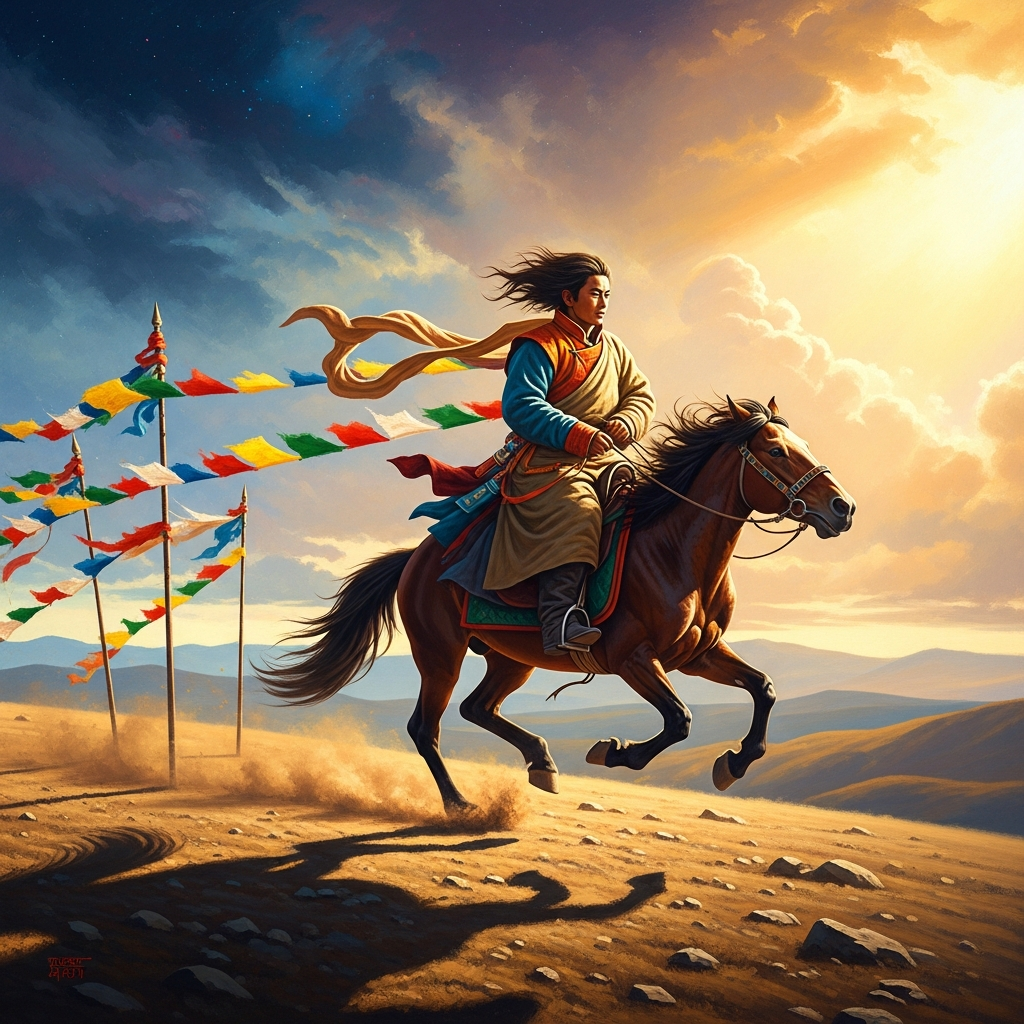
The horse was unusual. The horse was a windhorse — lungta in Tibetan, the prayer-flag word, the word for the divine animal that carries the soul’s intentions across the sky. Joru’s horse had been sent to him from the heaven realms, an elemental creature in horse form, capable of speeds and distances no ordinary horse could match. The horse spoke. The horse advised. The horse was, in many of the bardic versions, the principal companion of Joru’s exile years and the source of much of his early military strategy.
Joru was, by all the standards of the kingdom of Ling, mad. He talked to animals. He banished demons no one else could see. He raced across pasturelands the rest of the kingdom thought were uninhabitable. He was poor, ragged, dirty, without education in the formal sense, without connections in the political sense, the son of a foreign mother of low standing in the household, the boy nobody wanted to claim. He would have been, in any normal lineage, a footnote in the family genealogy and forgotten.
He was, instead, the future king of Ling.
The recognition came through the horse race.
The kingdom of Ling, deep in its troubles, faced a crisis: the demon-kings of the four directions were closing in on the small kingdom, and the current ruler — Trothung, Joru’s uncle, a politically capable but spiritually compromised figure — was not equal to the threat. A great race was called. The kingdom would race horses across the plateau, from the lower pastures to the high pass and back. The winner would be acknowledged as the kingdom’s champion, and would marry the princess Drugmo, the most accomplished young woman of the royal line, and would receive the throne.
Joru entered the race. He arrived at the start in his rough exile clothes, on his strange horse, with his mother watching from the side of the course. The other contestants laughed. Trothung, his uncle, watched with the expression of a man who has spent years arranging his nephew’s marginalization and is now seeing the marginalization come undone in public.
The race began. The horses pounded across the grassland. Joru’s horse — the windhorse — was visibly faster than any horse in the field. By the first turn, Joru was ahead. By the second turn, the other horses were laboring far behind. The race was not close. Joru reached the high pass first, turned the marker, and rode back to the finish line at a pace that the bards describe as not just fast but somehow above the ground — the windhorse’s hooves not quite touching the grass.
Joru crossed the finish line. The kingdom was silent. Joru, dismounting, announced that his name was no longer Joru. His name was Gesar. He was the king of Ling. He was the son of heaven sent to protect the dharma. He had been hiding in the exile of the grassland because the time had not yet come for him to be revealed, and the time had now come, and the kingdom would now stand behind him as he rode out to face the demon-kings of the four directions.
The kingdom — partly out of recognition, partly out of fear, partly because the windhorse and the manner of the race had made any other response impossible — accepted him.
What follows in the epic is the longest story in the world.
Gesar’s campaigns occupy more than a million verses across the various bardic traditions. He fights the demon-king of the north, who has been corrupting the salt routes. He fights the demon-king of the south, who has been kidnapping monks. He fights the demon-king of the east, who has been eating children. He fights the demon-king of the west, who has been a more political opponent — a sorcerer-king who has built a kingdom on perverted teachings and seduced ordinary people into following him. Each campaign is a self-contained epic. Each features Drugmo, the queen, who is sometimes a strategic adviser and sometimes a captive who needs rescuing and sometimes a warrior in her own right. Each features the windhorse and a complex cast of allies — divine, human, animal, and elemental — who fight at Gesar’s side.
The epic does not have a single ending. Different bardic traditions end it differently. In some versions, Gesar dies in battle and is taken back to heaven, his body retrieved by his celestial brothers and sisters. In other versions, he disappears into a mountain — riding into the rock and not coming out — and waits there for the world to need him again. In a third tradition, he never dies; he is still riding the high passes of the eastern Tibetan plateau, invisible to all but the most spiritually accomplished, his work continuing under the surface of ordinary politics.
The third tradition is the one that most modern Tibetans embrace. Gesar is not history. Gesar is not yet completed. He is in process. The world’s troubles continue, and Gesar’s work is therefore not finished, and his absence from the public scene is not death but biding. He will return when the world’s situation requires it. The bards who continue to sing the epic — and there are still living bards, drungpa, in eastern Tibet, who can sing for hours or days at a stretch and who are recognized as receiving the epic from a source rather than memorizing it from a text — are not historians. They are mediums. The epic is still being received from the world above, where Gesar’s source remains, and the bards transmit what they receive in real time.
The wind horse — lungta — has a life beyond the epic.
The Tibetan prayer flags that fly from every monastery, every pass, every rooftop in Tibet are called lungta: wind horses. Each flag carries on it the printed image of a horse with a flaming jewel on its back, surrounded by the four protectors of the directions. The wind moves through the flag, and the flag’s prayers are carried out into the world. The image is Gesar’s horse. The function is Gesar’s function. Every lungta flag is a small invocation of the same energy that carried Joru across the grassland and across the high pass and back to the finish line.
The Tibetan understanding is that the wind horse is also internal. Every person has a wind horse — an internal mount of the spirit, an inner energy of forward motion and clear intention, that can be cultivated by practice or weakened by neglect. A person whose wind horse is strong moves through life with appropriate energy, with the right speed and the right responsiveness. A person whose wind horse is weak is slow, depressed, unable to act. Cultivation of the wind horse is a basic Tibetan psychological practice. The lungta flags are not just objects. They are reminders. The same energy moves through the flag and through the practitioner.
This is one of the gifts of the Gesar epic to ordinary Tibetan life. The hero on the windhorse is not a distant figure. He is a model. The energy that carried Joru across the plateau is the same energy that carries every person across their day. Cultivate the wind horse. Live according to its pace. Do not let it weaken. The epic, on this reading, is not just about a king. It is about every life, undertaken with the right mount.
The Epic of King Gesar is the longest epic in the world. It is also the most alive — it is still being performed, still being added to, still being transmitted by bards who consider themselves not authors but receivers. The epic is a living religious phenomenon, not a literary fossil.
Gesar himself is a peculiar figure in world mythology. He is born of high divine descent but raised in poverty. He is dismissed as half-mad but reveals himself as a king. He fights the four directions but never finishes the work. He may be dead, may be sleeping, may be still active. The Tibetan religious imagination does not require him to be settled into any one of these states. He is a process that has not yet concluded.
The horse race is the moment that recognizes him, and the horse race is a rare structure in mythology — most heroic epiphanies happen in battle or in council. Gesar’s epiphany is athletic. He wins because his horse is faster. The horse is faster because the horse is a wind horse, sent from heaven. The lineage is recognized through the speed of the mount. There is something deeply Tibetan about this — about a people whose lives were shaped by long journeys across high passes, whose religious vocabulary included the wind and the horse as central elements, whose grandest hero earns his throne not by argument or blood but by riding faster than anyone else.
And Gesar, somewhere in a mountain in eastern Tibet, is still waiting. The bards still sing him. The wind horse flags still fly. The ordinary practice of cultivating one’s own internal wind horse continues. The kingdom of Ling is gone, the demons it fought are gone or transformed, but the figure of the warrior-king who descended from the sky into a difficult century and rode harder than anyone expected him to is still present, in stories told for hours by bards who are not trying to remember but trying to receive, in flags fluttering above passes at fifteen thousand feet, in the energy that any traveler on the high plateau can feel when the wind comes up and a horse moves into a gallop and the ground briefly seems to stop holding the rider down.
Echoes Across Traditions
Entities
- Gesar of Ling
- Padmasambhava
- Naga princess (Gesar's mother)
- Trothung
- Wind Horse (lungta)

Sources
- *The Epic of King Gesar*, oral tradition (Tibetan, Mongolian, Bhutanese versions)
- Alexandra David-Néel, *The Superhuman Life of Gesar of Ling* (1933)
- Robin Kornman et al. (trans.), *The Epic of Gesar of Ling* (Shambhala, 2013)
- Geoffrey Samuel, *Civilized Shamans: Buddhism in Tibetan Societies* (1993)
- Active Gesar bards (*drungpa*) of eastern Tibet, recording continuing into 21st c.