Brigid's Undying Fire at Kildare
mythic prehistory, continuous into 5th century CE — the flame at Kildare tended from pagan origins through Christian monasticism · Kildare (Cill Dara — the Church of the Oak), County Kildare, Ireland
Contents
The goddess of forge, poetry, and healing claims a meadow and lights a fire that nineteen women tend in perpetual rotation — a fire that burns continuously from the Iron Age through the Christian era without ever going out.
- When
- mythic prehistory, continuous into 5th century CE — the flame at Kildare tended from pagan origins through Christian monasticism
- Where
- Kildare (Cill Dara — the Church of the Oak), County Kildare, Ireland
The fire has no beginning anyone can name.
What the Kildare women know is this: it was burning when their mothers came to tend it, and their mothers’ mothers before them, back through generations until the lineage of tenders disappears into the age before names were kept. The oak grove is older than the memory of the grove. The fire is older than the oak grove. These are things known the way the shape of the land is known — not learned but simply found to be true.
Brigid comes to Kildare before any other account, in the way that primary powers arrive: without ceremony, as a fact of the landscape. She is the daughter of the Dagda, the All-Father, and she carries three things in her: the flame of the forge, the flame of inspiration, and the flame of healing. They are not three separate flames. They are the same fire working on different materials. Brigid is the principle that when a thing is heated enough, it becomes something it was not.
She claims the ground that becomes Kildare by a trick the Christian version of her hagiography preserves almost without alteration: she asks the king only for as much land as her cloak will cover. He agrees, imagining a small cloak on a small woman covering a small piece of ground. She spreads the cloak and the meadow opens under it — the fabric expanding by divine arithmetic until the meadow is hers in full.
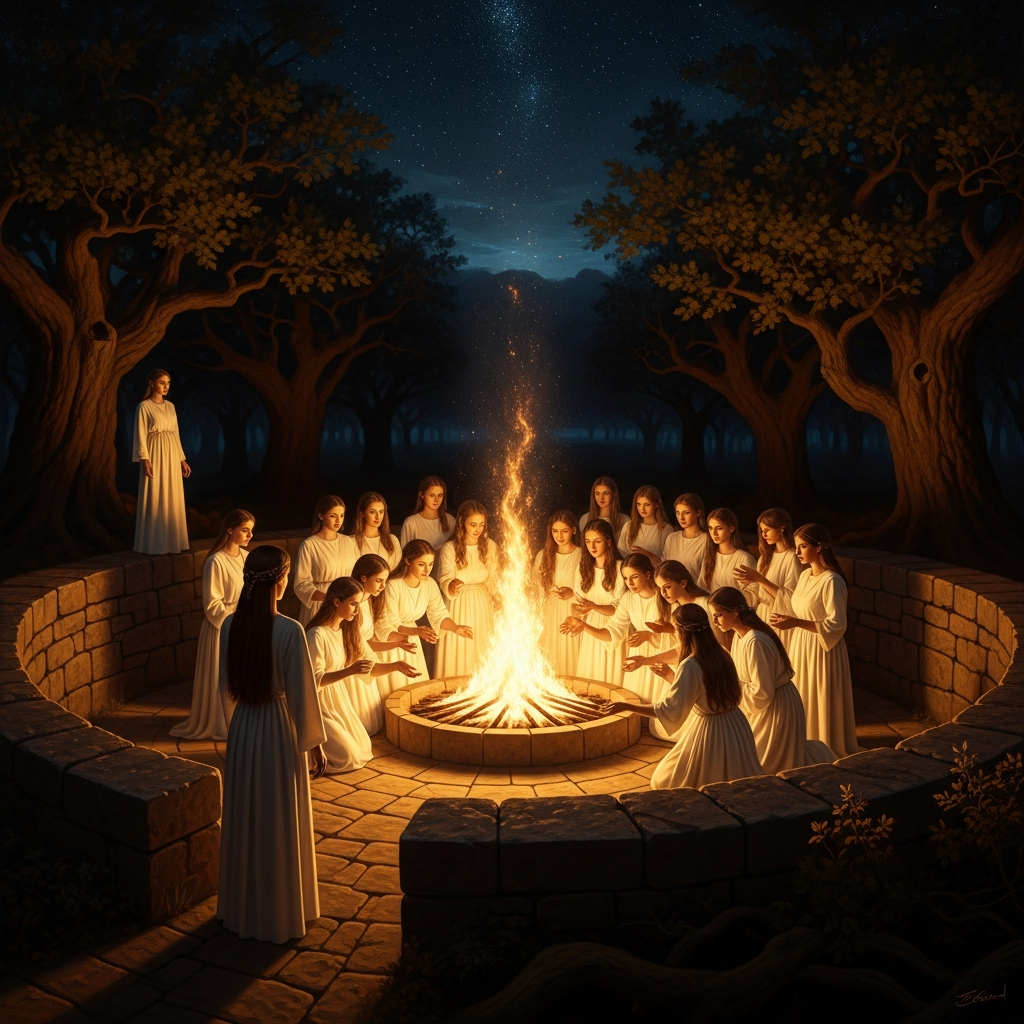
The fire is enclosed in a circular hedge. Nineteen women tend it, each woman responsible for one night in a twenty-night cycle. On the twentieth night, no human being tends the fire: it tends itself, because on that night the fire belongs to Brigid alone. In the morning it is burning as if someone had kept it through the dark hours.
Men may not cross the hedge. This is not a rule — it is the nature of the thing. The fire is not of the kind that men can tend. This is stated simply in the sources and left unexplained. There are some aspects of the sacred that do not require explanation; they simply cannot be crossed.
When Patrick comes to Ireland and Christianity comes with him, the usual practice is to find the sacred places and either destroy or absorb them. Kildare is absorbed. Brigid the goddess becomes Brigid the saint — or perhaps Brigid the saint absorbs the goddess, or perhaps they were always the same fire in different covers. The medieval abbess who bears the name continues the nineteen-woman rotation. The hedge remains. The prohibition on men remains. The fire continues.
Gerald of Wales visits Kildare in the twelfth century and describes it: the eternal fire, the circular hedge, the women moving through the rotation. He notes, with the careful skepticism of a Norman intellectual, that the fire’s ashes never increase — the same volume of ash regardless of how long the fire burns. He offers no explanation. He does not have one.
The Bishop of Kildare orders the fire extinguished in 1220. This is a political act, an assertion of episcopal authority over a female religious community operating with unusual independence. The fire goes out for approximately fourteen years. In 1235 a new abbess relights it.
The theological implications of an eternal flame maintained by women are not lost on the ecclesiastical hierarchy, which is why the bishop extinguishes it. The theological implications of an eternal flame that gets relighted despite episcopal orders are also not lost on the people of Kildare, which is why the abbess relights it.
The fire burns until the dissolution of Kildare’s religious houses in the sixteenth century, when the Reformation ends the practice. Modern Brigidine nuns, following the charism of the original community, have kept a flame in Kildare since 1993.
The fire has no beginning anyone can name. It also appears to have no end they can prevent.
Echoes Across Traditions
Entities
- Brigid
- Saint Brigid of Kildare
- The nineteen guardians of the flame
Sources
- Séamas Ó Catháin, *The Festival of Brigit: Celtic Goddess and Holy Woman* (DBA Publications, 1995)
- Mary Condren, *The Serpent and the Goddess: Women, Religion and Power in Celtic Ireland* (Harper & Row, 1989)
- Lisa Bitel, *Landscape with Two Saints: How Genovefa of Paris and Brigit of Kildare Built Christianity in Barbarian Europe* (Oxford University Press, 2009)