Contents
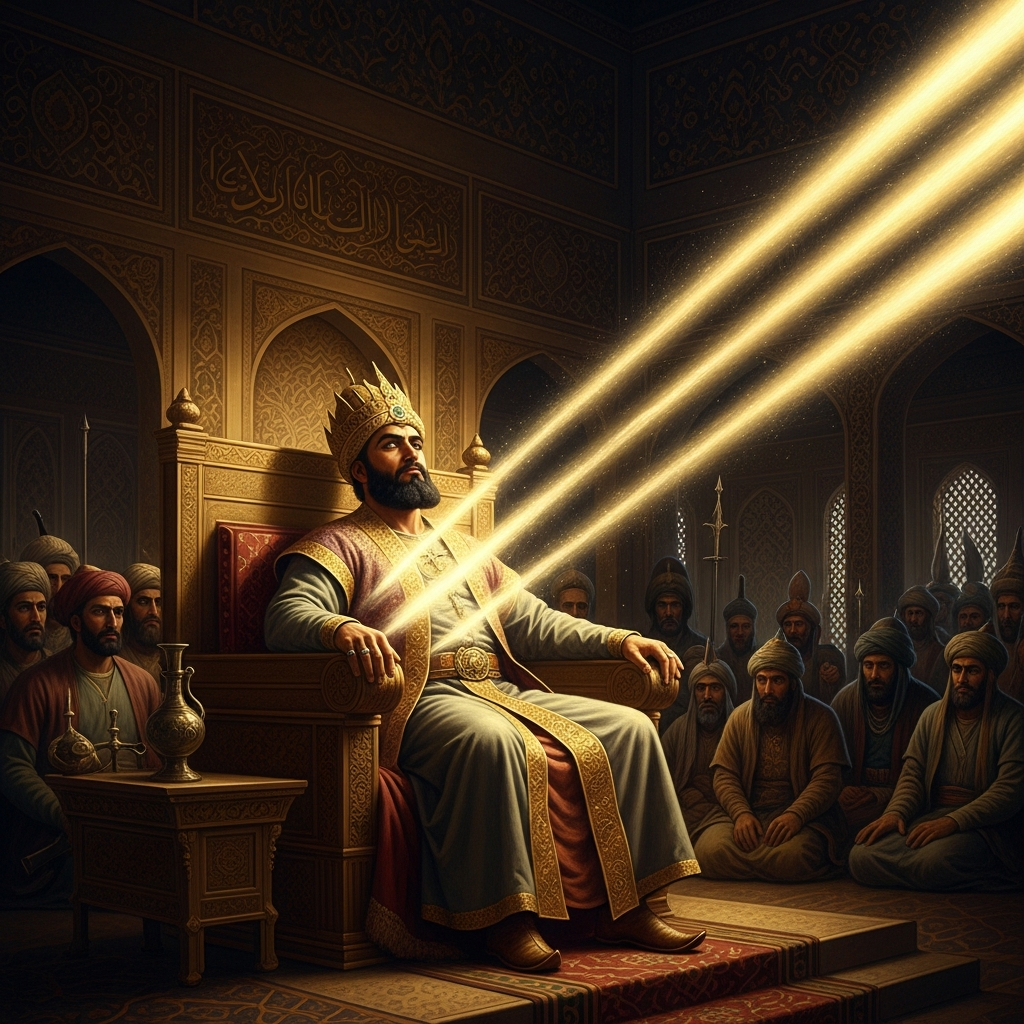
Bahrām V, the Sassanid king who earned his epithet 'Gūr' (wild ass) by hunting wild asses with impossible skill, is the Persian tradition's archetype of the just king who is also a great lover — his wild hunting and his romantic adventures are the same truth: a man fully alive to what the world offers.
- When
- 420–438 CE — the reign of Bahrām V in the Sassanid Empire
- Where
- The Sassanid court, the hunting grounds of Mesopotamia, and the palaces of the seven climes
The arrow passes through the onager’s ear.
Not through the neck, not through the body, not through the leg — through the ear, a moving target on a running animal at full gallop, and the arrow passes through cleanly enough that the animal shakes its head and runs on for a moment before it understands it is dead. This is Bahrām Gūr’s hunting. This is why they call him Gūr — after the gūr, the Persian wild ass, the animal he can kill in ways that no other hunter has attempted.
He made his nickname.
He was young when he did it, newly arrived at the Sassanid court from the court of the Hira kings in Arabia where his father had sent him to be raised. He had the look of a young man raised among Arabs: darker-complexioned than the Sassanid court expected, easier in the saddle than most princes, with the confidence of someone who has been the best rider and bowman in every room he has been in since childhood. The court was prepared to be skeptical.
He went hunting and came back with the ear-shot.
He also came back with a story about Āzāda, the slave-girl harpist he took with him who criticized his hunting method and whom he — in the less comfortable versions of the story — threw from his camel. The story is not simply a tale of temper. It is the first hint of what the Nizami Haft Paykar will develop into a full spiritual program: Bahrām is the king who must learn, through a series of encounters with beautiful women who tell stories, that beauty is not decoration but a path.
Nizami’s Seven Beauties is the full development.
Bahrām builds seven pavilions, one for each of the seven princesses from the seven climes of the world. Each pavilion has its planetary color: black for Saturn, yellow for the sun, green for the moon, red for Mars, turquoise for Mercury, sandal for Jupiter, white for Venus. Each night for seven nights he visits a different princess in her planetary pavilion and she tells him a story.
The stories are not what you expect from tales told by beautiful women to a king in a colored pavilion at night.
They are moral parables. Each princess’s story illuminates a virtue — or the consequence of its absence. The king who visits beauty and listens is not merely indulging himself. He is doing what Nizami argues kings must do: entering the world of beauty (the world of what is good and ordered and worthy of contemplation) and learning what it has to teach.
By the seventh night, Bahrām has received a complete education.
The historical Bahrām V was a competent Sassanid king who repelled the Hunnic invasions and made peace with Byzantium on favorable terms. The legendary Bahrām Gūr is something more: the proof that a king can be a great hunter, a great lover, and a just ruler simultaneously — not despite his wildness but through it.
The hunting is the practice.
To hit a wild ass through the ear at full gallop requires total present-tense awareness: the archer must be fully in the moment, tracking the moving target with all his senses, releasing at precisely the moment the ear passes through the arrow’s intended path. There is no planning for this shot; it can only be performed in the instant it exists.
The seven pavilions are the extension of this into the full range of human experience: the king who is fully present to each princess, each story, each color of the night, who brings to the encounter with beauty the same total attentiveness he brings to the hunt, becomes through those encounters the kind of king whose presence among his people is itself a kind of gift.
He disappears at the end.
The tradition is not settled on how — he rides into a marsh and the horse comes back without him, or he rides into the desert and is never seen again. His disappearance is not death exactly; it is the kind of exit a hero takes when the world no longer requires his specific form of presence. He was fully alive to what the world offered. He offered it everything back.
The ear-shot onager runs on for one moment.
Then it understands.
Echoes Across Traditions
Entities
- Bahrām V (Bahrām Gūr)
- Āzāda
- Yazdegerd I
- The Seven Princesses
Sources
- Nizami Ganjavi, *Haft Paykar* (Seven Beauties), translated by Julie Scott Meisami (Oxford, 1995)
- Ferdowsi, *Shahnameh*, 'The Reign of Bahrām Gūr,' translated by Dick Davis
- Ehsan Yarshater, 'Bahrām V,' *Encyclopædia Iranica* (1988)
- Julie Scott Meisami, *Medieval Persian Court Poetry* (Princeton, 1987)